

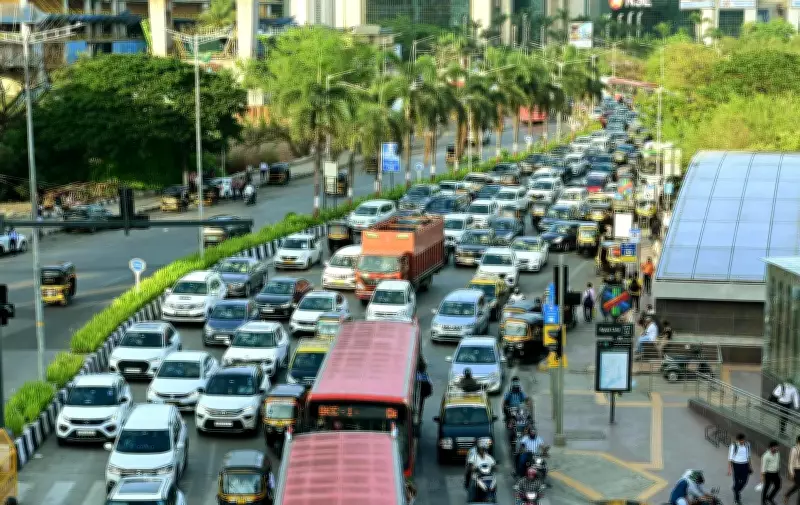
The Mumbai Metropolitan Region Development Authority (MMRDA) will face its first major test on Friday as it appeals to corporates in the Bandra-Kurla Complex (BKC) to use public transport at least one day a week. While the verdict of commuters is awaited, the initiative has inadvertently highlighted the severe challenges of commuting to BKC.
The new underground Aqua Line Metro station, which serves almost no one in the heart of the business district, inadequate BEST bus services, rude and exploitative autorickshaw drivers who refuse to use meters, and app-based cabs that cancel rides arbitrarily force employees to either use private vehicles or stay late at the office until peak hours subside.
TOI interviewed high-ranking corporate employees, bankers, consular officers, and other professionals working in BKC, along with transportation experts, traffic police, BEST representatives, ordinary commuters, and a local corporator about the Friday plan aimed at reducing traffic congestion and fuel consumption. The glaring gap in last-mile connectivity was never more apparent.

Traffic police clarified that the Public Transport Day is a voluntary appeal, not mandatory. "We have no official instructions to disallow cars in BKC. But if more people switch to public transport, it will ensure smoother traffic," said an officer. He added that the situation would improve as more Metro stations open.
"The Aqua Line Metro station near BKC benefits those working in the Family Court or government buildings nearby, not those in the heart of BKC," said office-goer Supriya Ambegaokar. Autos are so hard to find in the evening that people have to walk 2-3 km to the Metro station or Western Express Highway. "App cabs cancel rides during peak hours. We prefer to stay back late in office to get an app cab," said an employee.
Corporate employee Vijay Bansod said, "MMRDA should ensure public transport is available every five minutes, otherwise it won't work. We wait half an hour for autos." He recommended pod taxis as an alternative.
At Bandra (East) station, an officer of Mahatransco, BKC, said, "We have to haggle with autos that charge extra share fare of Rs 50 or Rs 100-120 for a solo trip before getting a seat for Rs 40." Many complained that autos refuse to use meters.
Transportation policy analyst Paresh Rawal said efforts to promote public transport fall short because the network is weak. The need is for reliable connectivity to Metro and suburban rail, perhaps by restoring dedicated bus lanes.
Transport expert Vivek Pai described first- and last-mile gaps as BKC's biggest mobility failure. He proposed a hop-on, hop-off bus loop linking Bandra and Kurla stations to every BKC cluster, supported by high-frequency BEST buses, and endorsed car-free Friday.
A senior BEST official said there is demand to increase AC double-decker bus frequency between Bandra and Kurla stations, up from 10 at present. "If there is a need, we can deploy single-decker electric AC buses from low-response zones to BKC and improve frequency to 5-10 minutes, especially on Fridays," he said.
An ICICI Bank executive said, "If public transport is accessible within five minutes, people will be willing to shift." Another office-goer warned that few people will be willing to wait for public transport during the monsoon season.
Andheri resident Suheil Merchant described the commute to BKC as a daily battle. "Much groundwork needs to be done before implementing such plans. The dirty road conditions outside Bandra (East) station worsen during the rains. The bus stop is near a nullah and garbage. Auto rides are overcrowded and uncomfortable. Bus stops are choked with commuters, while buses do not allow standing passengers," he complained.
Former Bandra East MLA and current MLC Zeeshan Siddique questioned the practicality of the Friday initiative. He said, "Last-mile connectivity in BKC is highly inadequate. The focus should be on more buses. BKC is a major commercial hub. Unless people are provided convenient transport, such an initiative will seem like a gimmick."
Chembur resident Sheldon Pinto said, "Reaching BKC by public transport is so difficult. Kurla station vicinity is chaotic, while the main bus route 310 crawls through CST Road. Waiting 30-45 minutes for a bus is common, so many office-goers simply walk 1-2 km to the station."

Kurla resident Amey Samant said, "Shared autos are also expensive. I was once quoted Rs 200 for a 2-km ride. More bus services are needed, including direct links from Sion and, once the Sion ROB is completed, from Chunabhatti station. The never-ending Metro work on the Bandra-Kurla Road has further worsened road conditions, and passengers boarding at intermediate stops often cannot even get onto overcrowded buses, forcing them to walk instead."
When TOI visited BKC to assess the response to MMRDA's plan, irregular commuters were unaware of the suggestion — some had come for job interviews or meetings. Regular travelers expressed concern and frustration. Sakina Mahimwala, who commutes from Bandra and works at Tira in the One BKC building, said, "It's very difficult to find an auto, Ola, or Uber. Surge fares rise up to five times, and even if you're ready to pay that, they still do not accept bookings." Fares increase significantly during high-demand evening hours. She said the trip to Bandra that normally costs Rs 150 can rise to Rs 250–300.
Scepticism runs deeper than pricing. Anand Katgaonkar, an architect and urban designer who visits BKC occasionally, questioned whether Mumbai's public transport can absorb the load at all. "The Metro's Aqua Line has some spare capacity, but autos are already quite congested," he said. Katgaonkar added that the shift may be particularly inconvenient for people accustomed to travelling in comfort by private cars.
Another employee said, "We wait 20 minutes for a bus, and because it arrives fully crowded, we have to wait another 20 minutes for the next bus."
However, auto driver Hasnain Khan, operating near BKC Metro station, disagreed with concerns over the availability of public transport. "Mushkil nahin hota, mil jata hai auto subah aur sham ke time mein," he said. Khan said a direct ride from the Metro station to One BKC costs around Rs 120, while shared autos charge Rs 160 for four people. Sharing commuters have to wait until enough passengers are available.
Auto drivers said fares from Bandra station to BKC are Rs 40-50 per seat, depending on destination and traffic. The blocking of a U-turn from the Metro to One BKC has increased distance, resulting in higher fares. But TOI observed drivers charging Rs 100 per person for the return journey from their offices to the Metro station.
Sanjay Mukherjee, metropolitan commissioner, MMRDA, said: "We are launching #BKCMovesTogether, a first-of-its-kind voluntary initiative under which every Friday will be observed as a Weekly Public Transport Day. We hope this encourages more people to choose public transport for their commute. A small change, such as choosing public transport for just one day a week, can bring significant incremental benefits to our city by easing congestion and promoting sustainable mobility."
"We have encouraged all MMRDA employees to commute by public transport on Fridays and appeal to corporates and government institutions in BKC to join this initiative. I hope that every week more people come on board and that this weekly practice eventually becomes a daily habit."
"I'll be taking the Metro from Grant Road and getting off at BKC station," said Ashok Gajera, owner of Laxmi Diamonds at the BKC Diamond Bourse and a resident of Malabar Hill. "Most of us are already connected to the Aqua Line. Our only concern is the last-mile connectivity to the bourse. We are hoping to find autorickshaws outside the station, but if we don't, we are prepared to walk." Gajera said the diamond trade was determined to make the transition work. "People may see us as belonging to the affluent or elite class, but we are disciplined. If a rule has been introduced, we will follow it and do our part to ensure that it succeeds," he said.





