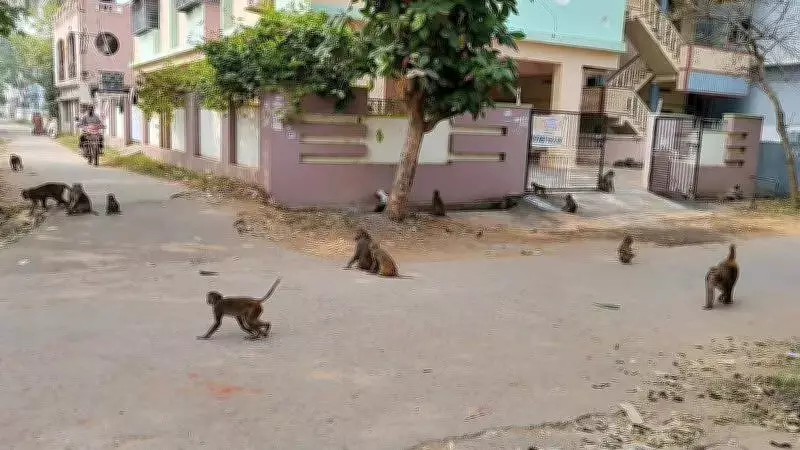
Monkey Menace Intensifies in Anakapalle District
Residents and farmers across several mandals in Anakapalle district are grappling with a severe and escalating monkey menace. Troops of monkeys are frequently seen roaming streets in towns and rural areas, causing significant damage to standing crops, including vegetables, banana plantations, fruit crops, and leafy greens. This persistent issue has raised serious public safety concerns, affecting both urban and rural communities.
Attacks on People and Persistent Complaints
Locals report that monkeys, moving in large groups, have attacked numerous individuals, particularly targeting the elderly and children. Residents from the Yalamanchili and Payakaraopeta Assembly constituencies have voiced strong allegations against local bodies and forest officials, accusing them of failing to address the problem effectively. They claim the issue has plagued Yalamanchili town and surrounding villages for over eight years, with no permanent solution in sight, despite monkeys becoming increasingly aggressive.
In one distressing incident, an elderly man sustained serious injuries after falling from a rooftop when a troop of monkeys attacked him, forcing him to jump from the terrace. Additionally, two girls at a social welfare hostel in Ravikamatam mandal were attacked by monkeys on the premises five months ago. Locals allege that such incidents are reported almost weekly, yet officials consistently fail to respond adequately.

Farmers' Struggles and Creative Solutions
Farmers are bearing the brunt of this crisis. KS Srinivasa Rao, a farmer from Payakaraopeta mandal, expressed frustration, stating, "We have stopped cultivating crops like banana and vegetables for fear of damage by armies of monkeys. When there is no solution and no care from officials, what can we do?" In response, some farmers have taken matters into their own hands with innovative but ultimately unsuccessful methods.
In Alamanda village of Payakaraopeta mandal, vexed with official inaction, farmers spent their own money to bring langurs to protect their fields. Initially, this move showed promise as monkeys fled upon seeing the langurs. However, N Surya Rao, a farmer from Yalamanchili, noted that after a few days, the monkeys became accustomed to the langurs and resumed roaming the fields.
Another farmer, Ch Srinivasa Rao, shared a similar experience: "We are not even in a position to enter our fields as hundreds of monkeys block the routes. Farmers tried another method after learning that monkeys fear bears, when bears were brought to a local festival. We bought bear costumes from Anakapalle and wore them while entering the fields. Initially, monkeys ran away, but within a few months they got used to that too."
Official Responses and Underlying Issues
Meanwhile, a panchayat in S Rayavaram mandal reportedly caught around 100 monkeys using its own funds and released them into the Anantagiri reserve forest area six months ago. Yalamanchili Municipality officials stated they have employed people to catch monkeys and release them into forest areas, but the catchers are demanding ₹1,500 per monkey, a significant increase from the previous rate of ₹800.
Yalamanchili Municipality Commissioner Prasada Raju explained, "The catchers are demanding advance payment and stand to benefit if there are more monkeys. A batch of catchers recently came to Yalamanchili, but they say more monkeys at one stretch would benefit them." An anonymous official added, "They are catching monkeys and releasing them in nearby villages, leading to the continuation of the problem. They often focus on personal benefit. If there are no monkeys, they would have no employment."
Forest officials attribute the monkey menace to habitat loss caused by deforestation for industries and shrinking green cover, which forces monkeys into residential areas. They also highlight that monkeys' growing intelligence makes them difficult to control, especially in urban zones. Additionally, officials note that monkeys have a high reproductive rate, giving birth once every few months, with pregnancy periods ranging from four to six months, further complicating control efforts.