

Madhya Pradesh's Debt Burden: Over 5% of India's Total, Liabilities Multiply Tenfold
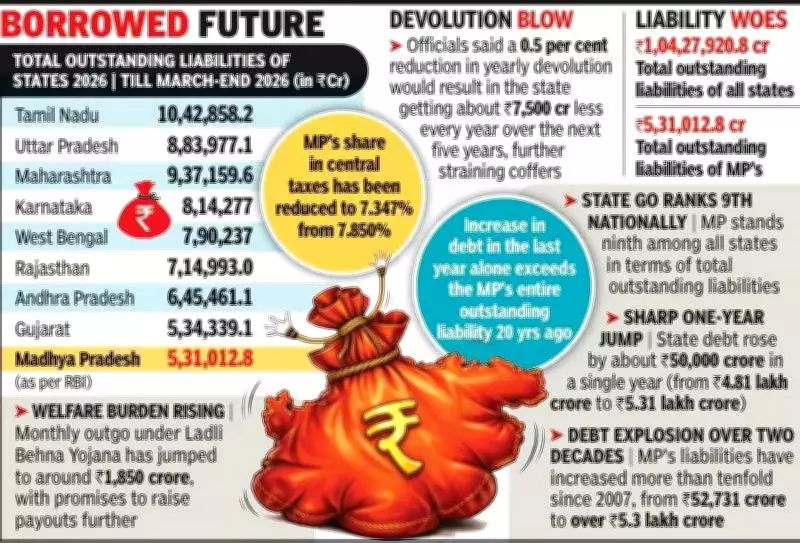
A recent report from the Reserve Bank of India (RBI) has cast a stark light on the financial standing of Madhya Pradesh, revealing that the state accounts for more than 5 percent of the nation's total debt. According to budget estimates compiled by the RBI up to March 2026, India's combined outstanding liabilities stand at a staggering ₹1,04,27,920.8 crore, with MP's share amounting to ₹5,31,012.8 crore.
Alarming Growth in Liabilities Over Two Decades
In a particularly concerning finding, the RBI report highlights that the increase in Madhya Pradesh's outstanding liabilities over the past year alone surpasses the total liabilities the state had accumulated two decades ago. The data shows a dramatic escalation from ₹52,731.1 crore in 2007 to ₹5,31,012.8 crore in 2026, marking a more than tenfold rise in less than 20 years. This translates to an approximate increase of ₹51,000 crore in liabilities.
Further detailing the upward trajectory, the budget estimate for 2025 had initially projected MP's total outstanding liabilities at ₹4,80,976.0 crore. However, revised estimates through March 2026 indicate a jump to ₹5,31,012.8 crore, reflecting an increase of ₹50,036.8 crore. Currently, Madhya Pradesh ranks ninth among all Indian states in terms of outstanding liabilities, trailing behind Tamil Nadu, Uttar Pradesh, Maharashtra, Karnataka, West Bengal, Rajasthan, Andhra Pradesh, and Gujarat.

Government's Rationale for Rising Debt
The state government has offered explanations for the escalating public debt and liabilities, emphasizing the necessity of funds to build public infrastructure in alignment with its development objectives. Officials have acknowledged that liabilities are expected to rise further in the future. A standard disclaimer issued via gazette notification during borrowings from the Centre states, "Though no actual assessment has been made of the value of the physical assets of the state government, it can be safely assumed that it far exceeds the state's outstanding liabilities."
Deputy Chief Minister Jagdish Devda, who also oversees the finance department, has previously downplayed concerns about the rising debt, asserting that loans are essential to meet broader infrastructure and development goals. He emphasized that the government secures central consent for each loan and operates within a predefined borrowing limit based on its current financial position.
Impact of Flagship Welfare Schemes
A significant contributor to the state's financial burden is the expense associated with the flagship Mukhya Mantri Ladli-Behna Yojana. The monthly outlay from state coffers for this scheme has surged to over ₹300 crore following an increase in the handout amount for beneficiaries from ₹1,250 to ₹1,500 per month. Previously, the monthly payout was ₹1,540 crore, but with the revised beneficiary amount, it has ballooned to approximately ₹1,850 crore.
The state has already committed to raising the monthly outlay under the Ladli-Behna scheme to ₹3,000 per month by 2028. Chief Minister Mohan Yadav has even pledged to further increase the handout to ₹5,000, although no specific deadline has been announced for this enhancement.
Broader Financial Context and Central Coordination
Defending the mounting public borrowings, state officials have pointed out that funds are also required to pool the state's share of centrally funded schemes. They reiterated that every loan taken by the state is approved by the Centre, ensuring adherence to fiscal guidelines. Based on Madhya Pradesh's current financial standing, a borrowing limit has been established, beyond which the state cannot seek additional loans from the central government.
This financial scenario underscores the delicate balance between development aspirations and fiscal prudence, as Madhya Pradesh navigates its economic challenges while striving to meet the needs of its populace through ambitious welfare and infrastructure projects.






