

Nagpur Municipal Corporation's BJP Shifts Focus to Zonal Consolidation
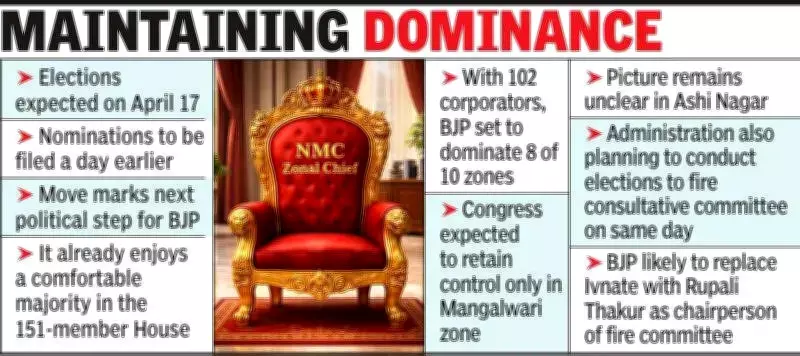
Nearly three months after the conclusion of the civic polls, the ruling Bharatiya Janata Party (BJP) in the Nagpur Municipal Corporation (NMC) has now turned its attention towards consolidating administrative control at the zonal level. Elections for the chairpersons of all ten zones are anticipated to be conducted in mid-April, marking a significant political maneuver for the party.
Election Timeline and Political Landscape
According to reliable sources, the zonal elections are expected to take place on April 17, with nominations scheduled to be filed just one day earlier. This strategic move represents the next phase in the BJP's political agenda, building upon its already comfortable majority within the 151-member House. With an impressive tally of 102 corporators, the BJP is poised to dominate eight out of the ten zones, ensuring near-complete administrative authority at the grassroots level.
The zones where the BJP is set to establish control include Laxmi Nagar, Dharampeth, Hanuman Nagar, Dhantoli, Nehru Nagar, Gandhibagh, Satranjipura, and Lakadganj. This widespread dominance underscores the party's stronghold in the municipal corporation and its ability to influence local governance directly.

Opposition Dynamics and Key Contests
The Indian National Congress is projected to retain control solely in the Mangalwari zone, where it commands a clear majority with 11 corporators. In a notable move, the Congress is likely to nominate a woman corporator for the zonal chairperson's position in this area, reflecting a commitment to gender representation in local politics.
However, the political scenario remains uncertain in the Ashi Nagar zone, which is expected to witness a closely contested battle. The Congress holds seven corporators in this zone, matching the combined strength of the alliance between the All India Majlis-e-Ittehad-ul-Muslimeen (AIMIM) and the Indian Union Muslim League (IUML). With one corporator each from the BJP and the Bahujan Samaj Party (BSP) also present, the final outcome could hinge on post-poll alliances and strategic negotiations.
If the AIMIM-IUML alliance manages to secure the support of the lone BSP corporator, they could potentially stake a claim to the zonal chairman post, introducing an element of unpredictability into the election process.
Strategic Significance and Broader Implications
These zonal elections carry considerable importance as they follow the mayoral and deputy mayor elections held on February 6, which themselves succeeded the civic poll results announced on January 16. Since that time, the BJP leadership has methodically strengthened its grip over key decision-making bodies within the corporation, demonstrating a clear and calculated approach to governance.
Having already surpassed the majority threshold in eight zones, the BJP has decided to nominate exclusively women corporators for the zonal chairperson positions. This decision replicates the formula previously employed in appointments for the mayor, deputy mayor, and standing committee roles, highlighting the party's consistent emphasis on promoting female leadership within municipal administration.
Concurrent Administrative Developments
Simultaneously, the municipal administration is planning to conduct elections for the fire consultative committee on the same day as the zonal elections. The panel's election was initially postponed following the nomination of former mayor and BJP corporator Mayatai Ivnate to the Rajya Sabha. Her swearing-in ceremony is scheduled for April 8, paving the way for the ruling party to appoint two-time BJP corporator Rupali Thakur as the new chairperson of the fire committee.
Ruling party leader Narendra Borkar confirmed that the nomination process for ten nominated members will be addressed in the upcoming general body meeting. This procedural step is expected to further reinforce the BJP's dominance within the corporation, solidifying its control over both elected and appointed positions.
The BJP's focused efforts on zonal consolidation reflect a broader strategy to entrench its influence across all levels of Nagpur's municipal governance, ensuring streamlined decision-making and enhanced administrative efficiency in the months ahead.






