Nagpur Civic Body Opts for Internal Reshuffle Over Action on Encroachments
More than two weeks after Union Minister and Nagpur MP Nitin Gadkari issued a strict seven-day deadline to clear encroachments from public spaces, the Nagpur Municipal Corporation (NMC) has responded with an internal administrative reshuffle rather than visible enforcement on the ground. This move underscores a significant and growing gap between high-level directives and tangible action within the city's civic administration.
Administrative Changes Without Enhanced Enforcement
In an order dated April 10, the NMC's general administration department relieved Assistant Commissioner Harish Raut of the additional charge of the encroachment department. This responsibility has now been transferred to Superintendent Sanjay Ganesh Kamble, who is already part of the enforcement wing. Kamble will handle encroachment control alongside his existing duties without any additional compensation or support.
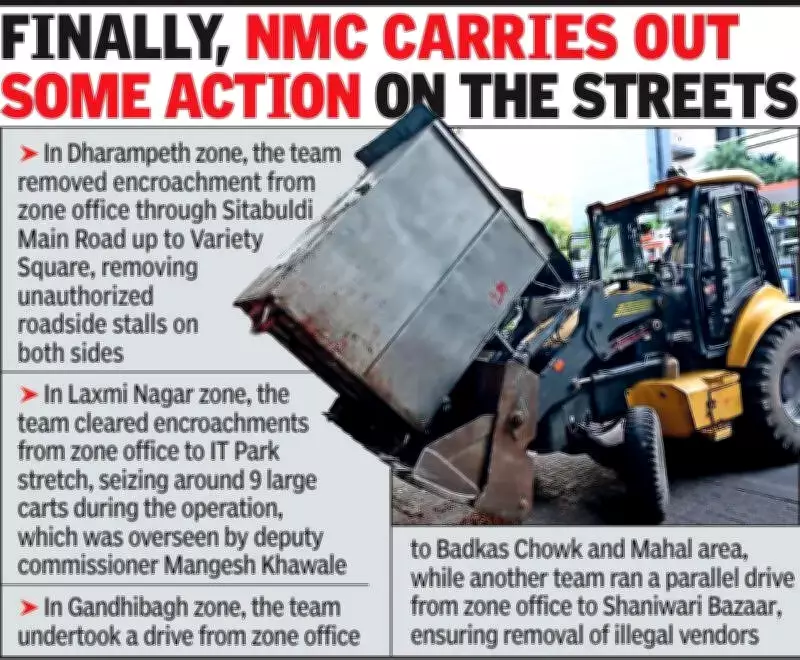
The timing of this reshuffle has raised considerable eyebrows among observers and residents alike. Gadkari's directive, issued on March 29, demanded swift and decisive clearance of footpaths and other public spaces. However, encroachments remain deeply entrenched across key residential and commercial stretches throughout Nagpur, with little visible progress.

Systemic Failures and Lack of Dedicated Oversight
This administrative reshuffle effectively sidesteps a core issue that has been repeatedly flagged within the civic body: the absence of a full-time officer dedicated exclusively to tackling encroachments. NMC insiders openly admit that the dual-charge system has consistently failed to deliver results.
Harish Raut, who was also overseeing the Satranjipura zone, struggled to sustain meaningful action against encroachments due to competing responsibilities. The latest move merely transfers that burden to another official without strengthening manpower, resources, or accountability mechanisms.
"Encroachment is not a part-time problem. Without a dedicated officer and a specialized team, enforcement drives will remain cosmetic and ineffective," stated a senior NMC official, speaking on condition of anonymity.Ground Reality Unchanged for Nagpur Residents
For Nagpur's residents, the ground reality has shown no improvement despite the ministerial deadline and subsequent administrative changes. Footpaths in many areas exist only on paper, forcing pedestrians to walk on dangerous roads.
"Footpaths are virtually non-existent in practice. We are forced to walk on roads every single day, risking accidents and inconvenience," said Anil Sharma, a resident of Dharampeth.A shopkeeper from Sitabuldi Main Road, who requested anonymity, added, "These enforcement drives happen for a day or two, creating a temporary show of action. Then everything returns to normal, and the encroachments are back in full force."
Organized Networks and Political Interference
Reports have consistently highlighted how organized encroachment networks operate across Nagpur, with public spaces allegedly being monetized and enforcement reduced to sporadic, ineffective drives. Officials concede that political interference continues to derail sustained action against these encroachments.
"The moment our enforcement teams move in to clear an area, calls start coming in from local political leaders. It becomes extremely difficult to sustain any meaningful action under such pressure," revealed another NMC officer, also speaking anonymously.
Immediate Consequences and Structural Gaps
For pedestrians, the consequences of this administrative inaction are immediate and severe: unsafe roads, shrinking walkways, and a constant risk of accidents. Senior citizen Mihir Pal emphasized, "The failure to clear encroachments directly compromises public safety and accessibility for everyone, especially the elderly and children."
For the administration, the inability to meet even high-level deadlines set by a Union Minister highlights deep structural gaps within the civic system. The preference for internal reshuffles over substantive enforcement action suggests a lack of political will and administrative capacity to address the encroachment crisis effectively.

The situation in Nagpur serves as a stark reminder of the challenges faced by urban civic bodies across India in translating directives into ground-level action, particularly when faced with entrenched networks and political pressures.