

Nagpur Development Review: Parking Mandate and Encroachment Crackdown Ordered
In a significant move to address urban infrastructure challenges, Union Minister Nitin Gadkari and Maharashtra Chief Minister Devendra Fadnavis issued strict directives to the Nagpur Municipal Corporation (NMC) administration on Sunday. The high-level review meeting, held at the Chief Minister Secretariat (Hyderabad House), focused on accelerating Nagpur's development projects while tackling persistent civic issues.
Mandatory Parking Provisions in New Constructions
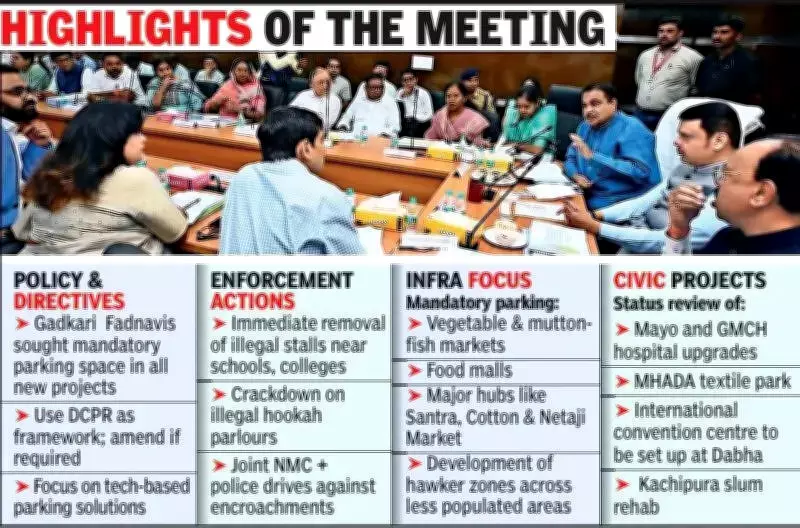
The ministers directed that adequate parking space must be mandatorily ensured in every new construction undertaken through NMC, Maharashtra State Infrastructure Development Corporation (MSIDC), and other government agencies. This directive aims to alleviate the chronic parking congestion plaguing the city's growing urban landscape.
Gadkari specifically instructed officials to incorporate ample parking facilities at new vegetable markets, mutton-fish markets, food malls, Santra Market, Cotton Market, and Netaji Market. He emphasized that modern technology should be employed to find innovative parking solutions in areas where space constraints exist. Chief Minister Fadnavis reinforced this approach, stating that the Integrated Development Control and Promotion Regulations should serve as the framework, with necessary amendments to facilitate these parking requirements.

Immediate Action Against Encroachments and Illegal Establishments
In a parallel crackdown on urban encroachments, Gadkari and Fadnavis ordered the immediate removal of illegal stalls near schools and colleges across Nagpur. They directed NMC and police authorities to conduct joint drives to clear shops spilling onto footpaths and roads, which impede pedestrian movement and traffic flow.
The ministers separately addressed the issue of illegal hookah parlours operating in the city, with Fadnavis specifically directing action against these establishments. This comprehensive approach targets both temporary encroachments and unauthorized commercial operations that compromise public safety and urban order.
Comprehensive Project Review and Infrastructure Priorities
The meeting extensively reviewed ongoing and proposed development projects under NMC's jurisdiction, including:
- Zone-wise development of vegetable and mutton-fish markets
- Establishment of food malls and designated hawker zones for localities with populations exceeding one lakh
- Status updates on Phase 5 cement road works covering 135 roads totaling 89 kilometers across nine zones
- Priority measures to stop water leakage in the city's supply network
Additional infrastructure projects discussed included the Yashwant Stadium redevelopment, Nag and Pohra river projects, underground sewerage systems for the growing population, stormwater drainage improvements, and pipeline funding mechanisms. The meeting also took stock of development works at Mayo Hospital and Government Medical College and Hospital, Mankapur Divisional Sports Complex, MHADA's Textile Park, Dabha International Convention Centre, and slum rehabilitation initiatives at Kachipura.
High-Level Participation and Implementation Framework
The review meeting witnessed participation from key officials and representatives, including Guardian Minister Chandrashekhar Bawankule, Rajya Sabha member Maya Ivnate, MLAs Mohan Mate and Krishna Khopde, Mayor Neeta Thakre, Additional Chief Secretary (Housing) Aseem Kumar Gupta, Divisional Commissioner Vijayalakshmi Bidari, NMC Commissioner Dr. Vipin Itankar, District Collector Kumar Ashirwad, and MSIDC General Manager Brajesh Dixit.
This collective presence underscores the coordinated approach being adopted to implement these directives effectively. The ministers' instructions establish clear accountability mechanisms, with NMC taking the lead on parking provisions while collaborating with police on encroachment removal, creating a multi-agency framework for urban management improvements.






