

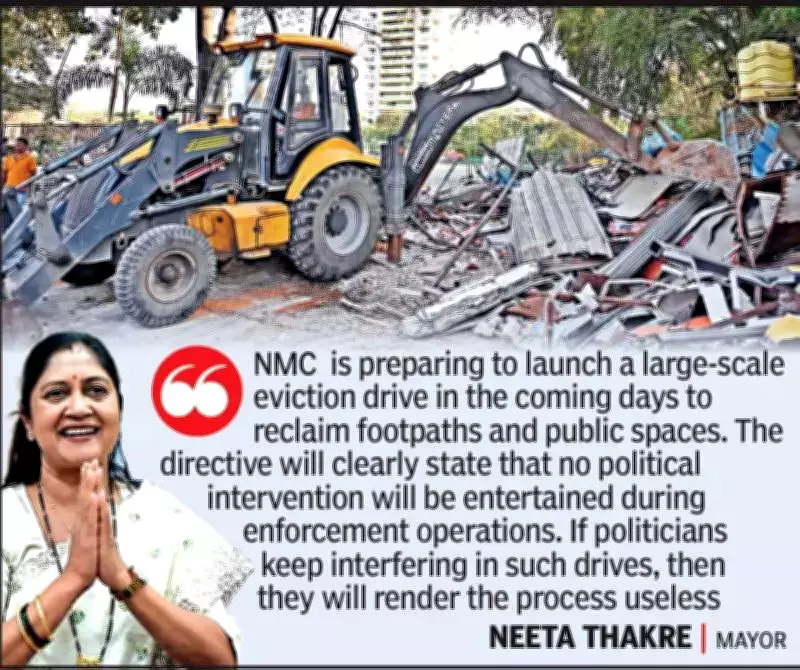
Nagpur Mayor Takes Firm Stand Against Political Interference in Anti-Encroachment Operations
In a bold move to address urban encroachment issues, Nagpur Mayor Neeta Thakre has issued a stern warning that political interference in anti-encroachment drives will no longer be tolerated. Speaking exclusively to TOI, Thakre revealed that the civic administration is preparing to launch a large-scale eviction drive in the coming days to reclaim footpaths and public spaces from illegal hawkers.
Directive to Curb Political Intervention
Mayor Thakre announced that she will soon issue an official directive clearly stating that no political intervention will be entertained during enforcement operations. "If politicians keep interfering in such drives, then they will render the process useless," she emphasized. This decision comes in response to past instances where political pushback has complicated eviction efforts, often stalling actions against hawkers occupying footpaths and leaving civic officials struggling to enforce regulations.
Call for Comprehensive Hawker Policy
Congress corporator Abhijeet Jha highlighted that the recurring conflict stems from the absence of a comprehensive hawker policy. He argued that hawkers are not solely to blame for pedestrian issues, pointing out poor footpath quality with obstacles like DP boxes and trees. "Hawkers are easy to blame, but they are not the sole reason for pedestrian deaths. People walk on roads as the footpaths themselves are of shoddy quality," Jha stated. He urged authorities to ensure proper rehabilitation mechanisms before displacing vendors who have operated from the same locations for decades, suggesting that a structured policy could generate civic revenue while addressing parking and pedestrian concerns.

Proposed Solutions and Community Involvement
NMC law committee chairperson Nidhi Telgote acknowledged the dual challenges faced by elected representatives, balancing the needs of poor vendors against public inconvenience. She proposed long-term solutions, including designated vending zones and organized marketplaces modeled after Mumbai's Khau Gallis. "Our focus is on developing concrete market zones and rehabilitating the hawkers there. Each ward can have at least one such zone," Telgote suggested. She stressed the need for public support, noting that hawkers are reluctant to move due to their dedicated consumer base, and called for governance and community efforts to go hand-in-hand.
Hawker Association's Concerns
Hawker association president Abdul Razzaq Qureshi expressed frustration over unfulfilled promises, stating that while the administration talks of new policies, old ones remain incomplete. He cited issues during the festival season, with authorities not allowing business and the town vending committee failing to issue new licenses. Qureshi criticized the lack of consultation, giving an example of proposed space in Sitabuldi's multi-storey parking building that was rejected by the administration despite hawkers' willingness to pay nominal fees.
As Nagpur gears up for its eviction drive, the debate underscores the need for balanced approaches that consider both regulatory enforcement and the livelihoods of street vendors, aiming to create sustainable urban solutions.






