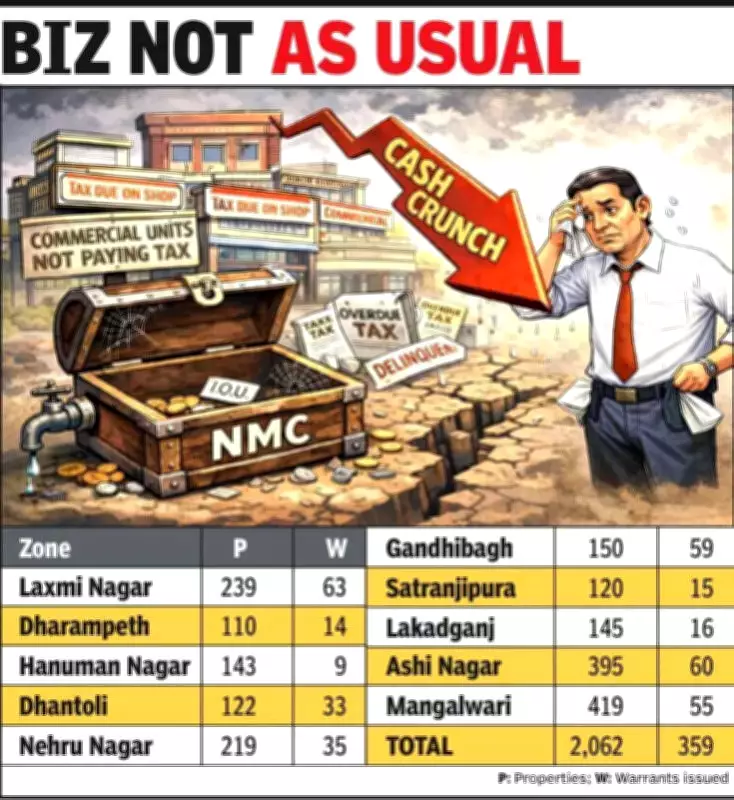
Nagpur Civic Body's Enforcement Gap on Commercial Property Tax Dues
In Nagpur, a concerning disparity has emerged between the potential revenue from commercial property taxes and the actual enforcement actions taken by the civic body. Data reveals that out of a total outstanding amount of Rs190.33 crore in commercial property tax dues, a mere 11.7% is currently under warrant action. This highlights a significant gap in the Nagpur Municipal Corporation's (NMC) recovery efforts, with only 359 properties out of 2,062 non-residential defaulters facing warrants, representing just 17.4% of the total cases.
High-Value Defaulters Largely Unaffected
The bulk of the unpaid dues is concentrated in the high-value category, where properties owe over Rs5 lakh each. Specifically, 229 such establishments have defaulted on a staggering Rs157.01 crore. However, warrants were generated against only 53 of these properties, accounting for Rs16.70 crore. This leaves 176 major defaulters, responsible for over Rs140 crore, outside coercive recovery proceedings, raising questions about the effectiveness of enforcement strategies.
Similar Trends in Lower Value Brackets
The enforcement gap is not limited to high-value properties. In the Rs1 lakh to Rs5 lakh bracket, 1,833 commercial properties have cumulative dues of Rs33.32 crore. Yet, warrants were issued against only 306 properties, involving Rs5.65 crore. This means 1,527 establishments, accounting for Rs27.67 crore, have not faced warrant action, further illustrating the widespread nature of the issue.
Absolute Figures and Enforcement Shortfalls
In absolute terms, while Rs22.35 crore is currently under warrant recovery, a massive Rs167.98 crore remains beyond the reach of the strongest enforcement mechanism available to the NMC. This disparity raises troubling questions: why are nearly 83% of commercial defaulters yet to face warrant proceedings, and why was coercive action initiated against barely one in six properties? More critically, why are 77% of high-value defaulters still operating without warrant pressure?
Implications for Civic Revenue and Infrastructure
Commercial properties form a crucial revenue backbone for the NMC, as they generate business income and are expected to comply strictly with tax obligations. Yet, thousands continue to function while crores in public revenue remain locked in arrears. At a time when the NMC routinely cites financial constraints for infrastructure upgrades, road repairs, and drainage projects, the muted pace of warrant generation appears inconsistent with the urgency of revenue recovery.
Conclusion: A Call for Enhanced Enforcement
The numbers tell a blunt story: enforcement has only touched the surface. Unless the civic body significantly expands warrant action against commercial defaulters, the message remains clear—defaulting carries limited immediate consequences, and compliance is not being uniformly enforced. This situation not only undermines public trust but also hampers the city's development efforts, necessitating a more robust approach to tax recovery.