

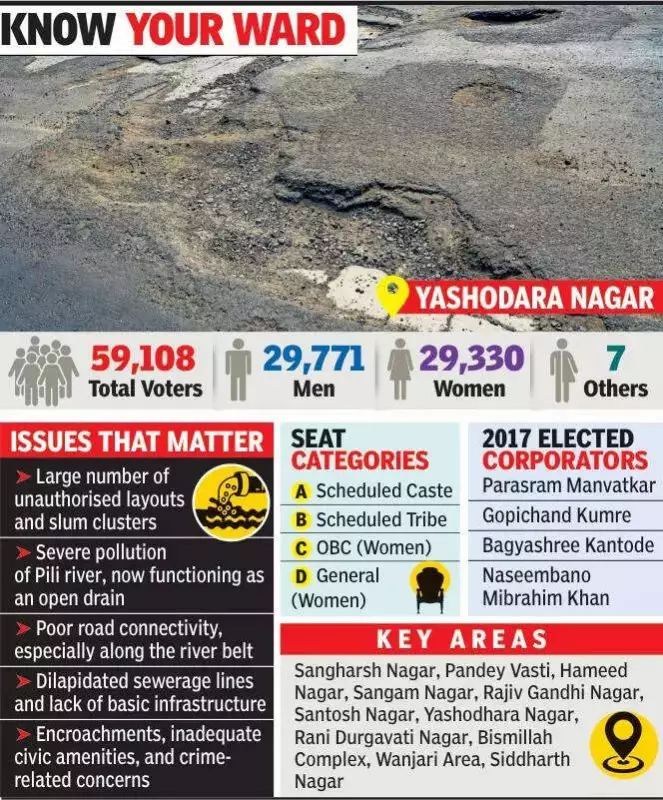
As Nagpur prepares for its upcoming Municipal Corporation elections, all eyes are on Prabhag 3, a constituency defined by its unauthorised layouts and dense slum clusters. This area, encompassing localities like Wanjra Industrial Estate, Sangharsh Nagar, and Vandevi Nagar, has long grappled with developmental neglect, making civic issues the central theme of the impending political contest.
A Legacy of Neglect and Civic Struggles
The Prabhag is a mosaic of densely populated neighbourhoods including Pandey Vasti, Sharda Ispat Company area, Hamid Nagar, Dhammanand Nagar, Yogi Arvind Nagar, Ramai Matoshri Ambedkar Nagar, and Bhimwadi. A significant portion of this territory consists of slums and unauthorised layouts, which have historically struggled for basic amenities. Adding to the civic woes is the Pili River, which flows through the Prabhag. Once a prominent water body, it has now deteriorated into a heavily polluted drain, exacerbating living conditions for nearby settlements.
Residents here face a multitude of persistent problems. Poor road connectivity along the Pili river, a crumbling sewerage network, inadequate infrastructure in industrial zones, widespread encroachments, and concerns over crime are daily realities. Frequent protests at the Nagpur Municipal Corporation (NMC) headquarters over the lack of fundamental services have become a common sight, highlighting years of unresolved grievances.

The Electoral Calculus and Shifting Dynamics
Politically, Prabhag 3 presents a fascinating and competitive landscape. In the 2017 civic elections, the Bharatiya Janata Party (BJP) demonstrated strong dominance by winning three of the four seats. The Congress managed to secure just one seat, and that too by a razor-thin margin of 57 votes. However, the political climate has shown signs of change.
The demographic composition, with a sizeable population of Scheduled Castes (SC), Scheduled Tribes (ST), Muslims, and Other Backward Classes (OBCs), is a critical factor. In recent years, an increase in Hindi-speaking residents has added a new layer to the electoral arithmetic. While smaller parties like the Bahujan Samaj Party (BSP) and the All India Majlis-e-Ittehadul Muslimeen (AIMIM) are expected to be in the fray, the main contest is anticipated to be a direct BJP versus Congress battle.
Recent trends suggest a potential shift. During last year's Lok Sabha and Assembly elections, the Congress reportedly secured a stronger vote share in this area. Political observers now believe a straight fight could work to the Congress's advantage, though the final outcome may hinge on how many votes the BSP, AIMIM, and other regional outfits manage to draw from the traditional vote banks of the major parties.
The Contenders and the Road Ahead
Both major parties have a long list of aspirants vying for tickets. The BJP's hopefuls include names like Vijay Parve, Gopichand Kumre, Bhagyashree Kanthode, Khan Naseem Bano, and Kiran Panpaliya. The Congress side features hopefuls such as Parasram Manwatkar, Vijay Hedau, Sunita Dhole, Shahija Ansari, and Sanjay Pendam. Several aspirants are also expected from the AIMIM and BSP, whose influence could be decisive in a close race.
As the election campaign heats up, the narrative in Prabhag 3 is firmly centred on development, infrastructure, and the resolution of long-standing civic issues. The electorate's patience, tested by years of neglect, will be the ultimate judge. The outcome here will not only decide the local corporators but also serve as a barometer for the political mood in Nagpur's urban heartland, making it one of the most closely watched constituencies in the NMC polls.






