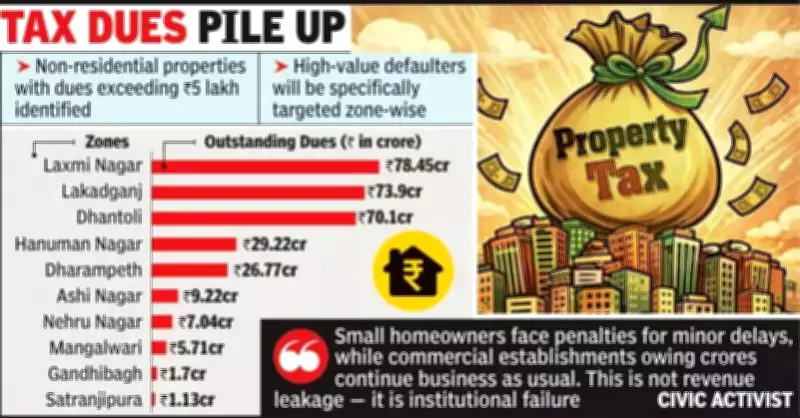
The Nagpur Municipal Corporation's persistent financial crisis stems not from insufficient revenue streams but rather from its systemic failure to pursue high-value tax defaulters effectively. According to data from the NMC's property tax department, a staggering 474 commercial property owners within city limits each owe more than Rs5 lakh, accumulating to a colossal outstanding amount of Rs303 crore.
Breaking Down the Massive Dues
The unpaid tax comprises three significant components: Rs137 crore in arrears, Rs151 crore as penalty, and Rs14.90 crore as current demand. These figures highlight years of consistent non-payment and inadequate enforcement mechanisms. Despite numerous announcements about recovery initiatives, these substantial defaulters continue withholding funds that could independently finance multiple essential civic projects.
Zone-Wise Concentration of Defaults
Analysis reveals that the burden concentrates heavily in prime commercial areas. Laxmi Nagar leads with Rs78.45 crore in pending dues, followed closely by Lakadganj at Rs73.90 crore and Dhantoli at Rs70.10 crore. Other prominent zones include Hanuman Nagar (Rs29.22 crore) and Dharampeth (Rs26.77 crore). Even zones like Nehru Nagar, Ashi Nagar, and Gandhibagh collectively account for several crores, demonstrating that defaults are widespread rather than isolated incidents.

Infrastructure Projects in Limbo
Civic officials acknowledge that the locked-up Rs303 crore could substantially transform Nagpur's deteriorating road infrastructure. This amount would enable comprehensive resurfacing of damaged roads, elimination of potholes, and construction of new cement concrete roads across multiple zones—issues that consistently dominate public grievances annually.
Furthermore, these funds could fulfill the municipal body's matching share requirements for state and central government-funded projects, which frequently face delays due to insufficient municipal contributions. Officials admit that initiatives like the Nag River pollution abatement plan, stormwater drainage upgrades, and sewage infrastructure improvements could accelerate significantly if these outstanding dues were recovered.
Municipal Response and Recovery Plans
Deputy Municipal Commissioner (Property Tax) Milind Meshram stated that the civic body has identified non-residential properties with dues exceeding Rs5 lakh and intends to pursue recovery zone by zone. "These high-value defaulters will be specifically targeted in each zone to recover the dues," Meshram explained. He added that all assistant commissioners across ten zones have been instructed to issue warrants to these tax defaulters. "If defaulters fail to settle outstanding taxes, the civic body will initiate property attachment followed by auction," he clarified.
Criticism and Institutional Challenges
However, critics argue that identification without decisive action has characterized NMC's approach for years. "While small homeowners face penalties for minor delays, commercial establishments owing crores continue operating normally. This isn't merely revenue leakage—it represents institutional failure," remarked a civic activist.
With no election protection remaining and diminishing public patience, attention now focuses on whether NMC will progress beyond issuing notices and statements to implementing actual recovery, attachment, and sealing procedures—or permit Rs303 crore to remain inaccessible while the city's infrastructure continues to deteriorate.