

A Historic Shift at Bihar's Seat of Power
For the first time in twenty years, the oath-taking ceremony at Lok Bhavan in Patna delivered a powerful and unmistakable message of transformation at the very heart of Bihar's governance. The event on Wednesday presented a scene that was markedly different from the political rituals of the past two decades.
From Center Stage to Spectator's Seat
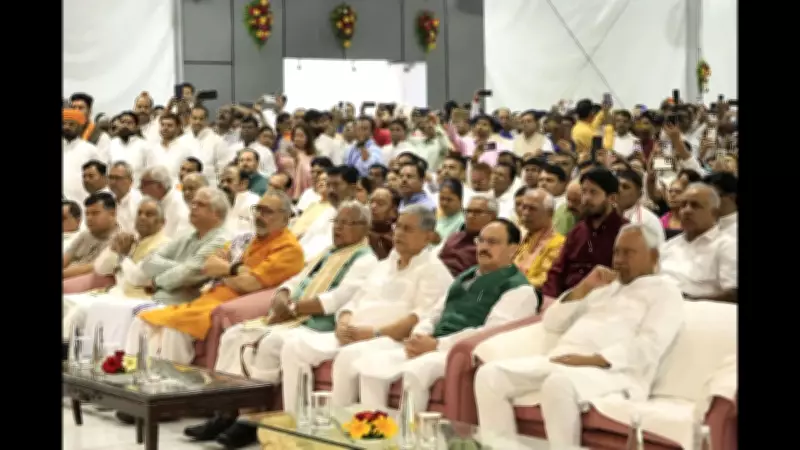
JD(U) president Nitish Kumar, who has been the "star attraction" at the governor's house for years, found himself in an unfamiliar position. Having taken oath as chief minister of Bihar ten times over the past twenty years, alternating between the NDA and the Grand Alliance, he was now quietly observing the proceedings as a "spectator" from the front row of guests.
Seated on a sofa alongside former BJP chief J P Nadda and Union ministers Lalan Singh, Jitan Ram Manjhi, and Giriraj Singh, Nitish appeared noticeably "dejected" according to observers. He rested his fingers thoughtfully on his chin, his gaze fixed into the distance, contemplating what many saw as the end of an era in Bihar politics.

A Moment of Awkward Recognition
The ceremony produced a particularly telling moment when party colleague Bijendra Prasad Yadav, after taking his oath as a minister, struggled to locate Nitish among the guests standing on the dais. Despite repeated attempts to spot his party leader, Yadav remained confused until cabinet colleague Vijay Kumar Choudhary finally pointed toward Nitish seated on the sofa.
"Dikhte nahin (Can't you find me)?" Nitish called out loudly, prompting laughter from the assembled audience. The moment carried profound symbolic weight, given that for the past twenty years, Nitish himself had been the absolute focal point of such ceremonies, taking the oath of office as chief minister on ten separate occasions.
The Transfer of Power and Blessings
Nitish Kumar first took oath as chief minister in March 2000 and remained at the helm of Bihar's government until April 14, 2026, when he quietly transferred power to a BJP colleague. In a gesture of respect and continuity, Samrat, after taking oath as the new chief minister, approached Nitish and sought his blessings. Nitish responded by placing both hands on Samrat's shoulders, symbolically passing the mantle of leadership.
Political Analysis and Notable Absences
Political expert D M Diwakar, former director of the Patna-based A N Sinha Institute of Social Studies, commented on the unprecedented transition. "Don't know what prompted Nitish ji to hand over power to the BJP. The masses had given the mandate to Nitish ji but he transferred power to his saffron partner," Diwakar observed, highlighting the unexpected nature of this political shift.
Another significant aspect of the ceremony was the absence of Nishant Kumar, who joined active politics only last month and was widely seen as a probable deputy chief minister from the JD(U) quota. His non-appearance added another layer of intrigue to an already historic political transition.
This ceremony at Lok Bhavan marked not just a change in administration but a fundamental reconfiguration of Bihar's political dynamics, with Nitish Kumar transitioning from the perennial chief minister to a respected elder statesman observing from the sidelines.






