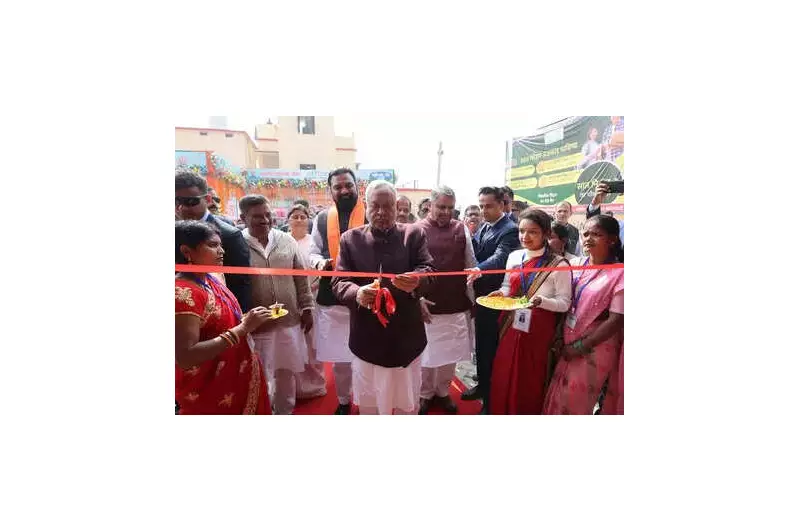
Chief Minister Nitish Kumar inaugurated a comprehensive package of development initiatives valued at Rs 391 crore in Madhubani district on Tuesday. This significant event marked the second phase of his ongoing Samriddhi Yatra, where he also presented the state government's ambitious development blueprint for the period 2025-2030, framed under the Seven Resolves-3 program.
Major Infrastructure and Welfare Projects Launched
During his visit, the Chief Minister personally inspected the progress of the Mithila Haat Phase-II riverfront development project located in the Araria Sangram gram panchayat under Jhanjharpur block. In a ceremony aimed at accelerating regional growth, he formally inaugurated 294 separate schemes with a combined cost of Rs 93 crore. Furthermore, he laid the foundation stones for an additional 101 projects with a substantial investment of Rs 298 crore, signaling a major push for infrastructure and public welfare in the district.
Review of Ongoing Development Initiatives
Senior officials provided the CM with detailed briefings on the status of various projects that were announced during the earlier Pragati Yatra. These include the expansion and beautification of the Mithila Haat complex, the construction of a new inter-state bus stand in Madhubani town, a road overbridge near Jaynagar Shaheed Chowk, and the development of the Madhubani town ring road. In a move to boost industrial growth, the administration informed about plans for a new industrial area spanning approximately 450 acres near Bangama village in Laukahi block, strategically located along National Highway-27. Simultaneously, work is advancing on another industrial centre covering about 250 acres in the Majha-Lohna area of Jhanjharpur block.

The development of Phulhar Sthan, a site of religious and cultural significance associated with Mother Sita and Lord Shri Ram, into a prominent tourism destination is also actively underway. Chief Minister Kumar emphasized the critical importance of timely and high-quality completion for all development and welfare schemes, stating that this approach is essential for enhancing public convenience and accelerating holistic regional growth.
Inspection of Panchayat Facilities and Jeevika Initiatives
As part of his district review, the CM conducted a thorough inspection of the newly constructed panchayat government building at Araria Sangram. This facility houses a gram nyayalaya (village court), a gram sabha room, and a panchayat knowledge centre. Officials highlighted that children from surrounding areas regularly utilize the library resources available at the knowledge centre, underscoring its community value.
In a significant step for women's empowerment and rural livelihoods, Nitish Kumar later inaugurated a newly constructed Jeevika Bhawan. He symbolically handed over the keys of the building to Jeevika Didis, representatives of women's self-help groups. The Chief Minister also inspected various stalls operated by these self-help groups, showcasing local products and entrepreneurial efforts. To further bolster economic support, he distributed cheques worth Rs 301 crore to 26,312 self-help groups through bank linkage programs. Additionally, Rs 2 crore was disbursed among 507 beneficiaries under the Satat Jeevika Upliftment Scheme.
Public Address and Vision for Bihar's Future
Addressing a public dialogue in Araria Sangram village, Chief Minister Kumar reflected on Bihar's transformative journey since 2005. He asserted that the state has successfully achieved rule of law, sustained peace, and witnessed rapid development, with marked improvements in critical sectors like road connectivity, electricity supply, water provision, sanitation, and flood control measures.
Outlining the priorities under the Seven Resolves-3 vision for 2025-2030, Kumar detailed an ambitious roadmap. Key focus areas include doubling employment opportunities and per capita income, establishing industrial zones in every district, reviving closed sugar mills, implementing agricultural marketing reforms, setting up model schools and colleges in every block, upgrading healthcare facilities, constructing new expressways, expanding solar energy infrastructure, and promoting tourism and eco-tourism across the state.

Madhubani-Specific Development Plans
For Madhubani district specifically, the plans are equally comprehensive. The blueprint includes the establishment of model schools and degree colleges across all 21 blocks within the district, a significant upgrade of community health centres, the development of a dedicated industrial zone in Laukahi, and a focused dairy promotion program targeting over 1,100 villages to enhance rural incomes.
The high-profile program was attended by Deputy Chief Minister Samrat Choudhary, several state ministers, Members of Parliament, and senior administrative officials, highlighting the collective governmental focus on Madhubani's development trajectory.