

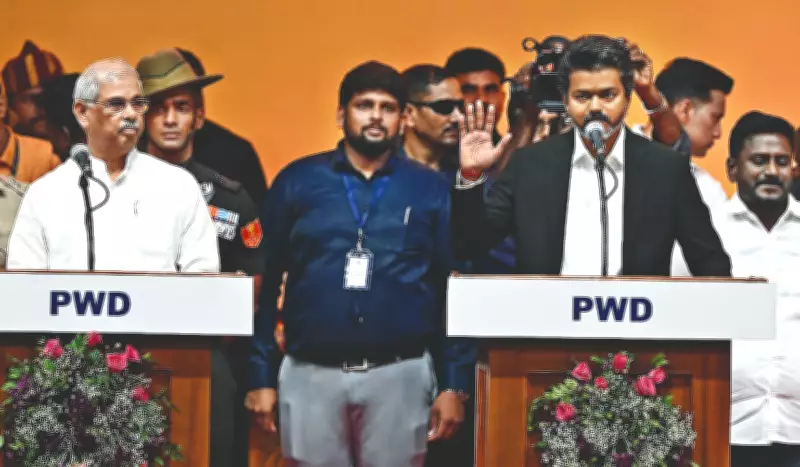
R S Raveendhren, Tamil Nadu's new chief minister, took a theatrical oath in the name of god, drawing thunderous applause from party cadres but also igniting serious political discussion within the state. While most of his ministerial colleagues followed his lead, Aadhav Arjun affirmed in the name of 'conscience'. Curiously, on the floor, CM Joseph Vijay took an oath upon his conscience as a member of the legislative assembly. For the uninitiated, a constitutional oath is a solemn declaration or affirmation made by elected members, affirming that they will bear true faith and allegiance to the Constitution of India, uphold sovereignty and integrity, and faithfully discharge their duty. It is sworn either in the name of god or upon one's conscience.
Historical Roots of Oath-Taking
Oath-taking is as old as time itself. The Code of Hammurabi contains the earliest reference to oaths taken by witnesses and officers. The modern oath-taking traces its origin to the Glorious Revolution of 1688 in Britain. This standardized oath was then adopted by the rest of Europe, the US, and most other British colonies. The Presidential Oath, which came into being with the US Constitution in 1789, is widely considered the world's first democratic constitutional oath.
In medieval India, ascension to the throne happened by coronation. The Marathas, Rajputs, Mughals, Vijayanagar empire, and Chola empire took a pledge or dharma-oath that did not follow a standard format. The monarch pledged to protect people, uphold justice, and preserve dharma in the presence of priests and courtiers.

Colonial and Constitutional Evolution
The system fundamentally changed with the advent of the East India Company. When it gradually established a formal governance structure, public officials were required to take an oath in the name of god before assuming office. This laid the foundation for formal oath-taking in India. When the British Crown took over in 1857, it made oaths mandatory for governors-general, governors, high court judges, and all civil servants. Interestingly, the 28th Report of the Third Law Commission of India (1965) noted that oaths were taken on the holy book or water of the Ganges until 1840.
After the Government of India Act, 1919, every elected representative took oath under a legislative framework. The Government of India Act, 1935, gave it constitutional status. The Third Schedule to India's Constitution enshrines oath-taking in pursuance of Articles 164(3) and 188. Our Constitution, in line with its secular nature, permits religious and non-religious affirmations. The first Prime Minister, Jawaharlal Nehru, took oath by affirmation. Indira Gandhi, in her first tenure, used solemn affirmation, but in her last tenure, she swore in the name of god, marking a sharp shift. Many successors, including Prime Minister Narendra Modi, also took oath in the name of god.
Tamil Nadu's Political Symbolism
In Tamil Nadu, a single word defines political leanings: 'ulamara' (by my conscience) or 'Aandavan meethu' (in the name of god). Former CMs like C N Annadurai, M Karunanidhi, and M K Stalin chose 'ulamara' affirmation, aligning with Dravidian rationalism. M G Ramachandran, a believer, also took oath only upon his conscience. Later CMs like J Jayalalithaa, O Panneerselvam, and Edappadi K Palanisamy swore only in the name of god.
When questioned about 'ulamara', Annadurai emphatically said that “one can seek atonement and compromise with god, but not with one’s conscience.” In Tamil Nadu, this is a strong message of political identity. Oath-taking today is far more than a constitutional formality; it reflects the state's distinct political ideology, culture, and belief system.
Beyond Ceremony
Oath-taking can no longer be a ceremonial formality. When an elected official takes the oath, it is an honest expression of commitment to truthfulness, morality, legal accountability, justice, and constitutional values. They should remember US President Woodrow Wilson's words: “When you take oath of allegiance, the allegiance is towards a great ideal, to a great body of principles, and to a great hope of the human race.” May the torch of constitutional morality guide them in office and afterwards.

No God, No Seat
For a long time, oath-taking was part of the religious landscape until 1880, when Charles Bradlaugh, a social reformer and atheist, challenged it. Bradlaugh won a seat in the House of Commons but objected to the religious Oath of Allegiance and asked to merely affirm its principles. His request was denied, and he was forced to forfeit his seat. He was re-elected four times, each time refusing the religious oath and forfeiting his seat.





