Odisha Sets Aggressive Economic Targets for 2047 with 17-Fold Income Rise
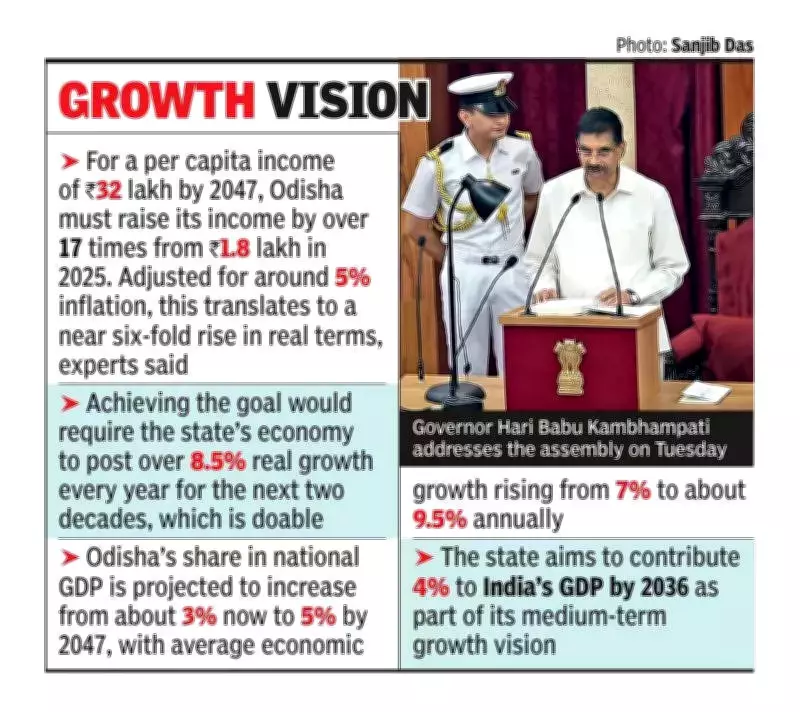
In a landmark address to the state assembly, Governor Hari Babu Kambhampati unveiled an ambitious vision to transform Odisha's economy, targeting a dramatic 17-fold increase in per capita income by 2047. The governor outlined a comprehensive roadmap focused on rapid industrialization, massive infrastructure development, and extensive skilling initiatives to achieve this goal.
Ambitious Economic and Social Targets
Opening the budget session, Governor Kambhampati declared that Odisha aims to elevate its per capita income from the current Rs 1.8 lakh to an impressive Rs 32 lakh by 2047. This ambitious target is part of a broader strategy to significantly enhance living standards across the state.
The governor detailed several key social indicators that the government plans to improve substantially:

- Reducing multidimensional poverty from 15.68% to just 5%
- Increasing female labor force participation from 44.7% to 70%
- Raising life expectancy from 70.3 years to beyond 80 years
- Eliminating anaemia and malnutrition in alignment with national goals and global benchmarks
Growth Trajectory and Economic Expansion
Economic experts have analyzed that achieving this 17-fold income increase would require Odisha to maintain an average annual growth rate of approximately 14% over the next 22 years. This sustained double-digit expansion demands rapid industrialization, enhanced productivity across all sectors, and continuous investment in both human capital and physical infrastructure.
The governor referenced the state's Vision Document for 2036 and 2047, which was unveiled by Prime Minister Narendra Modi. According to this strategic plan:
- Odisha's contribution to India's national GDP is projected to rise from 3% to 5% by 2047
- Average annual economic growth is expected to accelerate from 7% to 9.5% through comprehensive reforms in investment, execution, and technology adoption
- The state aims to become a $500 billion economy by 2036 and further expand to a $1.5 trillion economy by 2047
Industrial Base and Infrastructure Development
Highlighting Odisha's existing industrial strength, Governor Kambhampati noted that the state currently hosts 55 operational steel plants with an installed capacity of 45.62 million tonnes per annum (MTPA), representing 23% of India's total steel capacity. The target is to expand this capacity to 100 MTPA by 2030, contributing significantly to the national goal of 300 MTPA.
The governor reported substantial progress in industrial investments since the new government took office:
- 85 industrial projects worth over Rs 2 lakh crore have been grounded, creating 1.65 lakh jobs
- Since January 2025, approvals have been granted for 343 large projects with combined investment potential of Rs 7.1 lakh crore and employment generation of 4.65 lakh jobs
Infrastructure development remains a critical priority, with Governor Kambhampati describing it as the "silent enabler" of the Samruddha Odisha 2036 vision. Recent major approvals include:
- The Rs 8,300 crore Rameshwar-Paradip coastal highway
- The Rs 8,308 crore Capital Region Ring Road
- Rs 2,066 crore semiconductor investment
Skilling Initiatives and Clean Energy Push
Recognizing the crucial need for skilled manpower to support economic growth, the governor emphasized the state's commitment to digital skilling. Since 2023, over 2.6 lakh students have been enrolled in various digital skilling initiatives, preparing the workforce for future economic demands.
The government is also pushing aggressively for clean energy development, with plans to install 10 gigawatts of renewable energy capacity by 2030. This commitment to sustainable energy aligns with both national priorities and global environmental standards.
Governor Kambhampati's address presents a comprehensive vision for Odisha's economic transformation, combining ambitious targets with concrete implementation strategies across industrial development, infrastructure expansion, human capital investment, and sustainable growth initiatives.