

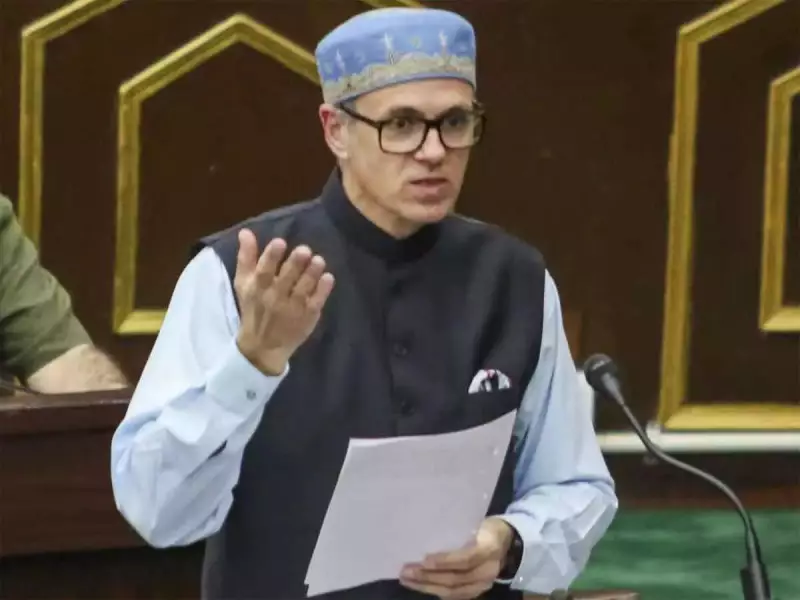
Jammu and Kashmir Chief Minister Omar Abdullah asserted on Thursday that the legacy of his grandfather, Sheikh Mohammad Abdullah, is not dependent on whether his birth anniversary is officially observed as a public holiday. His comments came five years after the Centre-appointed Lieutenant Governor's administration removed the date from the official holiday list.
A Question of Statehood and Decision-Making
Speaking on the sidelines of a passing-out parade for Agniveers in Srinagar, Omar Abdullah addressed questions about the National Conference's plans to grandly observe Sheikh Abdullah's birth anniversary on December 5. He clarified that declaring such holidays is not within the powers of the elected state government.
"Declaring a holiday on such occasions is not within the powers of the elected government. The decision lies with the Centre," the Chief Minister said. He connected the issue directly to the broader political context, stating, "That is why we keep saying we should have our statehood back so that we can take both big and small decisions."

He firmly dismissed the idea that a holiday status defines his grandfather's contributions. "Holiday or not, it will not be the yardstick to gauge his contribution. Sheikh Mohammad Abdullah resides in the hearts of people," Omar Abdullah emphasized.
Historical Context of Holiday Changes
The political significance of public holidays in Jammu and Kashmir has been a point of contention since the abrogation of Article 370. In January 2020, the Lieutenant Governor's administration made significant changes to the official calendar.
The birth anniversary of Sheikh Abdullah, observed on December 5, was removed from the list of public holidays. Simultaneously, Martyrs' Day (July 13), which commemorates the 1931 killings of protesters by Dogra forces, was also delisted.
In a contrasting move two years later, in 2022, the administration added the birth anniversary of the last Dogra ruler, Maharaja Hari Singh (September 23), to the holiday list. These shifts are widely viewed through a political lens, reflecting changing historical narratives in the Union Territory.
CM's Address at JAKLI Agniveer Parade
Omar Abdullah made these remarks after attending the passing-out parade of 711 Agniveers for the Jammu and Kashmir Light Infantry (JAKLI) Regiment. He used the occasion to highlight the regiment's deep historical ties to the region.
Addressing the new recruits in the freezing cold, the CM provided a brief history lesson. "You are joining a regiment that has deep ties with Jammu and Kashmir. Before Independence, the regiment served as a militia and fought the tribal invasion in 1947," he said. He noted that this was his first opportunity to attend such an event at the JAKLI regiment.
He praised JAKLI's role in national security, stating it has played a crucial part in safeguarding India's borders "from the heights of Siachen to the deserts of Rajasthan."
The Indian Army, in a statement, highlighted the preparedness of this batch of Agniveers. It pointed out that the recruits "were barely a week into training when Operation Sindoor commenced." The Army noted that the drills conducted during this high-intensity period served as essential battle inoculation, fostering an "unshakeable resolve" among the young trainees.
Legacy Beyond Official Recognition
Omar Abdullah's statements underscore a persistent political narrative in Jammu and Kashmir, where symbols and official recognitions remain deeply politicized. The removal of Sheikh Abdullah's birth anniversary as a holiday is seen by many supporters of the National Conference as part of a pattern following the constitutional changes of August 2019.
By explicitly stating that his grandfather's place is secure in popular memory regardless of official status, the Chief Minister aimed to reinforce the enduring political legacy of the NC founder. His linkage of the holiday issue to the demand for restored statehood frames it as a matter of democratic empowerment and local decision-making authority for Jammu and Kashmir.






