

OPS Campaigns as DMK Candidate in Bodi, Faces Loyalty Questions
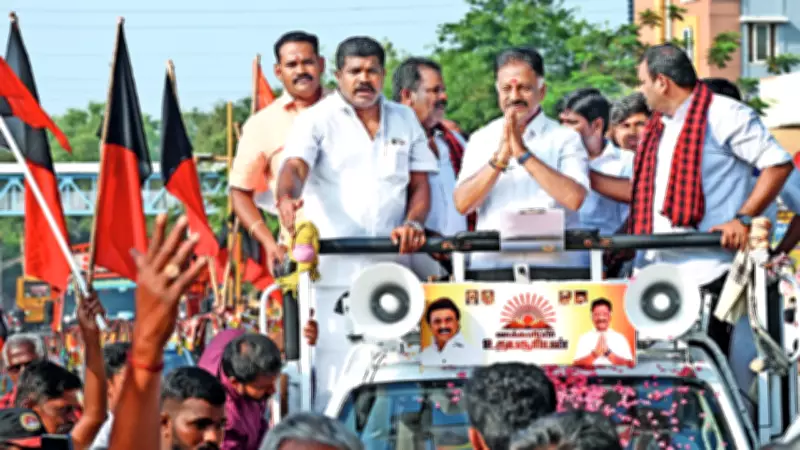
The early morning tranquility of Palani Chettipatti, a panchayat town in Theni district, is shattered by the rhythmic drumbeats and blaring DMK propaganda songs. Scores of men and women gather along the main road, holding up posters of Chief Minister M K Stalin and his new party associate, O Panneerselvam.
A Defiant Shift in Party Allegiance
For Panneerselvam, a three-time chief minister, this represents a defiant and dramatic shift in party allegiance. This move came after AIADMK General Secretary Edappadi K Palaniswami repeatedly stonewalled his attempts to return to the party. Today, OPS steps out to the town center as DMK's Bodinayakkanur candidate, marking a significant personal and political turning point.
He emerges from his car and carefully climbs into a tempo van that has been repurposed as a campaign vehicle. His three-vehicle convoy weaves through a paid yet enthusiastic crowd as he greets supporters with folded hands. In a symbolic gesture, the photograph of J Jayalalithaa that once rested in his pocket has been replaced by a profile of Stalin. The picture on his car dashboard has also been flipped, underscoring his new political alignment.

Campaign Promises and Voter Reactions
The convoy navigates through narrow lanes and arrives at Vadakku Jayanathapuram Karuppusamy Koil Street, where OPS takes to the microphone. "Stalin will come back as CM. The Dravidian model governance will be back," he declares, eliciting clapping and cheering from the gathered crowd. He glances up at dangerously hanging electric cables and promises to have them reinstalled, addressing local infrastructure concerns.
A party member holding a public address system then asks, "Raise your hands if you will vote for OPS." Most people comply with the directive, and Panneerselvam looks pleased with the response. However, the reactions among voters reveal a complex mix of emotions and loyalties.
Visithra, a 27-year-old local resident, lifts her hand and that of her toddler. "TVK has not come campaigning here yet," she notes, adding cautiously, "But I am not sure if my family, which has traditionally voted for AIADMK, will vote for DMK." This sentiment reflects the deep-seated party affiliations that characterize Tamil Nadu politics.
Historical Context and Electoral Challenges
Panneerselvam has recorded easy victories in Bodi three times as an AIADMK candidate since 2011. However, this election may not be a cakewalk. AIADMK candidate V T Narayanasamy presents a tough opponent, and OPS's rivals are accusing him of betraying Amma, referring to the late J Jayalalithaa.
Conversations in tea shops and on street corners reveal a blend of assurance of victory, skepticism, and cautious optimism. Some voters admire OPS's past political heft and view his move to join DMK as driven by compulsions. Others question whether loyalty to Amma can be so easily set aside, highlighting the emotional and ideological dimensions of his switch.
Symbolic Shifts and Ideological Repositioning
The office in his bungalow in Subburaj Nagar, Bodi, now sports three large, framed pictures of Stalin and Udhayanidhi Stalin. A smaller portrait of Jayalalithaa hangs by the side, symbolizing the transition from his previous allegiance to his current one.
Panneerselvam's dramatic change in allegiance marks not just a personal turning point but a controversial ideological repositioning. Long identified with AIADMK's MGR legacy and Jayalalithaa's persona, Panneerselvam now aligns with DMK's Dravidian framework, which emphasizes social justice, rationalism, and development.
"His switching sides is a result of political necessity," observes Mohammed Ali, a resident on Four Cross Road, capturing the pragmatic undertones of the move.
Political Strategy and Community Loyalties
Bodinayakkanur has long been an AIADMK bastion, with its political identity shaped by deep-rooted loyalties, particularly among the dominant Mukkulathor community, which has historically leaned towards AIADMK. In Tamil Nadu, party affiliations are not merely a matter of strategy; they are intricately intertwined with community identity and personal loyalty.

For DMK, fielding Panneerselvam in Bodi signals a strategic intent to breach an AIADMK stronghold. His campaign blends personal outreach with narratives of good governance and development under Stalin's leadership, aiming to sway traditional voters.
As Panneerselvam's convoy continues its journey, drums beat and songs play on. On OPS's trail, a fundamental question remains: Can Jayalalithaa's handpicked man convincingly present his DMK avatar to the people of Bodi? The answer will unfold in the voting booths, as voters weigh his promises against their longstanding loyalties.





