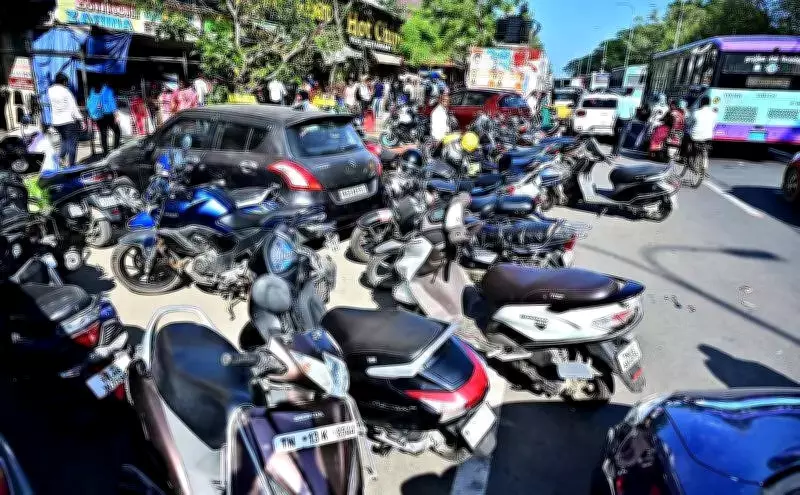
Parking Anarchy Grips Key Chennai Arterial Road Outside Madras High Court
A critical stretch of road outside the iconic Madras High Court in Chennai has descended into complete traffic chaos, with advocates' parked vehicles effectively taking over the carriageway. The situation on NSC Bose Road, a key arterial route, has reached a breaking point, crippling movement and pushing pedestrians dangerously into the path of moving traffic.
Three-Lane Occupation Worsens Chronic Congestion
While two lanes along the high court campus have historically been used for parking, investigations have now revealed a disturbing expansion. Cars were found occupying a third lane as well, severely eating into what little remained of the already narrow two-lane NSC Bose Road. The congestion was compounded on the opposite side of the road, where a continuous line of two-wheelers and four-wheelers was parked illegally right up to the Prakasam Salai junction, blatantly ignoring prominent no-parking signage.
Advocates have further exacerbated the problem by cordoning off parking areas using physical barricades. This action has left pedestrians, court visitors, and daily commuters with no safe passage, forcing them to navigate amidst moving vehicles. The scene presents a significant public safety hazard.

Systemic Failures and Lack of Enforcement Blamed
Commuters and observers point to a clear failure of enforcement as the root cause. While the Greater Chennai Corporation officially permits parking along two lanes of the court campus, violations on the opposite stretch continue unchecked. The civic body's promised solution—a multi-level parking facility specifically for advocates announced in 2024—remains unbuilt, leaving a critical infrastructure gap.
Prominent advocate Sudha Ramalingam argued strongly against any special exemptions. "Even advocates must be fined for parking violations. I personally paid parking fees earlier," she stated, highlighting the issue of unequal application of rules. She identified the core problems as poor inter-agency coordination, a lack of active supervision by traffic police, and the absence of a consistent city-wide parking policy. "Rising vehicle numbers and inadequate designated spaces have only worsened the situation," she added, noting that barricades are ineffective when vehicles park beyond them. She proposed developing parking infrastructure near Parry's Corner as a potential remedy.
Multiple Perspectives on a Complex Problem
Another advocate, N Vishwanathan, offered a different viewpoint, suggesting that parking space exists on the court campus itself and that late arrivals tend to park outside. He also pointed to vehicles from nearby commercial establishments like Aavin Milk outlets and notary offices, as well as officially parked patrol vehicles, as contributors to the congestion near Gate 3. He proposed reducing some official in-person movements through increased use of video conferencing to alleviate pressure.
Local auto-rickshaw drivers blamed recent infrastructure changes, including the demolition of a nearby bus stop for commercial use, which has left buses with no proper halting space. One driver also hinted at lax enforcement as elections approach, suggesting vehicles belonging to influential persons are not being penalized.
Calls for Immediate and Long-Term Solutions
Civic activist V Gopalakrishnan called on the Metropolitan Transport Corporation (MTC) to improve public transport connectivity to the High Court area. He advocated for route extensions and scheduling more buses to halt there, which would benefit daily commuters and potentially reduce private vehicle dependency.
In response to the growing crisis, Royapuram zonal officer C Vijayababu has indicated that corrective measures are currently being planned and implemented. However, with the proposed multi-level parking still on paper and enforcement seemingly weak, the residents and commuters of Chennai await tangible action to reclaim NSC Bose Road from the grip of parking anarchy.