

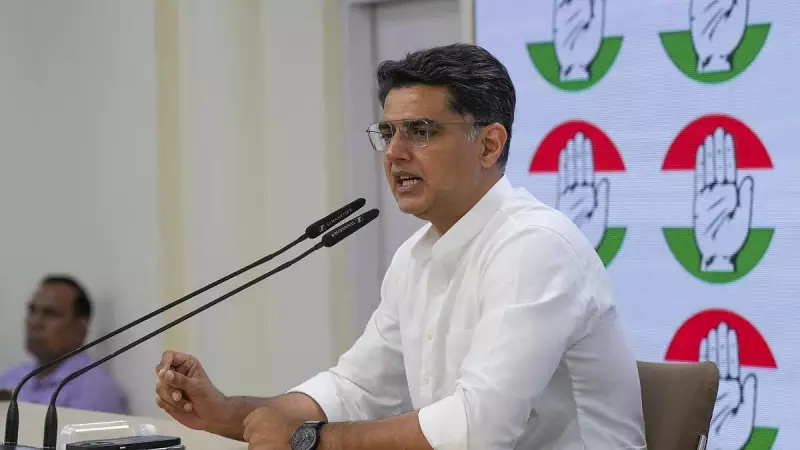
Senior Congress leader and former Rajasthan minister Sachin Pilot has launched a sharp critique against the central government's newly introduced VB-G RAM G scheme, asserting that it severely undermines the foundational principles of the Mahatma Gandhi National Rural Employment Guarantee Act (MGNREGA).
Centralization from Delhi, Disempowerment at Village Level
Drawing from his direct experience handling the panchayat raj portfolio in Rajasthan, Pilot stated that the new law would effectively "disempower" gram panchayats. He argued that the scheme's design shifts crucial decision-making and operational control away from local village councils. Instead, the program is being orchestrated to run in a highly centralized manner from the national capital, New Delhi.
"This move takes away the autonomy and authority of the very institutions that understand local needs best," Pilot implied, highlighting a fundamental shift in governance of rural employment guarantees. The veteran politician's comments bring a significant political and administrative perspective to the ongoing debate about decentralization and federalism in welfare schemes.

Contrast with MGNREGA's Grassroots Framework
The core of Pilot's argument lies in the contrast between the new scheme and the original architecture of MGNREGA. The UPA-era flagship program was built on the principle of grassroots planning and implementation, with gram panchayats playing a pivotal role in identifying work, executing projects, and ensuring transparency. This local involvement was seen as key to its accountability and effectiveness.
The VB-G RAM G scheme, as per Pilot's analysis, disrupts this model. By pulling control to the centre, it risks creating bureaucratic delays, reducing contextual relevance of projects, and diluting the political and administrative agency of elected local bodies. This criticism points to a larger ideological battle over how welfare should be delivered in India.
Potential Consequences and Political Repercussions
The implications of this centralization, as flagged by the Congress leader, are multifaceted:
- Weakened Local Governance: Gram panchayats could become mere implementing agencies without real planning power.
- Reduced Accountability: With control moving to Delhi, the direct line of accountability to local villagers may blur.
- Political Fault Lines: The critique firmly places the issue within the national political discourse, setting the stage for a confrontation between the ruling BJP and the opposition Congress on federalism and rural development.
Sachin Pilot's statement, made on 22 December 2025, is likely to resonate in political circles and among stakeholders in rural development. It raises critical questions about the future of India's largest rural job guarantee scheme and the role of local self-government in the world's largest democracy.






