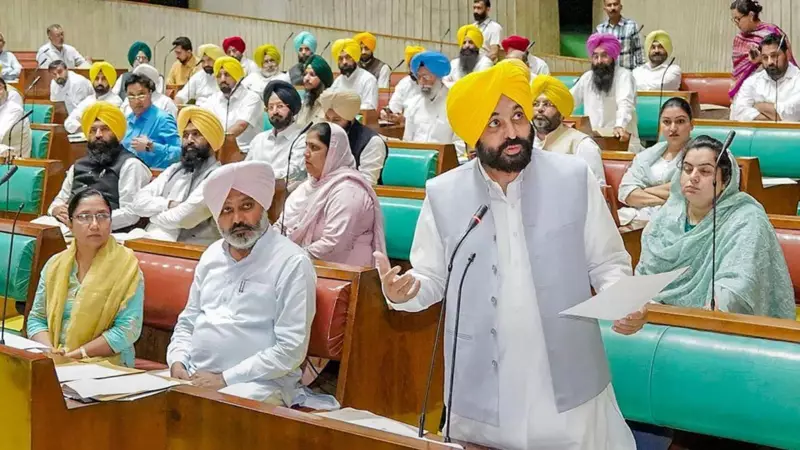
The Punjab government, led by Chief Minister Bhagwant Mann, has decided to convene a one-day special session of the state legislative assembly on December 30, 2025, to formally oppose the Centre's newly passed Viksit Bharat – Guarantee for Rozgar and Ajeevika Mission (Gramin) Bill. The session aims to pass a resolution against the legislation, which seeks to replace the long-standing Mahatma Gandhi National Rural Employment Guarantee Act (MGNREGA).
Why the Date Was Advanced
The decision to hold the session on December 30 marks a significant shift from the initial plan to convene it in the second week of January 2026. The move to advance the date by nearly two weeks is seen as a strategic political counter. Government sources indicate the ruling Aam Aadmi Party (AAP) aims to pre-empt the opposition Congress, which has already launched protests against the VB-G RAM G Bill after making gains in recent rural polls.
Another technical reason cited for the December date is procedural. According to Vidhan Sabha rules, a session called in a new calendar year must begin with the Governor's address, followed by a mandatory debate, necessitating a longer session. The government reportedly wants to avoid this extended process to focus solely on the Bill.

Allegations Against the Central Legislation
After a cabinet meeting chaired by CM Mann, state Finance Minister Harpal Cheema addressed the media, launching a sharp critique of the BJP-led central government. He accused the Centre of systematically tearing apart the Constitution and misleading the public by naming the new scheme after Lord Ram while allegedly diluting its provisions.
"We are not against the name. We are not against Viksit Bharat. But they are misleading people... while making amendments to the scheme that would affect the beneficiaries," Cheema stated. He asserted that the special session would expose how the new Bill would "snatch the rights of the poor" and effectively "finish" MGNREGA.
Key Concerns: Funding and Work Days
The state government has raised two primary objections regarding the VB-G RAM G Bill's financial and operational framework. Firstly, Chief Minister Mann highlighted the change in the funding pattern. Under MGNREGA, the Centre contributed 90% of the cost, with states bearing 10%. The new scheme reportedly proposes a 60:40 Centre-State split, significantly increasing the financial burden on states like Punjab.
Secondly, despite the Centre's guarantee of 125 days of rural wage employment annually, Minister Cheema argued that the reduction in the number of permissible works would render even 10 days of employment unfeasible. He gave the example of cleaning village ponds, which could be undertaken twice a year under MGNREGA but is now reportedly restricted to just once a year under the new Bill.
The political stakes are high, with both the AAP and Congress vying to position themselves as the primary defenders of rural and poor populations against what they frame as a detrimental central policy. The December 30 session is set to be a platform for Punjab's strong legislative rebuke of the controversial Bill.