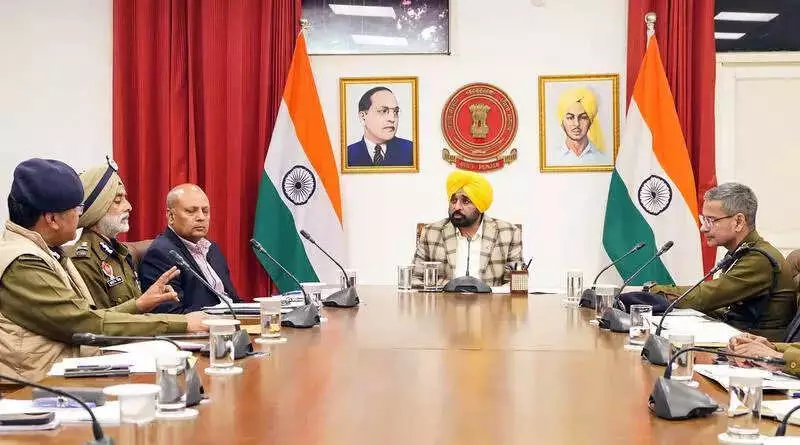
Punjab Chief Minister Bhagwant Mann declared on Saturday that the state is now decisively winning its protracted battle against narcotics and organised crime. He pointed to a significant surge in arrests, high conviction rates, and a strategic crackdown on trafficking networks as evidence of this turning point.
Sustained Enforcement Yields Tangible Results
Reviewing the police department's performance, the Chief Minister attributed the success to "sustained enforcement, tighter investigations, and zero political interference." He described the current phase as a "clear shift from rhetoric to results." Mann provided comprehensive data to back his claims, stating that over the past three and a half years, authorities have arrested 85,418 drug smugglers.
The conviction rate under the stringent Narcotic Drugs and Psychotropic Substances (NDPS) Act has reached an impressive 88%. Since his government took charge, 63,053 cases have been registered against drug peddlers. A major push came with the launch of the 'Yudh Nashian Virudh' campaign on March 1, 2025. In this drive alone, police have registered 30,144 First Information Reports (FIRs) and arrested 40,302 smugglers.

Multi-Pronged Strategy and Massive Hauls
Mann explained that a holistic strategy focusing on enforcement, de-addiction, and prevention has been implemented. This approach has led to the recovery of vast quantities of illicit substances. The seized contraband includes:
- Over 5,119.9 kilograms of heroin
- 3,458.5 kg of opium
- 5.8 kg of cocaine
- 82 kg of 'ice' (methamphetamine)
- Nearly 5 crore capsules of pharmaceutical drugs
Furthermore, drug money worth more than ₹52.6 crore has been confiscated. The Chief Minister emphasized that the fight against drugs has been a top priority since 2022, employing an outcome-oriented model combining financial investigations, technology, and public participation.
Financial Strikes and Tech-Driven Policing
Enforcement has evolved from targeting petty seizures to dismantling high-level supply chains. Financial probes have been crucial, with authorities confirming over 1,400 proposals to freeze illegally acquired properties. Assets valued at more than ₹2,730 crore were frozen or confirmed between 2022 and 2025.
Technological tools like the PAIS analytics system and digital forensics have strengthened policing. The 'SAFE Punjab' WhatsApp chatbot has been a game-changer in public engagement, generating nearly 30,000 actionable tips. These tips led to the registration of over 11,000 FIRs and approximately 14,000 arrests.
On the organised crime front, between January 1 and December 17, 2025, Punjab Police arrested 916 gangsters, neutralised 13, busted 389 modules, and recovered 594 weapons.
Opposition and High Court Raise Concerns
The government's assertive claims come just three days after the Punjab and Haryana High Court expressed grave concern over the state's law and order situation. Referring to the recent murder of a kabaddi player in Mohali, a division bench noted that armed criminals had a "free run," raising serious questions.
The opposition has outrightly rejected CM Mann's narrative. Leader of Opposition Partap Singh Bajwa stated that the government has "miserably failed" to curb the drug menace, with narcotics still being sold openly. He highlighted an increase in overdose deaths since the Aam Aadmi Party (AAP) came to power.
Senior Shiromani Akali Dal (SAD) leader Dr. Daljeet Singh Cheema called the 'Yudh Nashian Virudh' campaign a publicity stunt, asserting that crackdowns exist only on paper. Punjab BJP president Sunil Jakhar echoed these sentiments, accusing the government of presenting misleading data while villages and towns continue to suffer from easy drug access.

Thus, while the state government presents a picture of a war being won through data and decisive action, the judiciary and political opposition paint a contrasting picture of ongoing challenges and unchecked criminal impunity.