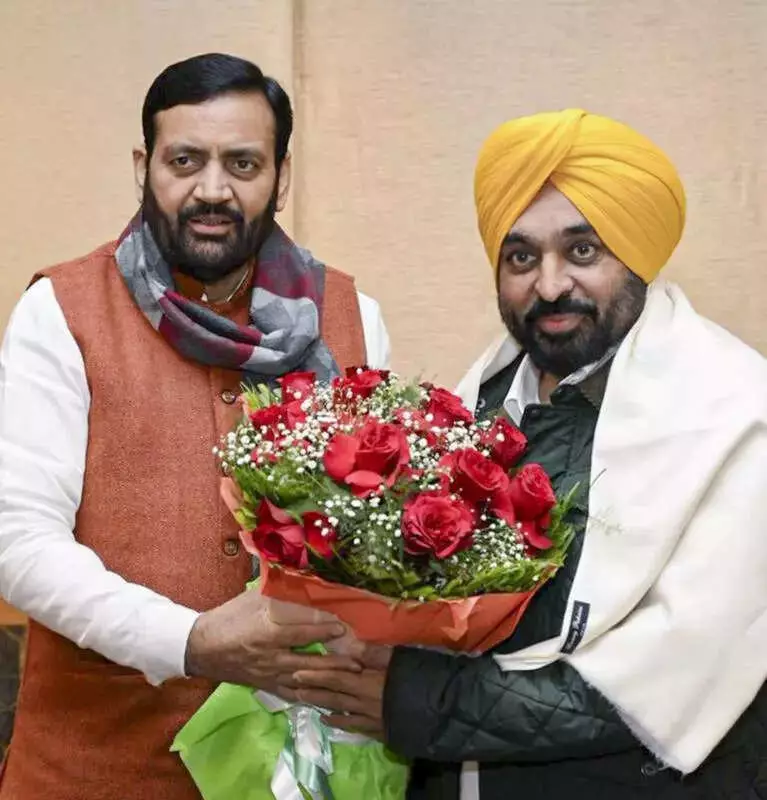
In a renewed effort to address the long-standing Satluj Yamuna Link (SYL) canal controversy, the chief ministers of Punjab and Haryana, Bhagwant Mann and Nayab Singh Saini, convened for another round of crucial discussions in Chandigarh on Tuesday. This meeting represents a significant step toward breaking the decades-long deadlock over water sharing between the two neighboring states.
Meeting Held in Cordial Atmosphere
The dialogue, which took place in a harmonious and positive environment, focused on finding an amicable solution to the contentious issue. Although the meeting remained inconclusive, both sides demonstrated a commitment to continued engagement by agreeing to maintain regular official-level talks. Senior officials from both states are scheduled to meet frequently to advance the discussions.
Key Participants and Supreme Court Directions
The chief ministers were accompanied by their respective irrigation and water resources ministers—Barinder Goyal from Punjab and Shruti Choudhary from Haryana—along with numerous functionaries from both governments. Also present were the advocate generals of both states, chief principal secretary to the Haryana CM Rajesh Khullar, Punjab chief secretary KAP Sinha, additional chief secretary of Haryana irrigation and water resources department Anurag Agarwal, and other senior officers.

This meeting was conducted following the directions of the Supreme Court, underscoring the judicial push to resolve the SYL canal issue. The 214-kilometer canal, of which 92 kilometers fall within Haryana, has been a source of tension between Punjab and Haryana for decades, primarily concerning the equitable distribution of river waters.
Statements from the Chief Ministers
Haryana Chief Minister Nayab Singh Saini emphasized the positive tone of the discussions, stating, "Today's meeting took place in a harmonious and positive environment. The way the meeting was held, we shall have good positive results. It was held on the directions of the apex court." He further invoked spiritual teachings, noting, "Punjab is the land of the Gurus. Guru Nanak Dev called ‘pavan' as guru, father to water and mother to earth. And this ‘baani' is our guiding force. His teachings are still precious gems for us."
Punjab Chief Minister Bhagwant Mann echoed this sentiment, affirming that the meeting was held in a good environment while reiterating the fraternal bond between the states. "Haryana is our brother and that we are guided by the teachings of our Gurus," he said. Mann also highlighted the global significance of water issues, adding, "Water became an important issue not just here, but this is a cause of concern across the world. We are moving forward to have meaningful solutions as well as conservation of water. Officers of both states will meet again on the need-based issues."
Focus on Water Distribution and Canal Construction
Addressing the core of the dispute, Mann reiterated Punjab's stance on the construction of the SYL canal. "What is the use of making a canal in the absence of adequate water to be released? It's better to have a water distribution compromise before the canal construction," he asserted. This statement underscores the state's priority on establishing a fair water-sharing agreement prior to any physical development of the canal infrastructure.
Path Forward and Ongoing Dialogue
The agreement to continue dialogue through regular official-level talks marks a proactive approach to resolving the SYL canal impasse. Both states have committed to engaging in need-based discussions, with officers set to reconvene to address specific issues. This ongoing engagement reflects a shared recognition of the urgency to find a sustainable solution to the water-sharing dispute, which has implications for agriculture, livelihoods, and regional harmony.
As Punjab and Haryana navigate this complex issue, the emphasis on spiritual guidance and brotherly relations provides a foundational framework for future negotiations. The involvement of top officials and adherence to Supreme Court directives further reinforce the seriousness with which both governments are tackling this decades-old challenge.