Punjab Government to Pursue Massive Water Royalty Claim Against Rajasthan
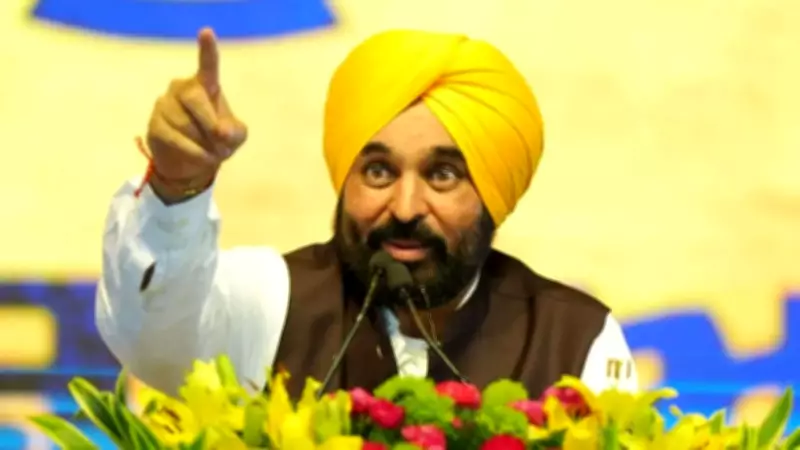
In a significant development regarding inter-state water disputes, Punjab Chief Minister Bhagwant Mann declared on Wednesday that his administration will formally seek royalty payments from the neighboring state of Rajasthan for water supplied over decades. The claim centers on an outstanding amount calculated at a staggering Rs 1.44 lakh crore, which has reportedly accumulated since 1960.
Historical Agreement Forms Basis for Royalty Demand
Addressing the media, CM Mann referenced a century-old tripartite agreement from 1920 that involved the British government, the state of Bahawalpur (now part of Pakistan), and the then Maharaja of Bikaner. This historical pact established the framework for Rajasthan to receive water through what is now known as the Rajasthan feeder canal.
"Rajasthan is currently receiving 18,000 cusecs of water through this system," Mann stated, emphasizing the ongoing nature of the water transfer. He clarified that the original 1920 agreement explicitly provided for a fee to be paid for the water supplied, establishing a precedent for royalty payments.

Six Decades of Unpaid Royalties
According to the Punjab chief minister, Rajasthan consistently paid the agreed-upon royalty until 1960. However, payments ceased after that year, and Punjab subsequently stopped demanding them. "Rajasthan paid royalty till 1960. But it stopped paying money thereafter, and Punjab also stopped demanding the same," Mann explained, as reported by news agency PTI.
The Punjab government has now meticulously calculated the unpaid amount, arriving at the figure of Rs 1.44 lakh crore. "We have worked out an outstanding figure of Rs 1.44 lakh crore, calculated at old rates, which is pending since 1960," Mann revealed. He pointed out that this calculation uses historical rates rather than current valuations.
Challenging Rajasthan's Continued Water Usage
Mann posed a direct challenge to Rajasthan's position, questioning why the state has continued to utilize Punjab's water resources without compensation for 66 years. "You (Rajasthan) are taking 18,000 cusecs of water from us. So why have you stopped paying money for 66 years?" he asked rhetorically.
The chief minister presented a clear ultimatum: "If they (Rajasthan) say there was no agreement with us, they should not take the water they are getting under the 1920 agreement." This statement underscores the connection between the historical pact and current water usage.
Formal Communications and Central Government Involvement
The Punjab government has initiated formal proceedings by writing to the Rajasthan government, seeking discussions to resolve the longstanding issue. Mann confirmed that "the 1920 agreement has not been terminated yet," indicating its continued legal relevance.
Beyond bilateral discussions, Punjab plans to escalate the matter to the national level. "We will demand royalty from Rajasthan," Mann asserted, adding that "Punjab would also take up the matter with the Centre," suggesting potential intervention by the central government in this inter-state dispute.
This development highlights the complex and often contentious nature of water sharing between Indian states, particularly when historical agreements intersect with modern governance and resource management. The substantial financial claim and the invocation of a century-old treaty add layers of legal and historical significance to what promises to be a closely watched inter-state negotiation.