

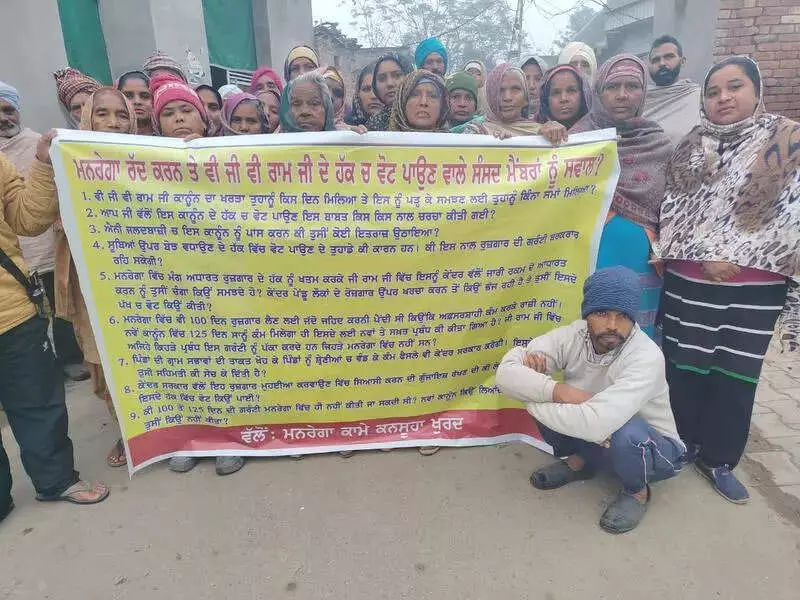
In a bold public move, workers and residents of Kansuha Khurd village in Punjab's Patiala district have directly challenged their local Members of Parliament for supporting the newly enacted VB-GRAM G rural employment legislation. The confrontation occurred on Saturday, just days before a crucial gram sabha meeting scheduled for January 6.
Nine Point Challenge to the MP
The villagers displayed a board with a set of nine pointed questions and also sent a formal letter containing the same to Union minister of state and Rajya Sabha MP Ravneet Singh Bittu. Bittu, who was elected unopposed to the Rajya Sabha from Rajasthan in a BJP ticket by-election last year, recently voted in favour of the Viksit Bharat – Guarantee for Rozgar and Ajeevika Mission (Gramin) law, which replaces the long-standing Mahatma Gandhi National Rural Employment Guarantee Act (MGNREGA).
The community demanded clear, written responses. They plan to formally raise these questions during the upcoming village council meeting, where they intend to record the collective view on the dismantling of MGNREGA. Labourers in the village expressed a profound sense of "deep unrest" and uncertainty about how their legal right to demand work will be affected under the new regime.

Key Concerns: Funding, Haste, and Autonomy
The villagers' questionnaire probes several critical areas. They asked how much time MPs had to study the bill before its passage, and which workers or panchayats were consulted in the process. A major point of contention is why such a significant law was approved "in haste" without wider village-level consultation.
One central worry is the shift in financial burden. Under MGNREGA, the Centre bore 100% of the wage cost and most material expenses. The new VB-GRAM G framework is a centrally sponsored scheme where states are expected to shoulder around 40% of the cost. The villagers questioned whether this signals an attempt by the central government to reduce its expenditure and shift the load onto already financially strained states.
"Why couldn't MGNREGA simply be amended to increase guaranteed employment from 100 to 125 days instead of being repealed entirely?" the villagers asked, highlighting their preference for reforming the old law over introducing a completely new one.
From Legal Right to Budget-Dependent Scheme
Residents linked their fears to existing problems in social security. Harpreet Kaur, a resident of Kansuha Khurd, pointed out that several elderly villagers had not received their old-age pensions for the past two months due to fund shortages.
"If pensions can stop when funds are short, what will happen to work for the poorest when employment too depends only on budget availability?" she questioned. This underscores the fundamental shift from MGNREGA's demand-based legal guarantee to VB-GRAM G's fund-based allocation system.
Other issues raised include the continued control of the Centre over fund allocations to states and districts, which villagers fear could lead to the politicisation of employment and worsen regional disparities. The questionnaire also criticised the dilution of gram sabha powers and an increased role for bureaucracy, arguing that administrative negligence was already a major cause of delayed work under MGNREGA.
Villagers Mobilise, Await Response
Villagers like Lakhveer Singh and Shingara Singh stated they have been actively discussing the implications of the new law and have participated in protests announced by workers' unions. They noted that apart from Ravneet Singh Bittu, very few MPs from Punjab appeared to have supported the VB-GRAM G law, which is why they chose to address their concerns directly to him.
They now await a point-by-point written reply. The original MGNREGA, enacted in 2005, guaranteed at least 100 days of wage employment per rural household on demand. The new VB-GRAM G law proposes to increase the guarantee to 125 days but changes the funding model to a "normative allocation" system, where the Centre sets expenditure ceilings for each state and prioritises works aligned with national development goals.

Critics, including labour organisations, argue the new framework weakens the justiciable right to work, recentralises financial control, and reduces the autonomy of Gram Sabhas in deciding local works. The stage is set for a decisive gram sabha on January 6, where the voices of Kansuha Khurd will seek official accountability.





