Rajasthan Budget 2026-27 Charts Course for 'Viksit Rajasthan' with AI and Infrastructure Focus
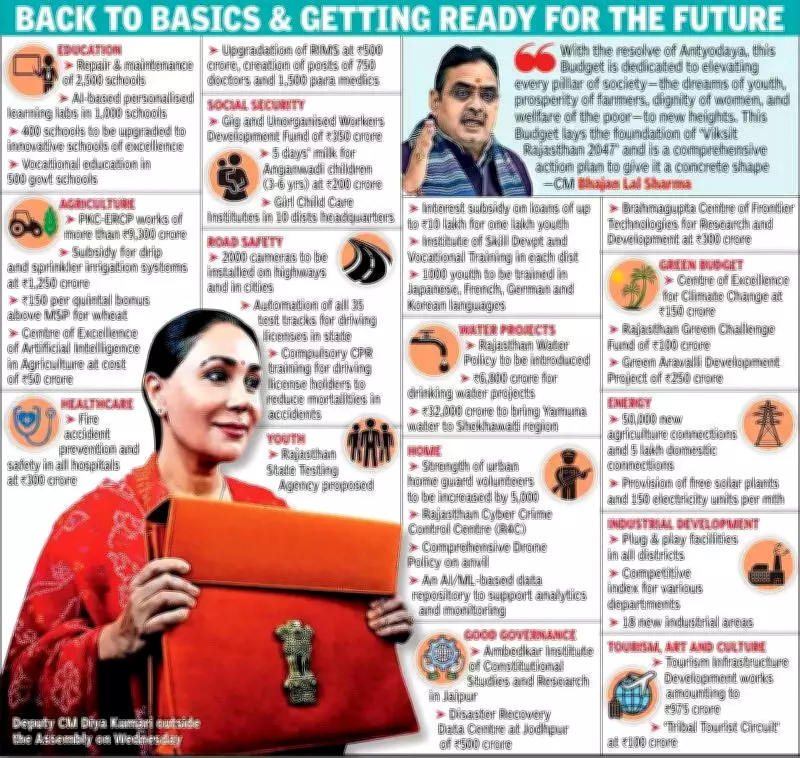
Jaipur witnessed a significant financial milestone on Wednesday as Deputy Chief Minister and Finance Minister Diya Kumari unveiled the state Budget for the fiscal year 2026-27. Anchored firmly in the vision of 'Viksit Rajasthan' (Developed Rajasthan), the Budget strategically channels investments into critical sectors including civic infrastructure, water security, energy systems, healthcare, and tourism, while placing fresh emphasis on artificial intelligence (AI) and startup-driven innovation.
Prudent Fiscal Management with Infrastructure Boost
Despite the state's stressed fiscal condition, which led to a deliberate avoidance of announcing large capital-intensive projects, the Budget underscores procedural reforms and capacity building as its central theme. In a bold move, capital expenditure has been pegged at Rs 53,978.41 crore, marking a substantial 36.9% increase over the previous year. This allocation reflects a strong commitment to infrastructure development while simultaneously extending welfare measures, such as enhanced pensions for senior citizens.
Urban Development and Civic Infrastructure Overhaul
Urban development emerges as a top priority in the Budget, addressing the growing challenges faced by major cities like Jaipur. These urban centers continue to grapple with congestion due to tourist inflows, rising vehicle density, and inadequate storm water drainage systems. To tackle these issues head-on, Rs 12,050 crore has been earmarked specifically for urban areas, with Rs 1,000 crore dedicated to Jaipur alone. This funding targets comprehensive improvements in sewerage, drainage, waste disposal, civic amenities, and mobility solutions, all supported by procedural reforms and technology interventions.

Healthcare and Education: Building Human Capital
The Budget delivers a significant boost to healthcare infrastructure, with allocations directed toward hospital upgradation, critical care blocks, and the expansion of district-level medical facilities. A notable investment of Rs 500 crore for the Rajasthan Institute of Medical Sciences will support the creation of 750 additional doctors and 1,500 paramedical personnel, addressing critical workforce shortages.
In the realm of education, the focus is on digital learning initiatives, skill development programmes, and the establishment of new techno hubs to empower youth. Approximately 40 lakh students will benefit from free uniforms, while meritorious students will receive support through Rs 20,000 e-vouchers. In response to the tragic school roof collapse in Jhalawar that claimed seven lives, the Finance Minister announced a renovation drive for 2,500 schools, backed by an expenditure of Rs 550 crore.
Water Security and Energy Initiatives
Ensuring access to clean water remains a cornerstone of the Budget. Under the CM Jal Jeevan Mission, Rs 6,800 crore has been proposed to provide tap water connections to both rural and urban populations. Additionally, Rs 4,500 crore is allocated for connecting villages to tap water, while Rs 2,300 crore will ensure drinking water supply in cities. On the energy front, Rs 3,000 crore has been earmarked for developing solar parks in Bikaner and Jaisalmer, promoting renewable energy sources.
Structural Reforms and Ease of Doing Business
Highlighting a shift toward structural reforms over traditional incentives, the Budget introduces the 'Once-Only Principle'. This innovative measure enables government departments to share data internally, allowing citizens and entrepreneurs to submit documents only once, thereby reducing compliance burdens. For investors, a 'One Application, One Digital Track' system will streamline approval processes, with physical inspections waived for low-risk projects. These reforms aim to digitize approvals, improve transparency, and rejuvenate both traditional and emerging industries.
Finance Minister Diya Kumari emphasized, "To realize the vision of a developed Rajasthan by 2047, our government, under the able leadership of Chief Minister Bhajan Lal Sharma, has prioritized service, dedication, and good governance, keeping in mind the important role of the poor, youth, farmers, and women in this development journey."

Tourism and Cultural Heritage Revival
Tourism receives a major push with the announcement of the Thar Cultural Circuit, backed by Rs 5,000 crore, designed to transform the desert region into a global hub. Ambitious plans include developing Khuri as an ultra-luxury Special Tourism Zone, reviving heritage sites like Khatu Shyamji and Pushkar, conserving 660 Shekhawati havelis, and establishing new cultural and convention centers such as the Braj Convention Centre in Bharatpur. Special measures will also enhance spiritual tourism, leveraging Rajasthan's rich cultural tapestry.
Support for Farmers and Entrepreneurs
Farmers are set to receive substantial relief, with Rs 25,000 crore allocated for interest-free short-term loans benefiting 3.5 million farmers, supported by an Rs 800 crore interest subsidy. The Mission Raj Gift initiative will ensure better prices for agricultural produce, complemented by mandi infrastructure upgrades. Modern farming facilities such as greenhouses, polyhouses, and shade nets will be subsidised with Rs 200 crore for 4,000 farmers, while Rs 350 crore will be spent on mandi sheds. Cooperative consumer stores will expand into new districts, and the non-farming sector will benefit from Rs 590 crore with a 5% interest subsidy, reaching 25,000 individuals.
To encourage entrepreneurship, the Budget announces interest-free loans and grants up to Rs 10 lakh, benefiting 30,000 youth, fostering a culture of innovation and self-reliance.