

Rajasthan Government Amends Excise Policy, Paving Way for Extended Liquor Shop Hours
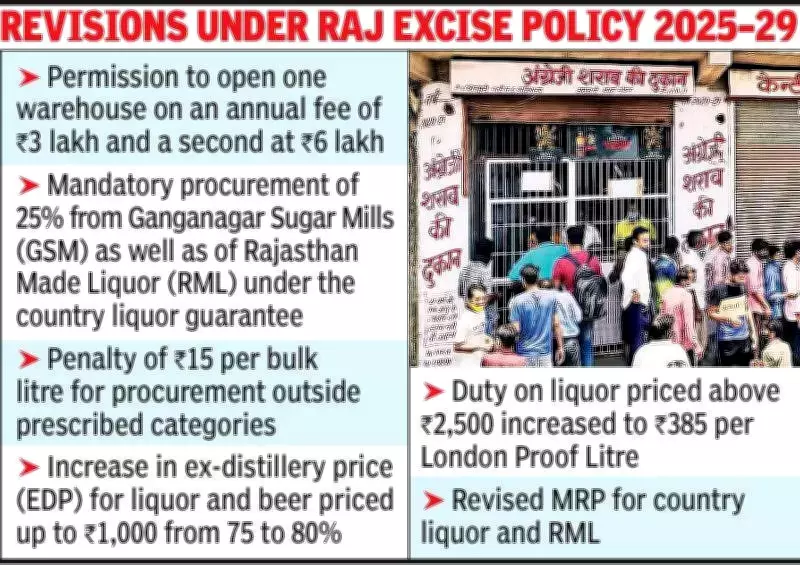
The Rajasthan government has introduced significant amendments to The Rajasthan Excise and Temperance Policy 2025–29, a move that is set to reshape the state's liquor retail landscape. Approved by finance secretary (revenue) Kumar Pal Gautam, these revisions primarily focus on extending operating hours for liquor shops across Rajasthan, alongside comprehensive changes in pricing, licensing, and operational guidelines.
Extended Operating Hours and Revised Pricing Structures
Under the newly amended provisions, the excise commissioner has been formally authorised to extend shop timings, with liquor outlets likely to be permitted to operate until 10pm. This marks a notable shift from previous restrictions, addressing long-standing demands from retailers. Concurrently, partial revisions have been implemented in excise duty on Indian Made Foreign Liquor (IMFL) and beer. According to sources within the department, these adjustments are expected to lead to an increase in liquor prices for consumers.
Retail rates for country liquor and Rajasthan Made Liquor (RML) have also been revised, with specific changes applied to the minimum and maximum prices for 180ml packs across various packaging formats. A senior excise official elaborated on the rationale behind these amendments, stating, "The amendments for the 2026–27 excise year aim to boost competitiveness and encourage capital investment without increasing liquor volume, in line with the state's temperance policy." This underscores the government's intent to balance revenue generation with responsible consumption measures.

New Provisions for Hospitality Sector and Licensing Fees
The revised policy introduces several relaxations and incentives for the hospitality industry. Hotel, restaurant, and club bar operators are now granted permission to set up microbreweries, accompanied by a 50% exemption in excise duty for the first two months of operation. This is designed to promote craft brewing and enhance tourism offerings.
Furthermore, the government has standardised licence fees for heritage hotel bars, categorising them based on room capacity. Properties with up to 10 rooms will pay Rs 3 lakh, those with 11–25 rooms will incur Rs 4 lakh, and hotels with more than 25 rooms will be charged Rs 5 lakh. These fees will be applicable in major tourism centres, including:
- Jaipur
- Jodhpur
- Udaipur
- Mount Abu and Abu Road
- Pushkar
- Sariska
- Bhiwadi
- Ranakpur Temple area
- Ranthambore
- Jaisalmer
- Kumbhalgarh
In other divisions and district headquarters, the licence fees will be Rs 1 lakh lower, providing some relief to establishments outside prime tourist zones.
Additional Regulatory Changes and Industry Response
The amended policy also prescribes an occasional licence fee of Rs 40,000 for registered commercial premises, with a penalty of Rs 50,000 for violations. Additionally, the excise commissioner has been authorised to decide on permitting Bottled in Origin (BIO) products in restaurant bars, potentially expanding the variety of alcoholic beverages available.
Other notable revisions include adjustments to the ex-distillery price (EDP) and ex-brewery price (EBP), along with amendments to maximum retail price mechanisms. In a move towards sustainability, environment-friendly aseptic brick packaging has been introduced for certain products. Concessional excise duty provisions have also been made for liquor supplied to Indian Army canteens, acknowledging their unique requirements.
The application fee for renewal of liquor shops has seen a significant increase. Shops with an annual value of up to Rs 2 crore will now pay Rs 60,000, while those above Rs 2 crore will pay Rs 1.20 lakh, compared to the previous flat rate of Rs 1 lakh. Despite these hikes, officials clarified that the policy does not permit any increase in liquor volume. The 12.5% increase in the guarantee amount for 2026–27 is viewed as reasonable, with the excise department expecting renewal of nearly 90% of liquor shops.

The president of the Rajasthan Liquor Welfare Association commented on the changes, stating, "We welcome the move as increasing shop timings has been our long-pending demand. However, we had sought renewal at a 10% increase. The 12% hike in the guarantee amount will certainly add to the financial burden on licensees." This highlights the mixed reactions from industry stakeholders, who appreciate the extended hours but express concerns over increased financial obligations.





