Rajasthan Cabinet Approves Sweeping Reforms: Two-Child Norm Scrapped for Local Elections
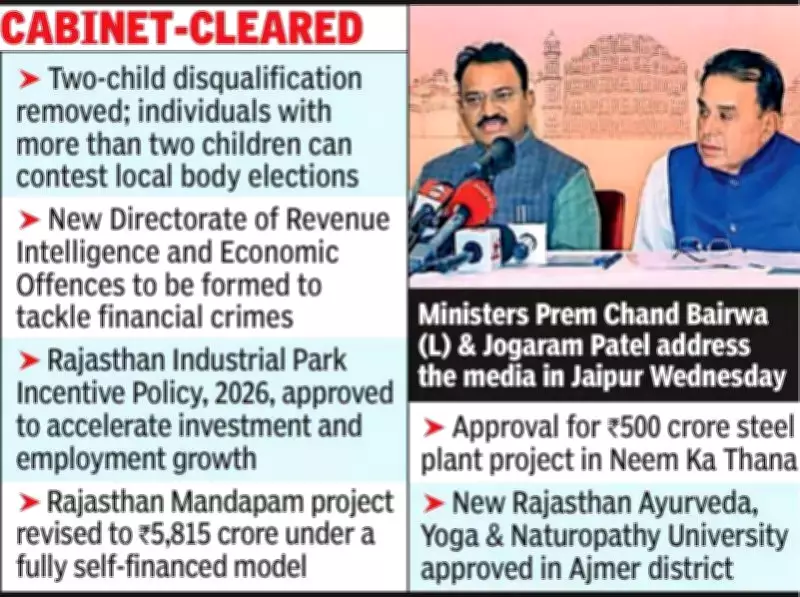
The Rajasthan Cabinet, in a significant meeting held on Wednesday, approved a series of major legislative amendments and policy decisions that are poised to reshape governance and economic development in the state. The most prominent change involves the removal of the long-standing two-child norm that previously barred individuals with more than two children from contesting elections for Panchayati Raj institutions and urban local bodies.
Legislative Amendments to Broaden Candidate Pool
The Cabinet cleared the Rajasthan Panchayati Raj (Amendment) Bill, 2026, and the Rajasthan Municipalities (Amendment) Bill, 2026. These bills specifically seek to modify Section 19 of the Rajasthan Panchayati Raj Act, 1994, and Section 24 of the Rajasthan Municipalities Act, 2009. The amendments are expected to be introduced in the state Assembly during the ongoing Budget session, with implementation likely ahead of the local body elections scheduled for March–April.
State parliamentary affairs and law minister Jogaram Patel explained the rationale behind this move to reporters after the cabinet meeting. "With this amendment, individuals with more than two children will now be eligible to contest Panchayati Raj and municipal elections," he stated. Patel highlighted that the two-child norm was originally introduced in the 1990s when population control was a critical national concern. "Between 1991 and 1994, the fertility rate was around 3.6. It has now declined to nearly 2. In the current scenario, the direct impact of such provisions is significantly reduced," he added, emphasizing the changed demographic landscape.
State industries and commerce minister Rajyavardhan Rathore also commented on the decision, noting that it reflects evolving social and demographic conditions. This policy shift is anticipated to substantially widen the pool of prospective candidates in both rural and urban constituencies, potentially increasing political participation and diversity in local governance.
New Directorate to Combat Financial Crimes
In another crucial decision, the cabinet approved the formation of a new Directorate of Revenue Intelligence and Economic Offences. This body is designed to intensify the crackdown on a wide range of financial crimes, including illegal land encroachments and fraudulent documentation practices. Deputy chief minister Prem Chand Bairwa announced that the existing State Revenue Intelligence Directorate will be dissolved and replaced by this new entity to ensure "better prevention of economic offences and improved financial discipline."
The directorate will have a broad mandate, targeting:
- Real estate fraud and illegal land transactions
- Financial crimes linked to banks, insurance companies, NBFCs, and the stock market
- Multi-level marketing scams and fraudulent bankruptcy cases
- Fake placement agencies and forged documents used for jobs or educational admissions
Industrial and Infrastructure Development Initiatives
The cabinet also focused on economic growth by approving the Rajasthan Industrial Park Incentive Policy, 2026. This policy aims to boost investment and employment across the state. Key provisions include:
- A minimum requirement of 50 acres and at least 10 industrial units for private parks
- A 20% capital subsidy, capped at Rs 20 crore for parks up to 100 acres, Rs 30 crore for 100–250 acres, and Rs 40 crore beyond 250 acres
- 50% reimbursement for Common Effluent Treatment Plant (CETP) expenditure, up to Rs 12.5 crore
Rathore detailed these incentives, stating they are designed to attract large-scale industrial projects and enhance the state's manufacturing capabilities.
Further infrastructure approvals included:
- A Rs 500 crore steel plant project in Neem Ka Thana, expected to create jobs and stimulate local industry
- A revised self-financed model for the Rs 5,815 crore Rajasthan Mandapam project in Jaipur, aimed at developing a major cultural and convention center
Advancing AYUSH Education and Medical Tourism
In the health and education sector, the cabinet approved the draft Rajasthan Ayurveda, Yoga and Naturopathy University, Ajmer Bill, 2026. This legislation paves the way for establishing a new university focused on AYUSH (Ayurveda, Yoga, Naturopathy, Unani, Siddha, and Homeopathy) disciplines. The university is intended to promote education, research, and medical tourism, addressing the current shortage of such institutions in the state. Rajasthan currently has only one Ayurveda university, located in Jodhpur.
These comprehensive decisions underscore the Rajasthan government's multifaceted approach to reforming electoral laws, strengthening economic oversight, fostering industrial growth, and enhancing educational infrastructure, setting the stage for significant developments in the coming months.