

Sacred Tree Sparks Political Storm in Rajasthan as BJP Government Faces Mounting Pressure
The Bhajan Lal Sharma-led Bharatiya Janata Party (BJP) government in Rajasthan is grappling with a significant political and environmental crisis following widespread protests against the large-scale felling of the khejri tree, revered as the state tree and considered sacred. The agitation, led by sadhus and the Bishnoi community, has forced the administration to reconsider its policies, with growing demands for a stringent Amrita Devi Act to protect desert trees.
Chief Minister's Response and Meeting with Protest Leaders
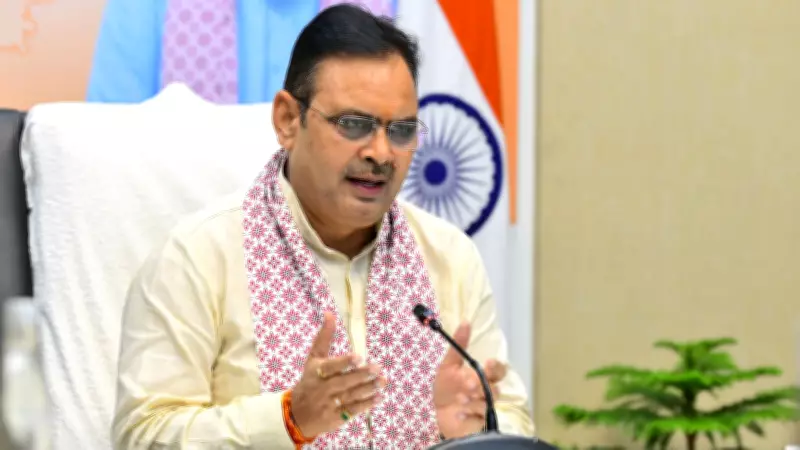
On February 5, 2026, Chief Minister Bhajan Lal Sharma announced plans to introduce a new law aimed at safeguarding the khejri tree, often referred to as kalpavriksha or the wish-fulfilling tree. This declaration came in response to escalating protests that began with a mahapadao on February 2 in Bikaner, approximately 275 kilometers northwest of Jaipur. The gathering, which included sadhus, Bishnoi community members, environmentalists, farmers, and local residents, expanded daily, spreading to neighboring districts and garnering cross-party support.
Three days after the announcement, Sharma met with a delegation of "revered saints and enlightened members of the Bishnoi community" at his residence. Photographs from the meeting showed the Chief Minister bowing before Ramanand Maharaj, the Pithadhishwar of Mukti Dham Mukam in Bikaner, who has emerged as a central figure in the agitation. The presence of saffron-clad sadhus lent a sacred character to the protests, emphasizing the cultural and spiritual significance of the khejri tree.

Demand for Amrita Devi Act and Historical Context
At the core of the protests is the call for an Amrita Devi Act, a specialized legislation to protect trees in Rajasthan, particularly desert species like khejri. This demand is rooted in a historical event from nearly 300 years ago when Amrita Devi Bishnoi of Khejarli village, along with her three daughters, sacrificed their lives to prevent the felling of khejri trees ordered by Marwar ruler Maharaja Abhay Singh for palace construction. In total, 363 Bishnoi community members were killed while hugging trees, an act that later inspired the Chipko Movement of the 1970s.
Swami Sachchidanand Acharya, a key leader of the campaign, welcomed the Chief Minister's announcement but urged immediate interim measures. He expressed concerns that the "tree mafia" is exploiting the delay by cutting trees secretly at night. Acharya demanded strict instructions to all district collectors to halt tree cutting until the law is enacted and enforced, vowing that the mahapadao would continue until such orders are issued. He also highlighted the need for the proposed law to categorize desert trees such as khejri, rohida, peepal, and bargad, which cannot be transplanted and take centuries to mature, with stringent penalties including imprisonment and heavy fines for violations.
Trigger of the Agitation and Government Missteps
The protests were ignited by a December 3 briefing by Law Minister Jogaram Patel on the Rajasthan Jan Vishwas Ordinance, which aims to promote "ease of living and ease of doing business" by decriminalizing provisions in 11 Acts, replacing imprisonment with monetary penalties. Patel stated that under the Rajasthan Forest Act, 1953, penalties for tree cutting were increased from Rs 100 to Rs 1,000 for first-time offenders, with doubled fines for repeat violations.
Acharya explained that this statement caused widespread bhranti (misunderstanding), as it gave the impression of weak penalties amid demands for stricter protection. The minister's failure to differentiate between general forest laws and specific protections for khejri trees, coupled with a lack of government clarification, allowed the message to spread rapidly, fueling public outrage.

Scale of Tree Felling and Environmental Impact
Estimates vary, but there is consensus that millions of khejri trees have been felled over recent decades. Independent MLA Ravindra Singh Bhati claimed in the Assembly that over 26 lakh khejri trees were cut in Jodhpur, Jaisalmer, Barmer, and Bikaner over the past 15 years. He warned that Rajasthan's state tree, along with its state bird (godawan) and state animal (camel), are on the verge of extinction.
Environment Science Professor Anil Kumar Chhangani of Maharaja Ganga Singh University, Bikaner, estimates that at least 50 lakh khejri trees have been felled in five western districts alone over the past decade. Citing a 1985 CAZRI study, he noted that khejri density ranges from 25–30 to about 150 trees per hectare across the state. The rise of solar plants and clearing of native vegetation has led to immediate loss of oxygen, increased temperatures, and collapse of agriculture, grazing, and biodiversity.
Congress MLA Rita Choudhary alleged that illegally felled khejri is sold at a mandi near the Haryana-Jhunjhunu border and transported across state lines, highlighting the commercial exploitation driving the crisis.
Spread of Protests and Government Actions
The agitation expanded through hunger strikes, kalash yatras by women, and support from groups like the ABVP. At its peak, over 500 people were on hunger strike, with several hospitalized. Protests spread to neighboring districts and states, including Hanumangarh, Sriganganagar, and Jalore. After ministers assured action, some protesters called off their hunger strikes, but confusion arose when the government restricted the ban on khejri felling to Bikaner and Jodhpur divisions, prompting demands for a statewide prohibition.
As of Tuesday, the protest continues, with disappointment growing among participants. Acharya remarked, "The axes of the woodcutters are heavy, but our heads are more in numbers... Whatever CM saheb has given, it's not much, it's just a little bit."
Cross-Party Support and Political Implications
Former Chief Minister Ashok Gehlot described the agitation, following earlier protests over the Aravallis, as an "auspicious sign," calling the felling of khejri trees "heartbreaking" and emphasizing the need to balance development with nature conservation. Former CM Vasundhara Raje also extended support, stating, "Khejri is not an ordinary tree; it is sacred and worshipped. Rising above politics, we must protect it."
Rashtriya Loktantrik Party (RLP) chief Hanuman Beniwal highlighted that khejri is "the environmental cornerstone of the desert," vital for biodiversity and rural livelihoods. With pressure mounting across party lines, it remains to be seen whether the Sharma government will table a dedicated Khejri protection Bill in the ongoing Assembly session, as the BJP navigates this environmental and political challenge.





