Rajasthan's Capital Spending Trails Major States, Raising Infrastructure Concerns
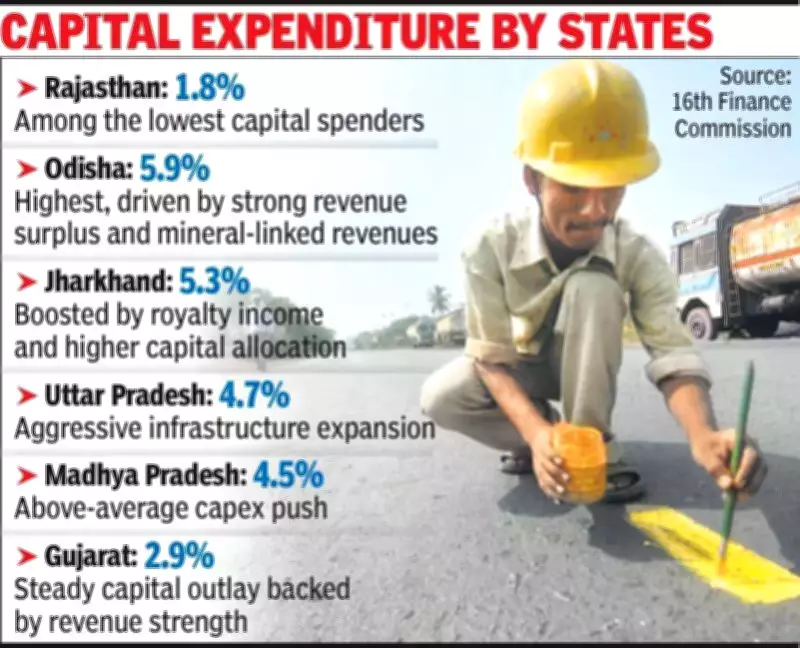
Jaipur: Rajasthan's capital expenditure continues to lag significantly behind several large Indian states, sparking serious concerns about the pace of infrastructure creation in one of the country's largest and fastest-urbanizing regions. According to the 16th Finance Commission's assessment, Rajasthan allocated a mere 1.8% of its Gross State Domestic Product (GSDP) to capital expenditure during the 2023-24 fiscal year, placing it among the lowest performers among major non-North-Eastern Hill states.
Stark Contrast with Better Performing States
The disparity becomes particularly evident when comparing Rajasthan's performance with other states. Odisha led the pack with an impressive 5.9% of GSDP allocated to capital expenditure, followed closely by Jharkhand at 5.3%. Uttar Pradesh and Madhya Pradesh also demonstrated stronger commitments, allocating 4.7% and 4.5% of their respective GSDPs to capital spending during the same period. These higher allocations reflect a sharper focus on critical infrastructure development including roads, water systems, power infrastructure, and industrial expansion.
Underlying Fiscal Challenges
Financial analysts point to deeper fiscal mismanagement as the root cause of Rajasthan's capital expenditure challenges. The state's revenue deficit climbed to 2.6% of GSDP in 2023-24, significantly limiting fiscal space for long-term capital creation. This deficit situation forces the state government to direct a larger share of available resources toward recurring expenses such as salaries, pensions, and subsidies rather than building productive assets that could support sustainable long-term economic growth.

The Finance Commission specifically noted that persistent revenue deficits inevitably "crowd out capital expenditure", a trend clearly visible in Rajasthan's current fiscal constraints. Even the central government's push through the Special Assistance to States for Capital Investment (SASCI) scheme failed to yield proportionate results in Rajasthan. While several states demonstrated strong correlations between interest-free loans and expanded capital outlay, Rajasthan's capital expenditure growth remained notably muted compared to its peers.
Success Stories from Other States
By comparison, states like Odisha and Gujarat have demonstrated how disciplined revenue management can effectively free up resources for infrastructure development. Odisha, which maintained a consistent revenue surplus, emerged as one of the strongest performers in capital spending, channeling nearly 6% of its GSDP into long-term assets during 2023-24. Gujarat similarly paired revenue surpluses with steady infrastructure expansion, recording approximately 2.9% of GSDP in capital outlay during the same period.
Unique Challenges and Future Implications
Rajasthan officials have pointed to unique pressures facing the state, including its vast geographic expanse, scattered population distribution, and high subsidy commitments. However, economic analysts warn that comparatively low capital spending could seriously hinder Rajasthan's growth momentum, particularly at a time when neighboring states are preparing aggressively for industrial investment and urban expansion.
With the Finance Commission pushing states for "greater expenditure discipline", Rajasthan now finds itself at a critical crossroads. The state must address its fiscal challenges and prioritize capital expenditure to avoid falling further behind in infrastructure development, which is crucial for supporting its rapidly growing urban population and attracting industrial investment in the competitive Indian economic landscape.