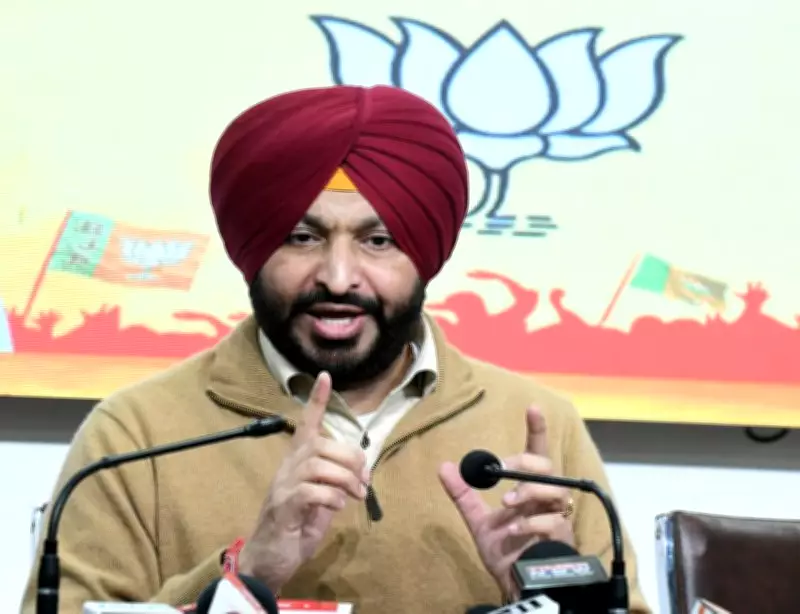
Union Minister Ravneet Singh Bittu, grandson of assassinated former Punjab Chief Minister Beant Singh, has broken his silence on the controversy surrounding the Diljit Dosanjh-starrer 'Satluj', which was removed from OTT platform ZEE5 amid allegations by Punjab's ruling Aam Aadmi Party that Bittu engineered its removal.
Bittu Defends Grandfather's Legacy
In an exclusive interview with The Tribune, Bittu did not directly address the AAP's charge but defended his grandfather's legacy, arguing that the movie offers a 'one-sided narrative' of Punjab's militancy years. 'Punjab deserves the whole truth, not half the story,' Bittu said.
He said any honest reckoning with the period must account for the violence unleashed by militant groups, not only the actions of the state. The third-generation Congressman, who switched to the BJP ahead of the 2024 Lok Sabha elections and unsuccessfully contested from Ludhiana, said the film's treatment of the period skirted the full complexity of what Punjab went through in the 1980s and early 1990s.

Question on Khalra's Case
Bittu pointed to human rights activist Jaswant Singh Khalra, whose disappearance and killing remain central to the film's narrative. He questioned why Khalra was able to continue his work and travel abroad during Beant Singh's tenure if the government was suppressing dissent as depicted. 'That question also deserves an honest answer,' he said.
Militancy Has No Religion
The Union Minister was emphatic that militancy could not be tied to any single community or faith. 'Militancy has no religion. Violence should never be associated with any faith or community,' he said, adding that the weapons militants carried were not meant for peaceful protest. 'Those weapons were used against police personnel, public servants, elected representatives, and countless innocent civilians. We must remember all the victims, not just a selected few.'
Beant Singh's Mandate: Restoring Peace
Bittu said his grandfather's government had a singular early mandate: restoring peace after years of bloodshed, before it could turn to governance. 'Beant Singh inherited a Punjab that was bleeding. His government's stated objective was to restore law, order, and normalcy so that ordinary people could live without fear,' he said, adding that his legacy ought to be judged 'in the full context of that period.'
He noted that security measures were paired with a democratic revival, citing the conduct of panchayat and local body elections as a deliberate effort to return power to the grassroots. 'Peace is not restored by security measures alone,' he said.
Allegations of Atrocities Require Scrutiny
On allegations of atrocities during the period, including against women, Bittu said such claims required scrutiny. 'Any allegation of widespread atrocities... should be backed by credible evidence and verified records. History should be discussed with facts, not assumptions,' he said.
Legacy of Violence
Bittu said the toll of the militancy years went beyond the loss of lives. 'What did years of militancy ultimately leave Punjab with? Thousands of lives lost, families destroyed, businesses ruined, investment driven away, economic hardship, and a generation that paid an enormous price,' he said.
Drawing a parallel with present-day anxieties over gangsters targeting ordinary citizens, he said the fear during the militancy era was of a far greater magnitude. 'Punjab cannot afford to return to any form of violence,' he said.
Direct Question to Film's Defenders
Turning the debate back on the film's defenders, Bittu posed a direct question: 'My simple question is: Do you support Khalistan today? If the answer is no, then we should also reject the violence that was carried out in its name and work together for Punjab's future.'
He cautioned against nostalgia clouding memory. 'It is easy to romanticise the past once peace has returned. But those who lived through those years remember the fear, uncertainty, and daily violence,' he said.
Real Tribute to Punjab
Asked what he considered the appropriate way to remember the period, Bittu said Punjab's real tribute lay in preventing a recurrence, not in dramatising it. 'The real tribute to Punjab is not to glorify conflict, but to ensure that such a chapter never repeats itself,' he said.

He said the debate over the film should not distract from the state's more pressing needs. 'The future of Punjab should be built on jobs, education, and stability, not on reopening old wounds. We can debate history, but we must never glorify violence. The real victory for Punjab was the return of peace and democracy.'