As assembly elections draw near, the ruling Aam Aadmi Party (AAP) in Punjab faces growing unrest among state employees and pensioners, a challenge that could influence electoral outcomes. Recent police action against apprentice linemen has intensified the situation, drawing sharp criticism from opposition parties.
Police Action Sparks Outrage
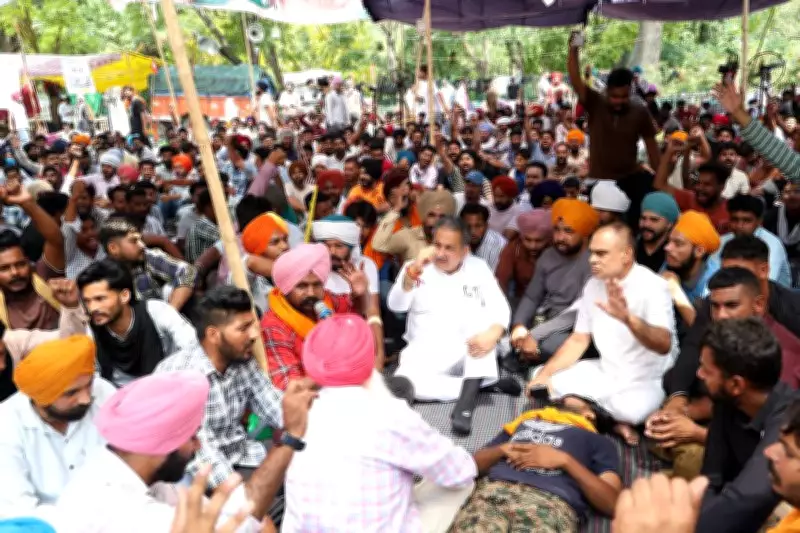
On June 5, the Patiala police resorted to a lathicharge on protesting members of the Apprenticeship Linemen Union, who were attempting to block the entrance to the Punjab State Power Corporation Limited (PSPCL) office to escalate their agitation over recruitment demands. An FIR was also registered against the protesters, prompting opposition parties to attack the AAP government over the incident.
Electoral Weight of Employee Discontent
Every five years, as elections approach, the discontent of nearly 3.50 lakh state employees and 3 lakh pensioners spills onto the streets. Their anger carries significant electoral weight, with each employee or pensioner influencing at least two eligible voters within their family—a fact no political party can afford to ignore.

Government's Response
In response to mounting protests, the AAP government has begun addressing three key long-pending demands: unpaid arrears of dearness allowance (DA), restoration of the Old Pension Scheme (OPS), and permanent appointment of outsourced and contractual staff.
Finance Minister Harpal Singh Cheema, who heads the Cabinet sub-committee looking into these issues, stated that the government is taking up all concerns one by one and seeking an amicable solution. He noted that the government inherited unpaid arrears, a large workforce of contractual employees, and precarious finances from previous administrations, but the AAP regime is committed to righting historic wrongs while improving fiscal health.
Steps Taken
The matter of DA payment is still pending before the Punjab and Haryana High Court, where the government may seek staggered clearance of dues. Meanwhile, Chief Minister Bhagwant Mann has addressed the regularisation of services for 65,000 employees across 51 departments. On May 30, the Punjab Cabinet approved two ordinances: The Punjab State Outsourced Personnel (Transition to Contractual Engagement) Bill, 2026, and the Punjab Contractual Personnel (Absorption Against Sanctioned Vacancies) Bill, 2026.
Within five days, a seven-member officers' committee was constituted to update data on outsourced employees, finalise a categorisation format, and calculate total vacant sanctioned posts. According to orders issued by Chief Secretary KAP Sinha on June 5, the committee must submit its report on categorisation by June 12, with a deadline of June 19 for compiling all eligible employee data.
Under the proposed framework, outsourced employees in Group C and D categories who have worked for five years (or three years for hazardous jobs like linemen, safai karamcharis, and firefighters) will be moved to contractual employment. After serving 10 years as contractual employees, they can be regularised against sanctioned posts. The committee will also examine immediate regularisation for those already working as contractual employees for over 10 years. The ordinances must be tabled in the Vidhan Sabha for passage before becoming law.
Employees Remain Restive
Despite these measures, employees remain sceptical. Sukhchain Khera, a leader of the Sanjha Mullazam Manch, an umbrella body of several employee unions, accused the government of dilly-dallying on paying pending arrears, citing lack of funds. He questioned why the government has money for free power subsidies and doles for women but not for employee dues.
The lack of faith in the new regularisation policy stems from past failures. In 2016, the SAD-BJP government enacted the Punjab Ad hoc, Contractual, Daily Wage, Temporary, Work Charged and Outsourced Employees' Welfare Act, which provided a framework for regularisation after three years of continuous service. However, legal disputes and other challenges hampered its implementation. In 2021, under the Congress government led by Captain Amarinder Singh and later Charanjit Singh Channi, another regularisation framework was introduced, but employee organisations argued it was restrictive and inadequate.

When AAP assumed power in 2022, it promised a more comprehensive solution. However, it has so far failed to allay the fears of employees, who continue to protest as elections approach.