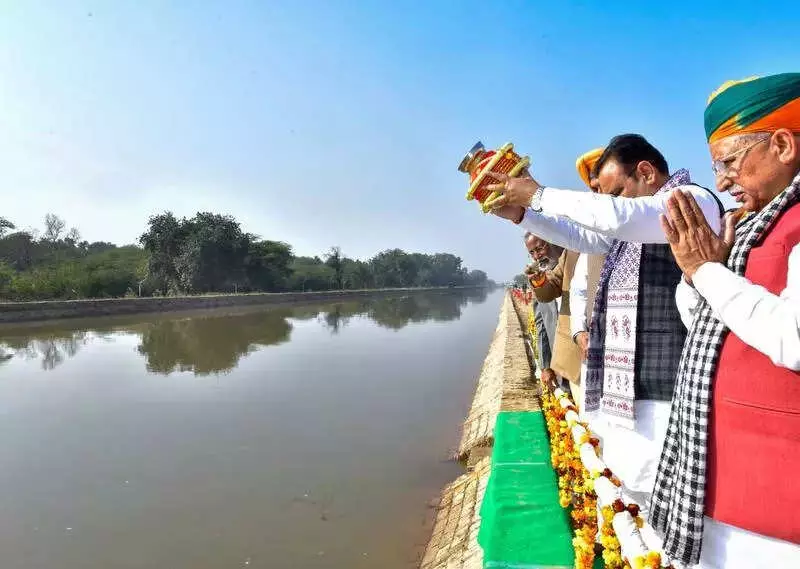
In a significant move for Rajasthan's agriculture, Chief Minister Bhajan Lal Sharma laid the foundation stone on Friday for a massive modernization project of the historic Gang Canal system. The ceremony in Sriganganagar marked exactly a century after the original foundation stone was laid by Maharaja Ganga Singh of Bikaner on December 5, 1925.
A Century-Old Lifeline Gets a Modern Makeover
The centerpiece of the new initiative is the Rs 670 crore upgrade of the Ferozpur feeder, a crucial channel that supplies water to vast agricultural belts in north Rajasthan. This project is part of a broader Rs 1,717 crore investment into the region's canal system announced by the Chief Minister. A separate Rs 300 crore restoration of the Bikaner Canal is also planned, which will directly benefit lakhs of farmers.
The ambitious plan aims to future-proof one of north India's most vital irrigation networks. The first phase, involving Rs 695 crore, will automate irrigation across 3.14 lakh hectares, promising greater efficiency and enhanced farm productivity. The entire project is targeted for completion in October 2027, coinciding with the 100th anniversary of the Gang Canal's inauguration.

Boosting Capacity and Harnessing Water
The reconstruction, a joint undertaking with Punjab, is expected to transform irrigation in the arid zones of Rajasthan. Once finished, the Ferozpur feeder's carrying capacity will see a substantial jump from 9,000 cusecs to 13,842 cusecs. This upgrade will enable the state to deliver an additional 4,000 cusecs of water to farmers in Sriganganagar and Hanumangarh districts.
A key objective is to allow Rajasthan to capture and store surplus monsoon water that currently flows unused toward Pakistan. This enhanced capacity will significantly improve water security and irrigation coverage across nearly 3.14 lakh hectares of farmland, providing a major boost to the region's agricultural backbone.
Honouring a Historic Struggle Against Drought
The current project pays homage to a century-old struggle led by Maharaja Ganga Singh. The canal's conception was a direct response to the catastrophic famine of 1899-1900. Historian Nitin Goyal of the Oriental Research Institute, Bikaner, notes that between 1905 and 1925, the Maharaja made relentless appeals to the British government, arguing that without irrigation, his state faced inevitable ruin.
His persistence finally led to a landmark tripartite agreement in 1925 between Bikaner, Bahawalpur (now in Pakistan), and Punjab. The path was fraught with challenges: strong opposition from Punjab and Bahawalpur, technical skepticism about carrying water over long distances to arid Bikaner, bureaucratic delays, and the disruptions of World War I. The canal finally became functional in 1927, despite protests in Punjab over water-sharing terms.
A hundred years later, the state government's reconstruction effort seeks to honour that legacy of perseverance. It aims to equip Rajasthan's farmers with a modern, robust irrigation system capable of meeting the challenges of the future, ensuring the prosperity of the next generation of agriculturists.