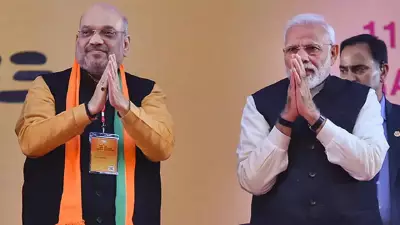
Political temperatures soared across India as Union Home Minister Amit Shah and West Bengal Chief Minister Mamata Banerjee engaged in a fierce verbal duel, setting the stage for the high-stakes West Bengal Assembly elections in 2026. The exchange, which also touched upon the upcoming Brihanmumbai Municipal Corporation (BMC) polls, unfolded in the public domain on December 30, 2025.
War of Words Escalates Ahead of Electoral Battles
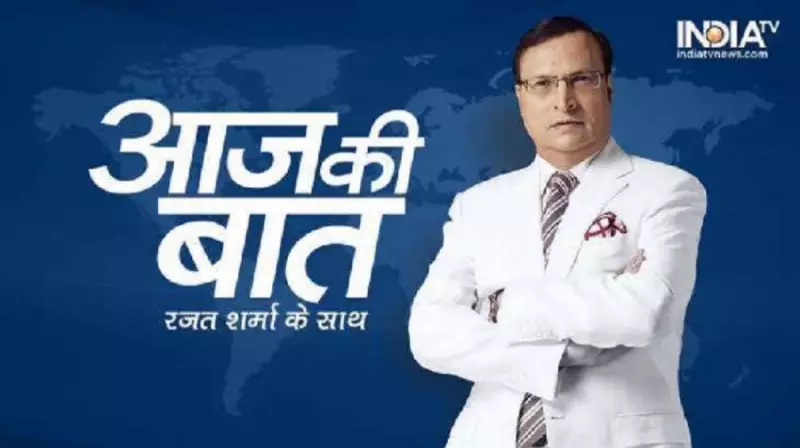
The political skirmish was a central feature of the day's news cycle, prominently discussed on India TV's flagship program 'Aaj Ki Baat'. Amit Shah, a senior Bharatiya Janata Party (BJP) leader, launched a scathing critique of Mamata Banerjee's Trinamool Congress (TMC) government in West Bengal. He accused the state administration of deep-rooted corruption, political violence, and stalling central welfare schemes meant for the poor.
In her characteristic fiery riposte, Chief Minister Mamata Banerjee dismissed Shah's allegations as politically motivated rhetoric ahead of elections. She countered by accusing the BJP-led central government of financial discrimination against non-BJP ruled states like West Bengal and undermining India's federal structure. Didi, as she is popularly known, asserted her government's commitment to development and social welfare, challenging the BJP's narrative.

BMC Elections and National Political Undertones
The political crossfire was not limited to Bengal. The leaders also traded barbs over the impending Brihanmumbai Municipal Corporation (BMC) elections in 2026. The BMC, India's richest municipal body, is a crucial prize for any political party. Amit Shah expressed confidence in the BJP's prospects in Mumbai, linking local governance issues to national performance.
Mamata Banerjee, a key figure in the opposition bloc, used the opportunity to highlight issues of urban governance, civic amenities, and the need for strong regional voices to counter the BJP's dominance. This extension of the debate to Mumbai underscored the national implications of the clash, framing it as a precursor to broader political confrontations.
Implications for the 2026 Electoral Landscape
The sharp exchange between two of India's most prominent political heavyweights signals the official commencement of a highly charged campaign season. The West Bengal elections in 2026 are seen as a critical battleground where the BJP aims to expand its footprint in the east, and the TMC fights to retain its fortress.
Analysts view this war of words as a strategy to solidify respective voter bases. For the BJP, the focus is on portraying the TMC government as inefficient and corrupt. For Mamata Banerjee and the TMC, the counter-strategy revolves around Bengali pride, federal rights, and showcasing state-level achievements. The outcome in Bengal is likely to have significant reverberations on the national opposition's morale and cohesion.
Similarly, the mention of the BMC elections indicates that national parties will frame local civic issues within larger national debates, making every municipal contest a high-profile affair. The political discourse established in episodes like this one on December 30th is expected to define the narrative for the coming months, keeping both political cadres and the electorate on tenterhooks.