

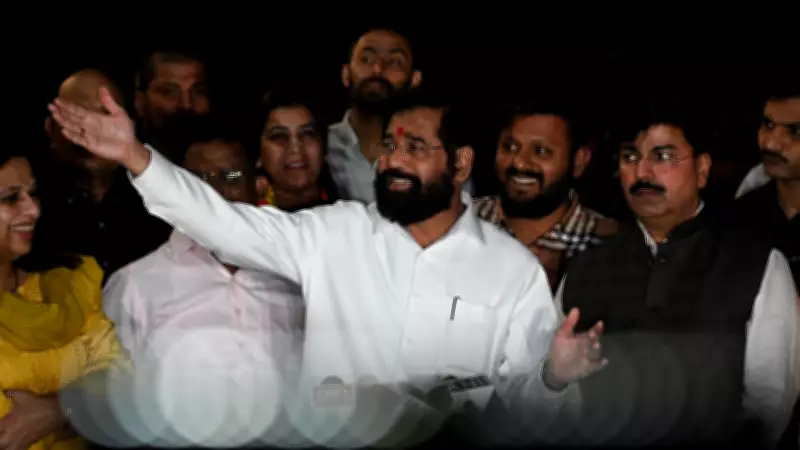
Eknath Shinde's Strategic Push to Build Shiv Sena's Rural Foundation in Maharashtra
In a significant political maneuver, Maharashtra Deputy Chief Minister and Shiv Sena chief Eknath Shinde has embarked on an intensive campaigning spree ahead of the Zilla Parishad and Panchayat Samiti elections scheduled for Saturday across 12 districts. Over the past five days, Shinde addressed an impressive 22 rallies in regions including Sangli, Kolhapur, Satara, and Chhatrapati Sambhajinagar, signaling a determined effort to fortify the party's rural infrastructure.
Addressing a Structural Weakness
Despite establishing itself as the dominant Sena faction with 57 MLAs and control over several municipal corporations in alliance with the BJP, the Eknath Shinde-led Shiv Sena faces a critical organizational gap. The party has historically relied heavily on its urban strongholds and legislative representatives, with its rural network remaining uneven and undergoing reconstruction following the 2022 split.
"Building the Sena's rural backbone is of utmost importance," revealed a party insider, highlighting the strategic imperative behind Shinde's recent blitz. This push is particularly notable because these local body elections are not statewide and are being held in districts that have traditionally not been the Sena's primary battlegrounds.

Beyond Immediate Elections: Preparing for 2029
Senior Sena leaders have clarified that this campaign transcends the immediate Zilla Parishad polls. "This is not just about Zilla Parishads. It is preparation for 2029," stated a senior party figure, referring to the upcoming Assembly and Lok Sabha elections. By winning these rural bodies, the party aims to embed itself deeply within village communities, expand its grassroots base, and enhance its bargaining power within the ruling Mahayuti alliance.
At rallies in Sangli and Kolhapur, Shinde emphasized the need for broader geographical presence. "We are a workers' party. There is no owner here. Every village must have our presence," he declared in Kolhapur, urging party workers to look beyond the Mumbai Metropolitan Region.
Strategic Calculations and Alliance Dynamics
The campaign's tone suggests more than mere alliance arithmetic is at play. Sena leaders acknowledge that strengthening the party's rural footprint is crucial for negotiating from a position of organizational depth rather than relying solely on legislative numbers. "This is about showing that Sena is not limited to Mumbai and Thane. We want to become the second-largest force in the state after the BJP," explained a senior leader.
The timing appears opportune, with the Congress weakened in several districts and the NCP divided between the Ajit Pawar and Sharad Pawar factions. This political fragmentation has created space in rural Maharashtra that the Sena believes it can effectively occupy.
Contrast with Sena (UBT) and Historical Context
In contrast, Uddhav Thackeray's Sena (UBT), which retains legacy support and emotional capital in urban centers like Mumbai, has not matched Shinde's statewide campaign intensity. For Sena (UBT), Zilla Parishad elections are not currently existential, as its strongest base remains urban, particularly evidenced by retaining 65 seats in the recent Brihanmumbai Municipal Corporation elections.
Historically, the undivided Shiv Sena was predominantly an urban force, strongest in Mumbai, Thane, and parts of Konkan and Marathwada. It was only in the 1990s, after consolidating control over the BMC, that founder Bal Thackeray aggressively pursued rural expansion under the slogan "Gaav tithe shakha" (there should be a Sena branch at every village of Maharashtra).
Shinde's current campaign echoes this historical logic. At one rally, he invoked Bal Thackeray's vision, stating, "Ghar tithe Shiv Sainik, gaav tithe shakha" (a Shiv Sainik in every home, a Sena unit in every village).
The Larger Political Vision
For Shinde, Saturday's elections represent more than just seat counts. Party leaders describe this as the "second phase" of the Sena's rural expansion, now under new leadership. The Deputy CM's legislative dominance has been secured, urban consolidation is underway, and rural expansion represents the next strategic frontier.

The fight for 731 Zilla Parishad seats across 12 districts is fundamentally about reshaping the party's structural identity. The ultimate goal is to ensure that when the 2029 Lok Sabha and Assembly elections arrive, the Shiv Sena name in villages is primarily associated with Eknath Shinde's faction, solidifying its position as a comprehensive state-level political force.





