

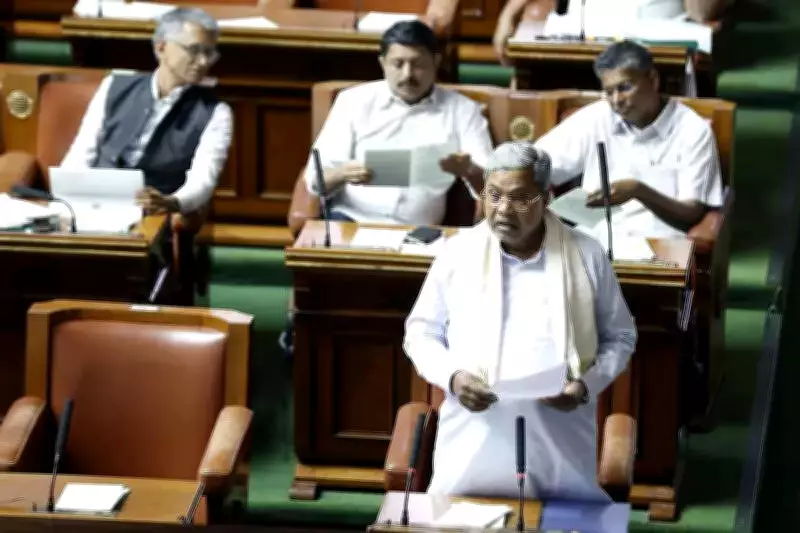
Siddaramaiah Defends Karnataka's Fiscal Management Amid Centre Fund Dispute
In a unique educational session on Monday, Karnataka Chief Minister Siddaramaiah assumed the role of a teacher to elucidate the intricacies of state budgets to legislators. However, the workshop swiftly transformed into a robust defense of his record 17th state budget, presented just last week. Siddaramaiah emphasized the state's fiscal discipline while launching sharp accusations against the central government for withholding crucial funds.
Opposition Absence and Legislative Engagement
As anticipated, opposition MLAs largely boycotted the event, with only two BJP rebels in attendance. In contrast, approximately 80% of the governing Congress legislators participated actively. The discussion veered away from technical budget aspects, with several lawmakers posing pointed questions about the recent budgetary allocations and their implications.
Deficit Budget and GST Impact
Siddaramaiah defended Karnataka's decision to present a deficit budget for 2026-27, attributing it directly to the non-release of funds owed by the central government. He admitted that while the state budget has expanded to Rs 4.48 lakh crore, the government could not fully execute the expenditure proposed in the previous fiscal year. "We were forced to present a deficit because funds from the Centre did not arrive," he stated unequivocally.

Highlighting the adverse effects of the Goods and Services Tax (GST), Siddaramaiah revealed a significant slowdown in state tax revenue growth. "Before GST, our tax revenue grew by 10% every year. After GST, it dropped to 4%," he explained, underscoring the fiscal strain imposed by the tax reform.
Fiscal Responsibility and Debt Concerns
Referring to the Fiscal Responsibility and Budget Management Act norms, Siddaramaiah outlined that sound finances require a state to maintain a revenue surplus, keep fiscal deficit within 3%, and limit debt to 25% of the Gross State Domestic Product (GSDP). He noted that Karnataka's GSDP stands at approximately Rs 33.5 lakh crore.
Addressing criticism over escalating state debt, Siddaramaiah countered opposition allegations. "These days, the opposition often alleges that Siddaramaiah has taken excessive loans and that the state is running on debt… But I have strived to maintain financial discipline," he asserted. He pointed out that Karnataka enjoyed a revenue surplus until 2018 but faced a deficit after GST compensation from the Centre concluded in 2022.
Revenue Deficit and Central Fund Shortfalls
Siddaramaiah provided specific figures to illustrate the fiscal gap: for 2025-26, the revenue deficit was around Rs 19,000 crore, and for the upcoming year, it is projected to be about Rs 22,000 crore. He argued that timely release of central funds could have eliminated this deficit entirely.
Citing the Jal Jeevan Mission as a case in point, Siddaramaiah detailed the funding imbalance. The scheme's estimated cost is Rs 69,000 crore with a 50:50 funding split between the state and Centre. "So far, the Centre has paid only Rs 11,000 crore, while we have already spent more than Rs 27,000 crore. Essentially, we have borne the Centre's share," he lamented.
Tax Contribution and State Share Disparity
In a striking comparison, Siddaramaiah highlighted the inequity in tax distribution. Karnataka contributes over Rs 4.5 lakh crore in taxes to the central exchequer but receives only around Rs 73,000 crore in return. "This means that for every Re 1 Karnataka contributes, only about 15 paise comes back to the state, while 85 paise remains with the Centre. This is not a political statement; several states face similar injustice," he concluded, framing the issue as a broader systemic concern beyond partisan politics.






