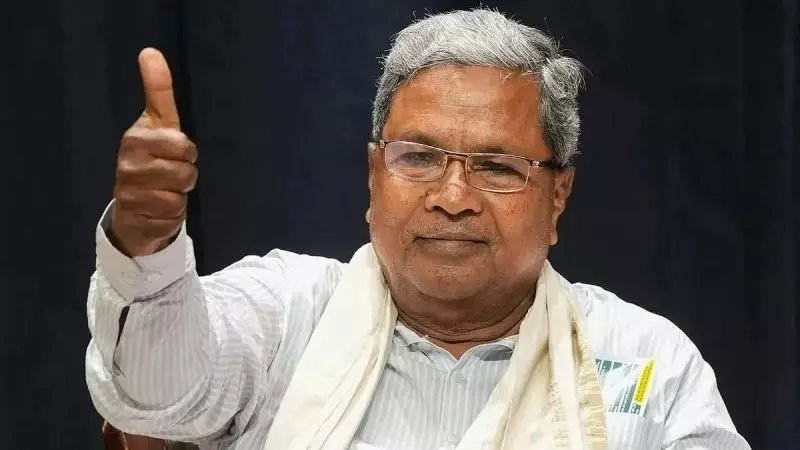
Karnataka's political landscape witnessed a sharp escalation in rhetoric as Chief Minister Siddaramaiah launched a scathing attack on Janata Dal (Secular) leader and former CM H D Kumaraswamy. The Congress leader labeled Kumaraswamy a 'Manuvadi' during a heated exchange centered on the sensitive issue of reservation policies.
The Spark: Kumaraswamy's Reservation Remarks
The political firestorm was ignited by comments made by H D Kumaraswamy. The JD(S) leader, who has recently allied with the Bharatiya Janata Party (BJP) at the national level, expressed concerns regarding the potential impact of the Congress government's initiatives on the existing reservation system in Karnataka. His statements suggested that the current administration's policies could disturb the delicate balance of the quota structure.
These remarks did not sit well with Chief Minister Siddaramaiah, who is known for his staunch advocacy for social justice and the rights of backward classes. The CM interpreted Kumaraswamy's comments as an attempt to safeguard the interests of dominant castes at the expense of marginalized communities.
Siddaramaiah's Fierce Retort: The 'Manuvadi' Accusation
Responding with vigor, Siddaramaiah did not mince his words. He accused Kumaraswamy of harboring a 'Manuvadi mindset'. The term 'Manuvadi' is politically charged in India, deriving from 'Manusmriti', an ancient legal text often criticized for its hierarchical social order. In contemporary political discourse, it is used to label individuals or groups perceived as supporting caste-based discrimination and opposing social equality and reservation for oppressed communities.
Siddaramaiah, a prominent leader from the AHINDA (Kannada acronym for minorities, backward classes, and Dalits) platform, framed his attack within this ideological battle. He asserted that Kumaraswamy's fears about the reservation system being undermined were unfounded and revealed a deeper opposition to social justice. The Chief Minister positioned his government as a protector of the constitutionally mandated quotas, contrasting it with what he portrayed as Kumaraswamy's regressive stance.
Political Repercussions and Escalating Tensions
This exchange is not an isolated incident but a significant flare-up in the ongoing political rivalry in Karnataka. With the JD(S) now formally part of the BJP-led National Democratic Alliance (NDA), the state's politics is increasingly polarized between the ruling Congress and the opposition BJP-JD(S) combine. Accusations like 'Manuvadi' serve to solidify voter bases along caste and ideological lines.
The incident has several immediate consequences. Firstly, it raises the political temperature in the state, setting the stage for a more aggressive campaign ahead of future elections. Secondly, it forces Kumaraswamy and the JD(S) to defend their position on social justice, a crucial issue for their traditional voter base. Thirdly, it allows the Congress, under Siddaramaiah, to reinforce its core identity as a party championing the cause of backward classes, Dalits, and minorities.
Analysts suggest that such sharp exchanges indicate a preparation for long-term political positioning. By using a term like 'Manuvadi', Siddaramaiah aims to paint the BJP-JD(S) alliance as anti-backward class and anti-Dalit, hoping to consolidate the AHINDA vote bank firmly behind the Congress. The response from the JD(S) and BJP is likely to be equally forceful, accusing the Congress of divisive politics and mismanagement.
As the war of words continues, the focus on reservation and social justice is expected to remain a central theme in Karnataka's political narrative, influencing public debate and electoral strategies for all parties involved.