

Surat Municipal Voter Data Exposes City-Wide Gender Imbalance
The most recent ward-by-ward voter statistics from the Surat Municipal Corporation have unveiled a concerning and persistent gender disparity that spans the entire city. In a striking revelation, male voters consistently outnumber their female counterparts across all 30 municipal wards, highlighting a deep-seated demographic imbalance.
The Numbers Behind the Disparity
Of the total electorate of 24.76 lakh voters registered with the Surat Municipal Corporation, the breakdown shows 13.02 lakh male voters compared to just 11.73 lakh female voters. Third-gender representation remains minimal at only 81 registered voters. This creates an overall gender gap of approximately 1.29 lakh voters in favor of males.
The most pronounced gender gaps appear in wards with significant populations of migrants from the Saurashtra region. Social science researchers and demographic experts have connected this imbalance to the historical prevalence of female feticide practices that were widespread approximately two decades ago.

Ward-Specific Analysis Reveals Patterns
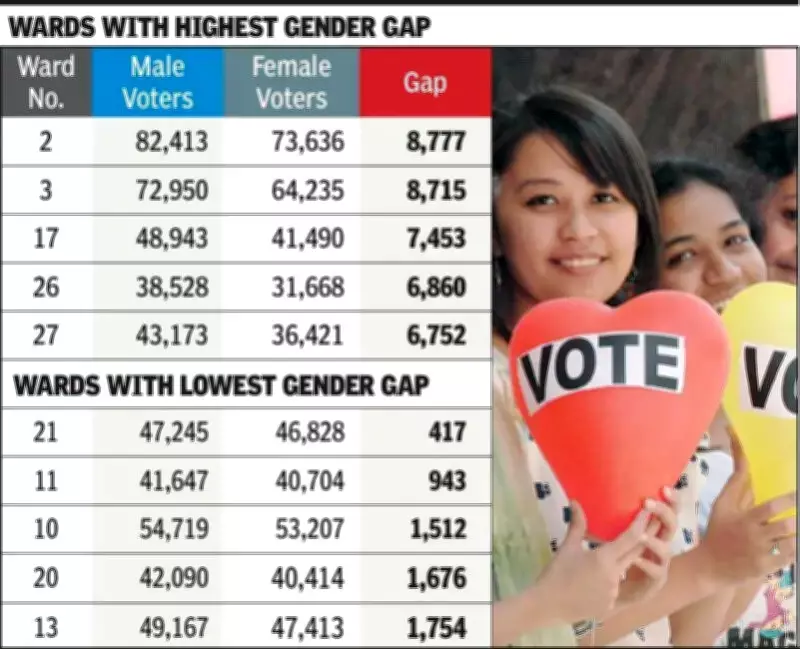
Ward 2, encompassing Amroli, Mota Varachha and Kathore areas, not only has the highest number of electors at 1.56 lakh but also exhibits one of the most substantial gender disparities. With 82,413 male voters against 73,636 female voters, this ward shows a gap of 8,777 more male voters.
Similarly, Ward 3 covering Varachha, Sarthana, Simada and Laskana demonstrates a comparable imbalance with 8,715 more male voters than female voters. This pattern suggests a continued demographic skew in densely populated urban zones.
Other notable disparities include:
- Ward 17 (Puna East) with a difference of 7,453 voters
- Ward 26 (Godadara and Dindoli North) showing a gap of 6,860 voters
- Ward 27 (Dindoli South) recording 6,752 more male voters
Expert Insights on Migration and Historical Factors
Kiran Desai, a social science researcher specializing in demographic studies, provided crucial context for these findings. "Single male migration is not the predominant pattern among those coming from Saurashtra to work in Surat. They typically migrate as entire family units. Therefore, the gender gap we observe can be directly attributed to female feticide, which was rampant around two decades ago. Among younger population cohorts, the situation has likely improved significantly."
This expert analysis suggests that while migration patterns contribute to Surat's demographic composition, they don't fully explain the gender imbalance observed in voter registration data.
Areas Showing Relative Balance
Despite the city-wide trend, some wards demonstrate notably smaller gender disparities. Ward 10 covering Adajan, Pal and Ichhapore areas stands out among more populous wards with just 1,512 more male voters than female voters (54,719 male versus 53,207 female voters).
Ward 21 encompassing Soni Faliya, Nanpura, Athwa and Piplod records one of the smallest overall gaps with only 417 more male voters. Interestingly, this ward also has the highest number of third-gender voters at 15 registrations.
Smaller Wards, Significant Disparities
Even in wards with lower overall populations, significant gender gaps persist. Ward 15 covering Karanj and Magob areas shows 26,489 male voters against 21,922 female voters, creating a difference of 4,567 despite its smaller electorate size.
Broader Implications and Contributing Factors
The comprehensive data indicates that while male voters consistently outnumber females in every municipal ward, the extent of this disparity varies considerably across different areas of Surat. Urban density, migration patterns, and underlying socio-economic factors appear to influence this distribution significantly.
According to senior government officials familiar with migration patterns, many male workers who migrate to Surat from states including Odisha, Bihar and Uttar Pradesh often fail to register as voters in their new location. This administrative gap actually reduces the visible gender disparity in areas with high concentrations of migrant workers, suggesting the actual demographic imbalance might be even more pronounced than voter registration data indicates.

The Surat Municipal Corporation's voter data provides a crucial snapshot of ongoing demographic challenges that require continued attention from policymakers, social workers, and community leaders to address the root causes of gender imbalance in urban populations.





