

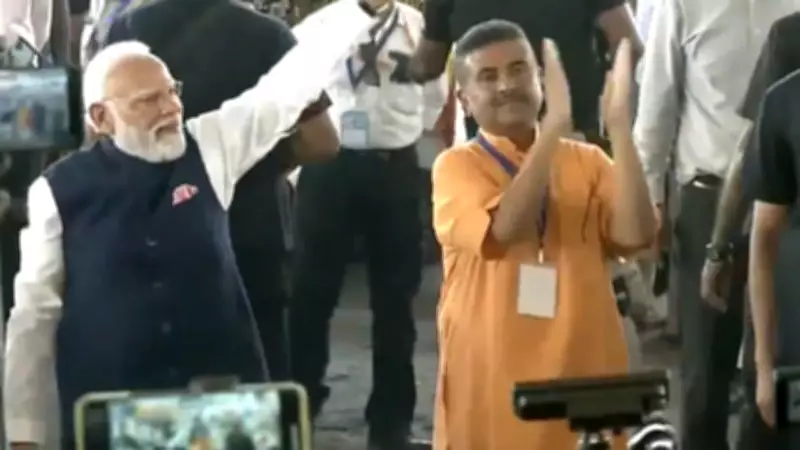
NEW DELHI: The Bharatiya Janata Party's vision of a 'Sonar Bangla' is set to become a reality as Suvendu Adhikari will be sworn in as the chief minister of West Bengal on Saturday. This historic event follows the BJP's overwhelming mandate in the assembly elections, where the party secured 207 out of 293 seats, a remarkable victory in a state long considered a challenging political terrain for the saffron party.
Bengal Gets Its First BJP Chief Minister
The significance of this moment cannot be overstated: Bengal has never before had a BJP chief minister. Since Independence, the state has been governed primarily by the Congress, the Left Front, and the Trinamool Congress. The BJP's rise from a marginal political force to the ruling party represents one of the most dramatic electoral shifts in Bengal's history. Union Home Minister Amit Shah described the victory as the culmination of a long political journey, while BJP leaders hailed it as the dawn of a new political era for eastern India.
Suvendu's Journey from Local Councillor to CM
Adhikari's ascent has been unusually dramatic, even by Bengal's volatile political standards. He began his political career in 1995 as a Congress councillor in Contai municipality at the age of 31 before moving to the Trinamool Congress. Over the years, he steadily built his influence in East Midnapore, becoming an MLA, MP, and state minister. He emerged as a key figure in the Nandigram movement against land acquisition, which shaped his political identity. His switch to the BJP in 2020 permanently altered Bengal's political landscape. Within five years of joining the saffron camp, he is now poised to become chief minister, a journey from Contai's local streets to Writers' Buildings that reflects one of the sharpest political transformations in recent decades.

The Man Who Defeated Mamata Banerjee, Twice
Adhikari's political stature grew immensely after the 2021 assembly elections when he defeated Mamata Banerjee in Nandigram. That contest became the defining battle of the election and turned Adhikari into the BJP's most prominent face in Bengal. Although the BJP lost the state election in 2021, Adhikari's victory gave the party a psychological breakthrough. He later became the Leader of Opposition and led an aggressive campaign against the Trinamool government. BJP leaders repeatedly highlighted his ability to challenge Mamata on her own turf and withstand intense political pressure. This victory established him as the party's natural chief ministerial candidate once the BJP secured power.
Unanimous Support Inside the BJP
The BJP leadership projected Adhikari's selection as completely uncontested. Amit Shah noted that eight MLAs proposed his name during the legislature party meeting, and no alternative was suggested despite ample time. This unanimous backing underscores Adhikari's dominance within the Bengal BJP unit. Party insiders acknowledged that no other leader commands comparable support among BJP legislators. His administrative experience as a former Bengal minister and his central role in the election campaign further strengthened his claim.
Midnapore Gets a Chief Minister After Decades
Adhikari's elevation is also geographically significant. He is only the second chief minister from Midnapore after Ajoy Mukherjee, and one of the few Bengal leaders to rise from outside Kolkata's traditional political elite. In Contai, celebrations erupted soon after his name was announced. Residents danced on the streets, burst crackers, and distributed sweets as CRPF personnel guarded his family home, Shantikunj. For many in Midnapore, his rise carries emotional and regional significance. His father, Sisir Adhikari, expressed hope that the district, historically sidelined politically, would finally receive recognition and respect under his son's leadership.

Nandigram Movement Shaped His Politics
Much of Adhikari's political identity was forged during the Nandigram anti-land acquisition movement in 2007. The protests against industrial land acquisition became one of Bengal's most defining political moments and significantly weakened the Left Front government. Adhikari emerged as a grassroots organizer capable of mobilizing mass resistance. He also led protests against the proposed Haripur nuclear power plant, strengthening his image as a leader connected to local concerns. These movements helped him build a loyal support base across East Midnapore long before he joined the BJP. Today, BJP leaders present him as a mass leader shaped by political struggle rather than organizational promotion alone.
BJP's Promise of a 'Double-Engine' Bengal
The BJP has framed its victory as the beginning of a 'double-engine' administration, where the state and Centre work together politically. Adhikari repeatedly used this phrase while promising faster development, infrastructure expansion, and administrative reforms. The party argued that Bengal suffered due to constant confrontation between the state and Centre under the Trinamool Congress government. BJP leaders now claim that alignment with the Modi government will accelerate investment and governance. The symbolism surrounding the ceremony, including the saffron illumination of Writers' Buildings and major state offices, was designed to reinforce the image of a complete political transition in the state.
A Massive Political Spectacle in Kolkata
The oath ceremony itself reflected the scale of the political moment. Brigade Parade Ground was transformed into a high-security mega venue capable of hosting nearly 80,000 people, despite heavy rain threatening preparations. A giant waterproof hangar was erected, while more than 1,000 workers restored waterlogged sections of the Maidan. BJP leaders kept Netaji Indoor Stadium ready as a backup venue. The dais was divided into sections for Modi, Shah, NDA chief ministers, the governor, and the incoming cabinet. The elaborate arrangements highlighted how the BJP wanted the swearing-in to appear not merely administrative but historic and symbolic.
The Return of Writers' Buildings as a Power Centre
One of the most symbolic aspects of the transition is the renewed focus on Writers' Buildings. The iconic colonial-era structure, long associated with Bengal's political authority, was illuminated in saffron shades ahead of Adhikari's arrival. Officials prepared a temporary chief minister's office there for his symbolic first visit after taking oath. The BJP's decision to visually transform Writers' Buildings carried strong political messaging because the structure represents the historic seat of Bengal's governance. For the saffron camp, Adhikari stepping into Writers' Buildings marks not only a transfer of power but also the arrival of a completely new political order in the state.





