

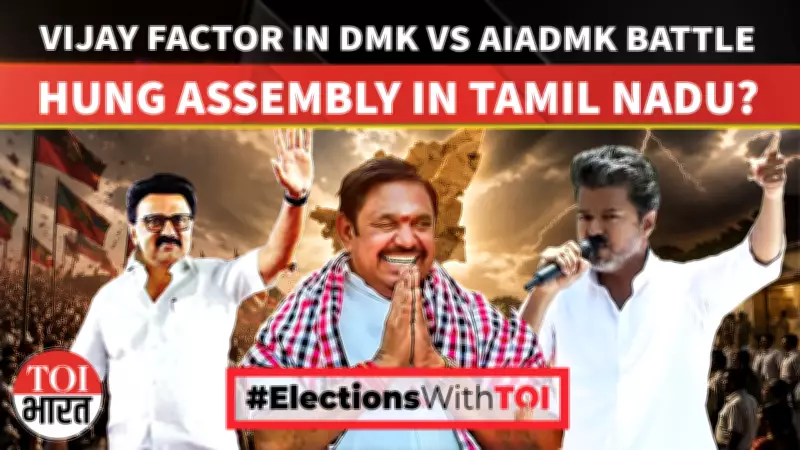
Tamil Nadu Election 2026: A Complex Political Landscape Emerges
The political scene in Tamil Nadu is intensifying as the 2026 state assembly elections approach, with new dynamics potentially reshaping the traditional DMK-AIADMK duopoly. Actor Vijay's entry into politics through his Tamilaga Vettri Kazhagam (TVK) party has injected fresh uncertainty, raising questions about vote share distribution and the possibility of a hung assembly.
The Vijay Factor: Screen Charisma Meets Political Reality
Vijay's transition from cinema superstar to political contender represents one of the most significant developments in recent Tamil Nadu politics. His massive fan following and public appeal have created substantial buzz, but political analysts are divided on whether this popularity will translate into electoral success. The critical question remains: can TVK achieve the 25% vote share threshold needed to disrupt established political equations?
Early assessments suggest TVK might draw support from younger voters and those disillusioned with traditional parties, potentially creating a three-cornered contest that could fragment the vote and lead to unpredictable outcomes.

Hung Assembly Possibility and Alliance Dynamics
The entry of a third significant player increases the likelihood of a hung assembly, where no single party secures a clear majority. This scenario would necessitate complex post-election alliances and could fundamentally alter Tamil Nadu's governance structure.
Current alliance optics reveal interesting developments:
- DMK-Congress coordination issues: The absence of a crucial joint rally has raised questions about the cohesion of this longstanding alliance
- BJP's persistent challenges: The national party continues to struggle to emerge from AIADMK's shadow in Tamil Nadu politics
- Udhayanidhi Stalin's rising profile: The DMK scion is increasingly visible in campaign activities, suggesting a generational transition within the party
The Delimitation Debate: Reshaping Tamil Nadu's Political Future
Beyond immediate electoral calculations, the delimitation process looms as a potentially transformative factor for Tamil Nadu's political landscape. Delimitation involves redrawing constituency boundaries based on population changes, which could:
- Alter the geographic distribution of political power
- Create new opportunities for emerging parties
- Potentially advantage parties with specific regional strengths
This process, scheduled to coincide with the 2026 elections, adds another layer of complexity to an already volatile political environment.
Key Players and Strategic Considerations
Udhayanidhi Stalin's increasing political involvement suggests DMK is preparing for leadership continuity, while his public engagements are carefully calibrated to build his political credentials. Meanwhile, the BJP faces the persistent challenge of expanding its base beyond its alliance with AIADMK, needing to demonstrate independent appeal to Tamil voters.
The DMK-AIADMK rivalry, which has dominated Tamil Nadu politics for decades, now faces disruption from multiple directions. Alliance management, voter mobilization strategies, and effective messaging will prove crucial as all parties navigate this transformed political terrain.
As Tamil Nadu moves toward the 2026 elections, the convergence of these factors—Vijay's political debut, delimitation uncertainties, alliance dynamics, and leadership transitions—creates one of the most unpredictable electoral scenarios in the state's recent history. The outcome will not only determine Tamil Nadu's governance for the next five years but could potentially redefine the state's political architecture for decades to come.






