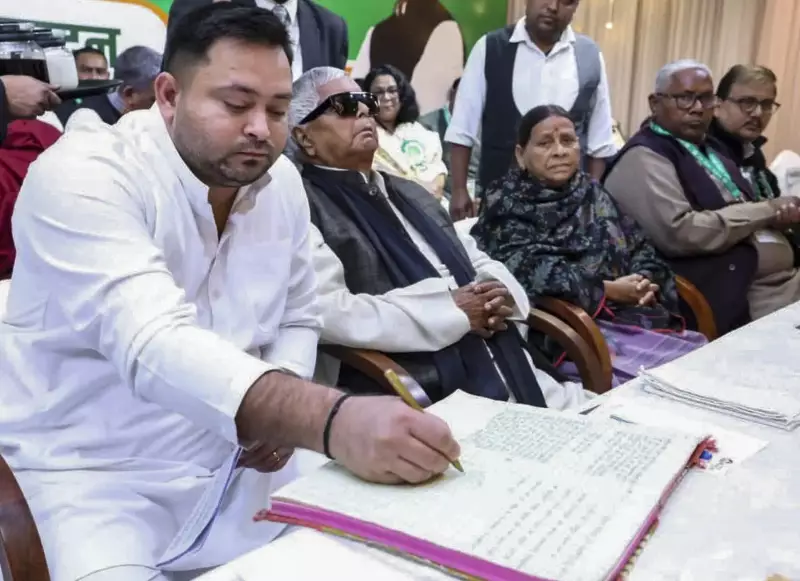
In a significant political development in Patna, Rashtriya Janata Dal (RJD) chief Lalu Prasad Yadav elevated his younger son, Tejashwi Prasad Yadav, to the position of national working president on Sunday. However, what should have been a celebratory moment for the party was quickly overshadowed by visible signs of internal discord and sharp criticism from opposition leaders.
Family Discord Casts Shadow Over Appointment
The announcement, made at a city hotel with almost all senior RJD leaders present including Rabri Devi, Mangani Lal Mandal, Abdul Bari Siddiqui, Jai Prakash Narayan Yadav, Bhola Yadav and party spokesperson Chitranjan Gagan, was immediately met with controversy from within the Yadav family itself.
Tejashwi's sister, Rohini Acharya, launched a scathing attack on her brother moments after his appointment was made public. In a veiled swipe that added an element of bitterness to the occasion, she referred to him as a "puppet of infiltrator gang" in a social media post.

"Congratulations to 'katputli bane shehzada (prince-turned-puppet)' of an 'infiltrator gang'," Rohini posted on X, mocking her brother's elevation. Even before the formal announcement, she had alleged that control of the party had slipped into the "hands of infiltrators and conspirators whose sole objective is to destroy Laluism."
Sibling Reactions Vary Dramatically
Tejashwi's elder brother, Tej Pratap Yadav, echoed Rohini's critical remarks when speaking to reporters. "Whatever she has written is 100% correct," he stated bluntly on Sunday, highlighting the deepening family rift.
In stark contrast, RJD MP and Lalu's elder daughter, Misa Bharti, struck a conciliatory note and extended her best wishes to Tejashwi. "The executive committee held a meeting today and Tejashwi was appointed as the working president. We extend our best wishes to Tejashwi from the party," she said, attempting to present a united front despite the evident divisions.
Opposition Leaders Seize on Internal Strife
The development drew sharp reactions from National Democratic Alliance (NDA) leaders, who interpreted Tejashwi's elevation as Lalu Prasad's attempt to preserve his family's political legacy and ensure the party's survival amid growing challenges.
Senior BJP leader and Union Minister Nityanand Rai criticized what he described as the Lalu family's "family first" principle that has dominated Bihar politics for three decades. "While Tejashwi has now been formally appointed as the party's working national president, he has been effectively running and controlling the party for years," Rai asserted.
Multiple Opposition Voices Weigh In
BJP OBC Morcha national general secretary Nikhil Anand claimed the RJD had lost its relevance after the Bihar assembly election and was now witnessing internal bickering. "During the Bihar assembly election, we all saw that Tejashwi removed Lalu ji and Rabri ji from the posters and forced them to sit at home. Tejashwi even strategically planned the eviction of Tej Pratap and Rohini Acharya to dominate the party and family system," Anand alleged.
LJP(RV) chief and Union Minister Chirag Paswan said Tejashwi being given such a senior position despite what he described as a devastating electoral performance showed that the RJD remained limited to one family's control.
HAM(S) founder and Union Minister Jitan Ram Manjhi, while calling it an internal matter of the RJD, added that he believed the party would never be able to move forward under current circumstances.
Dynastic Politics Criticism Intensifies
JD(U) spokesman Neeraj Kumar offered perhaps the most comprehensive criticism, stating that dynastic politics continued to dominate the RJD. "Many prominent faces from the Dalit, Muslim, OBC and EBC categories are in the RJD. Ignoring everyone else, Tejashwi, who is accused in 22 cases, is being given his father's position," Kumar pointed out.
"Even the daughter of the family has objected to this. Despite having faces like Uday Narayan Chaudhary, Shivchandra Ram, Alok Mehta, Ramchandra Purve and Abdul Bari Siddiqui in the party, Lalu made Tejashwi the national acting president," he added, highlighting what opposition parties see as the RJD's failure to promote leaders beyond the Yadav family.

The dramatic events in Patna have thus exposed not only internal family tensions within the RJD but also provided ample ammunition for opposition parties to criticize what they perceive as entrenched dynastic politics in Bihar's political landscape.