

Telangana Chief Minister Appeals for Central Rice Procurement
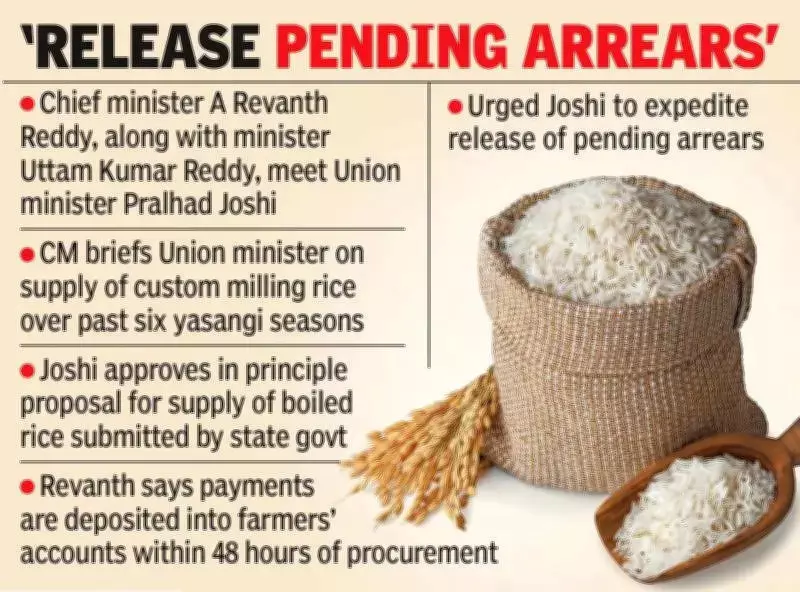
In a significant development for Telangana's agricultural sector, Chief Minister A Revanth Reddy has formally requested the Central government to procure 30 lakh metric tonnes (LMT) of boiled rice from the state during the ongoing yasangi (rabi) season. The appeal was made during a high-level meeting in Delhi on Friday, where the Chief Minister emphasized that the current harvest is particularly suitable for processing into parboiled rice.
High-Level Delhi Meeting with Union Minister
Chief Minister Revanth Reddy, accompanied by Civil Supplies Minister N Uttam Kumar Reddy, met with Union Minister for Food and Public Distribution Pralhad Joshi at his official residence in the national capital. During the detailed discussion, the Telangana delegation presented comprehensive statistical data outlining the state's rice production and supply history over the past six yasangi seasons.
The presentation highlighted Telangana's consistent performance in custom milling rice production and specifically focused on the current season's boiled rice output. Following the thorough briefing, Union Minister Joshi approved in principle the state government's proposal for boiled rice supply, marking a positive step toward formal procurement arrangements.

Substantial Paddy Production Expected
During the meeting, Chief Minister Revanth Reddy informed the Union Minister that Telangana is anticipating approximately 90 LMT of paddy production during the current yasangi season. He emphasized that this substantial harvest possesses ideal characteristics for milling into high-quality parboiled rice, making it particularly valuable for national food security requirements.
"Telangana stands ready to supply a total of 30 LMT of parboiled rice with 5% broken rice content, along with an additional 5 LMT of raw rice containing 10% broken rice content from our yasangi harvest," stated Chief Minister Revanth Reddy during the discussions. This commitment reflects the state's capacity to contribute significantly to India's rice reserves.
Addressing Financial and Nutritional Concerns
Beyond the procurement request, the Telangana delegation raised several critical financial matters with the Union Minister. Chief Minister Revanth Reddy specifically appealed for the immediate release of outstanding dues amounting to ₹1,468.94 crore related to additional levy procurement from the 2014-15 kharif season. The delegation highlighted Telangana's status as India's largest paddy-producing state and its efficient payment system that deposits funds into farmers' accounts within 48 hours of procurement.
The Chief Minister explained that the state's civil supplies department is facing considerable financial challenges due to these pending arrears, urging Minister Joshi to expedite their release to support agricultural operations and farmer welfare.
Additionally, the Telangana ministers requested the immediate resumption of fortified rice kernels distribution through various channels including schools, hostels, and Integrated Child Development Services (ICDS) centers. This nutritional intervention, which had been recently discontinued, plays a crucial role in preventing anaemia and addressing nutritional deficiencies among children across the state.
Broader Implications for Agricultural Policy
The meeting between Telangana's leadership and the Union Food Minister represents more than just a procurement discussion—it underscores the evolving dynamics of center-state relations in agricultural policy. The state's detailed presentation of production data and quality specifications demonstrates a sophisticated approach to agricultural advocacy, while the Central government's in-principle approval suggests recognition of Telangana's significant contribution to national food security.
As India continues to address food distribution challenges and nutritional requirements, such collaborative discussions between state and central authorities become increasingly important for developing effective, responsive agricultural policies that benefit both producers and consumers across the country.






