

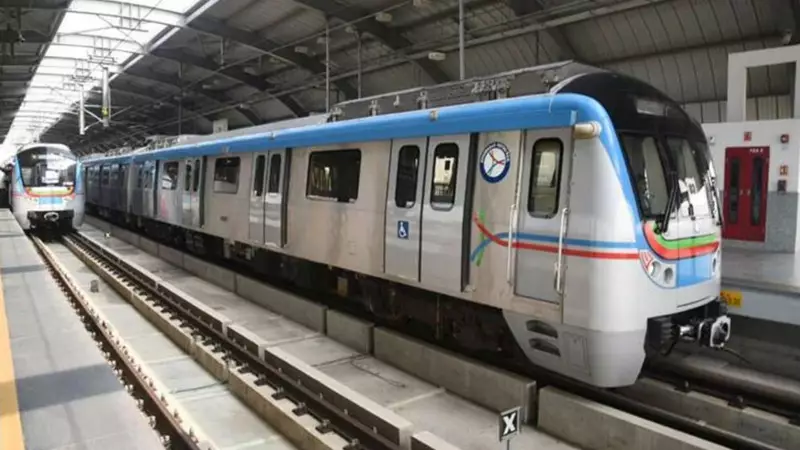
The Telangana High Court has intervened in the ongoing debate surrounding the proposed alignment of the Hyderabad Metro Rail's Phase II project near the historic Charminar. On Thursday, December 18, 2025, the court directed state authorities to prepare and present an audiovisual simulation of the planned route, stating that oral arguments were failing to clarify the situation.
Court Seeks Clarity Through Visual Simulation
A division bench comprising Chief Justice Aparesh Kumar Singh and Justice G M Mohiuddin issued the directive while hearing a Public Interest Litigation (PIL). The bench explicitly noted that "oral arguments are not taking us anywhere," prompting the call for a more tangible demonstration. The matter has been posted for its next hearing on January 8, 2026.
The PIL, filed by the Act Public Welfare Foundation and tagged with a related writ petition, seeks an immediate halt to all construction activities by the Hyderabad Metro Rail Limited (HMRL) within the notified Charminar and Falaknuma heritage precincts. The petitioners argue that work cannot proceed until a comprehensive, independent heritage impact assessment is conducted and all necessary statutory approvals under the Telangana Heritage Act 2017 and the Ancient Monuments Act 1958 are secured.

Petitioner's Claims and Government's Defense
Advocate Immaneni Rama Rao, representing the petitioner, presented a critical piece of evidence: the response to a Right to Information (RTI) query. He contended that this document proves the government has not obtained any permission for demolition or construction within the protected zones. He further argued that any construction, demolition, or excavation is illegal within the precincts defined under a government order dated January 2, 2003.
In defense, Additional Advocate-General Md Imran Khan submitted eight sketches of the proposed Corridor VI. He strongly refuted the allegations, calling them a "tirade" against the government. His central argument was that the metro alignment is planned at a significant distance from the core heritage structure. The corridor is proposed to be about 700 metres to 1 kilometre away from the Charminar, and no work is planned within the prohibited 500-metre radius.
"Wherever the metro rail is going, it is either going above or by the side of such structures. Not one heritage structure has been touched till now," Khan asserted. He acknowledged that only a window and a compound wall might be affected, assuring the court that requisite permissions would be obtained before any such work.
The Path Forward: An AI-Powered Presentation
Following the court's suggestion to move beyond paper sketches, the Additional Advocate-General agreed to prepare a detailed projected simulation. This presentation will utilize artificial intelligence to create a visual model of the proposed corridor, with all heritage structures clearly marked in red for easy identification. This audiovisual aid is intended to provide the bench with a unambiguous understanding of the project's proximity to and impact on the historic Old City landmarks.
The court's decision underscores the heightened sensitivity and legal scrutiny surrounding infrastructure development in areas of immense historical and cultural value. The upcoming AI simulation on January 8th is expected to be a pivotal moment in determining the future trajectory of Hyderabad Metro's expansion into the heart of the city's heritage zone.






