

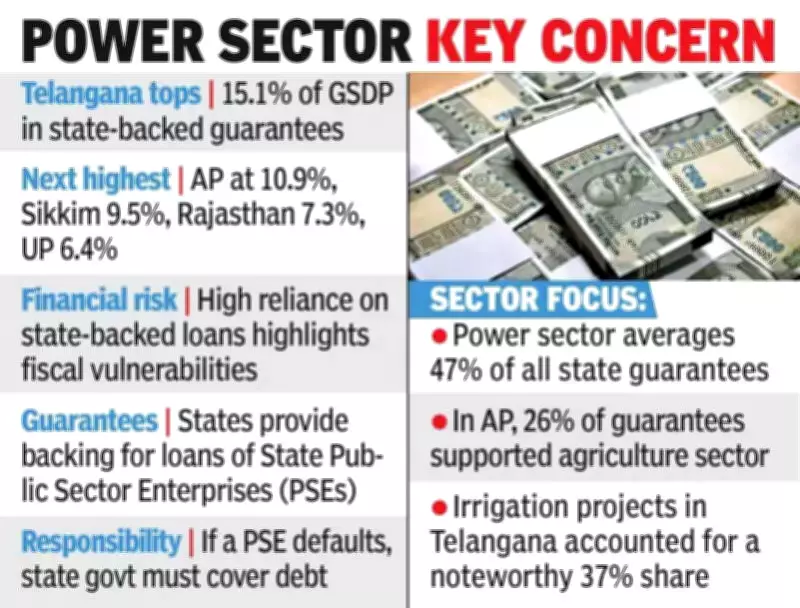
Telangana Leads India with Highest State Guarantees to GSDP Ratio at 15.1%
According to the State Finances Report 2025-26, Telangana has emerged as the top state in India with the highest ratio of state guarantees to Gross State Domestic Product (GSDP), reaching 15.1%. This figure underscores a significant financial reliance on state-backed loans, highlighting potential vulnerabilities in fiscal health. Following Telangana, Andhra Pradesh ranks second with a ratio of 10.9%, while Sikkim stands at 9.5%, Rajasthan at 7.3%, and Uttar Pradesh at 6.4%. These statistics come ahead of the state budget presentations, drawing attention to the fiscal strategies and risks involved.
Understanding State Guarantees and Their Implications
Outstanding liabilities of state governments encompass various financial commitments, but they notably exclude certain contingent liabilities that arise under specific conditions. A key component of these liabilities is the guarantees that state governments provide for borrowings by State Public Sector Enterprises (PSEs) from financial institutions. This reliance on government backing often stems from the subpar credit profiles of these enterprises, which may struggle to secure loans independently. By offering a government guarantee, states enhance the credibility of these entities, facilitating access to much-needed financial resources.
However, this arrangement carries substantial responsibility. Should the borrowing entity default due to unforeseen circumstances, the state government is obligated to cover the debt, posing significant fiscal risks. In 2023, a working group on state government guarantees put forward recommendations aimed at curtailing these risks. It suggested instituting a ceiling on annual incremental guarantees, recommending a limit of either 0.5% of the GSDP or 5% of revenue receipts, whichever amount is lesser. As of March 2024, the total guarantees extended by 27 states reached 4.4% of their collective GSDP, indicating a trend that could threaten financial stability if not managed carefully.

Sectoral Breakdown of State Guarantees
The power sector has emerged as the predominant area of concern for many states, accounting for an average of 47% of all outstanding state guarantees. This overwhelming share underscores the significance of the power sector within the broader financial landscape of state liabilities, reflecting its critical role in economic development and public welfare.
Beyond the power sector, guarantees have been extended to various other critical areas. For example, in Andhra Pradesh, 26% of guarantees supported the agriculture sector, highlighting the state's focus on agricultural development and food security. Additionally, irrigation projects in Telangana accounted for a noteworthy 37% share of state guarantees, emphasizing the importance of water management and infrastructure in the region.
These allocations illustrate the diverse priorities of state governments in guaranteeing loans across sectors vital to their economies and citizens' livelihoods. The data reveals a complex interplay between fiscal policy, economic growth, and risk management, with states balancing support for key industries against potential financial exposures.
Conclusion and Future Outlook
The high ratios of state guarantees to GSDP, particularly in Telangana and other leading states, raise important questions about fiscal sustainability and governance. As states prepare their budgets, there is a growing need for transparent reporting and prudent management of guarantees to mitigate risks. The recommendations from the 2023 working group offer a framework for limiting exposures, but implementation will be crucial in ensuring long-term financial health.
Overall, the State Finances Report 2025-26 serves as a critical reminder of the challenges facing state economies. By addressing these issues proactively, governments can work towards more stable and resilient fiscal systems, benefiting both public sector enterprises and the broader population.






