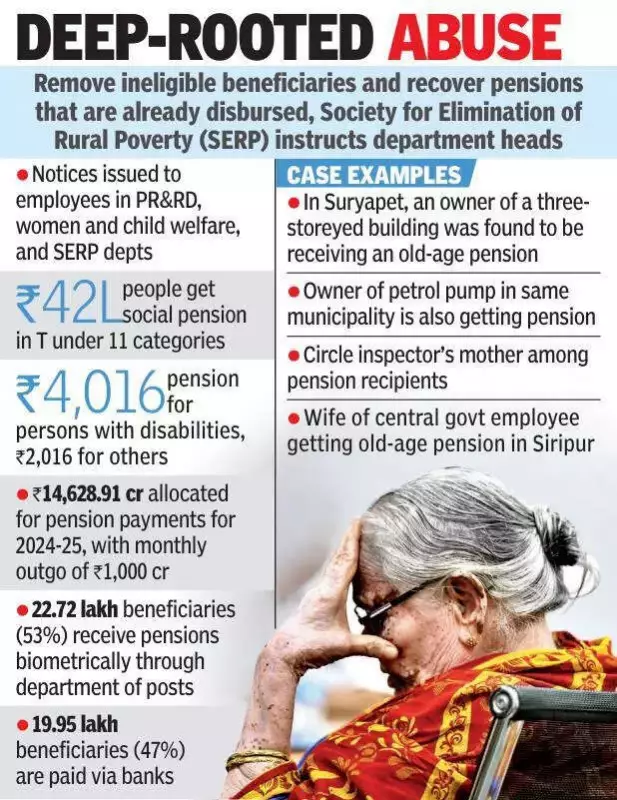
A recent government pilot audit has exposed deep-rooted irregularities and alleged widespread abuse within Telangana's social pension system. The investigation reveals that crucial financial benefits, designed specifically for the state's poorest and most vulnerable citizens, are being quietly siphoned off by the well-off.
Pilot Audit Uncovers Shocking Violations
The pilot social audit was conducted by the panchayat raj and rural development department in four key locations: Suryapet municipality, Karimnagar municipal corporation, Atmakur in Wanaparthy district, and Mavala village in Adilabad district. The findings were alarming. Out of approximately 20,000 to 25,000 beneficiaries verified, over 2,000 individuals—nearly 10%—were found to be completely ineligible for the pensions they were receiving.
The audit documented multiple, blatant violations of the scheme's eligibility norms. Parents of high-earning government employees drawing lakhs of rupees per month were found to be receiving social pensions. The list of ineligible recipients also included individuals who own cars, tractors, large houses, and even commercial assets like petrol stations. In one stark example from Suryapet, a man owning a three-story building was found to be drawing an old-age pension.

Specific Cases of Fraud and Mismanagement
The report highlighted several specific categories of fraud. Disability pensions were being paid to people without any disabilities, and old-age pensions were being claimed by individuals who had not yet crossed the minimum age threshold of 50 years. In a particularly egregious finding, the audit noted that in Karimnagar Corporation, between 200 to 300 pensions were being illegally drawn in the names of deceased individuals by their family members.
Officials pointed out that the system is vulnerable, especially with bank-linked payments common in municipalities. Since pension amounts are directly credited into bank accounts, verifying the continued eligibility or even the survival of a beneficiary becomes difficult unless relatives inform the authorities. The ease of access through ATMs has further complicated the identification of fraudulent recipients.
Statewide Clean-Up and Recovery Actions
The explosive findings have prompted the state government to prepare for a major statewide clean-up of the pension rolls. Extrapolating from the pilot study, the full social audit report estimates that if these findings reflect the broader situation across Telangana, as many as 4 to 5 lakh (400,000 to 500,000) bogus pensions could be in circulation.
In response, the government plans to conduct a comprehensive survey to weed out all ineligible beneficiaries and include those genuinely eligible persons who are currently excluded. The Society for Elimination of Rural Poverty (SERP) has written to department heads, directing them to remove ineligible beneficiaries and initiate recovery of pension amounts already wrongly disbursed. Notices have also been issued to employees in several departments, including panchayat raj and rural development, in connection with these irregularities.
Despite an order six months ago for annual KYC submissions at banks to curb illegal pensions, compliance has been poor. This has prompted the government to consider temporarily suspending pensions where beneficiaries fail to submit their updated Aadhaar details, photographs, and life certificates.
The Scale of Telangana's Pension Scheme
The scale of the problem is vast, given the size of the pension scheme. Currently, 42.67 lakh (4.267 million) people receive social pensions across Telangana under 11 different categories. The pension amount is Rs 4,016 for persons with disabilities and Rs 2,016 for others. For the financial year 2024-25, the government has allocated a massive Rs 14,628.91 crore for pension payments, with a monthly outflow of approximately Rs 1,000.47 crore. Of the total beneficiaries, 53% receive payments biometrically through post offices, while 47% are paid directly through banks.

The audit's revelations have cast a serious shadow over the administration of one of the state's most critical welfare schemes, intended to support the elderly, widows, disabled, and other marginalized groups. The planned statewide verification drive will be a crucial test of the government's resolve to ensure that welfare resources reach only those for whom they are truly meant.