

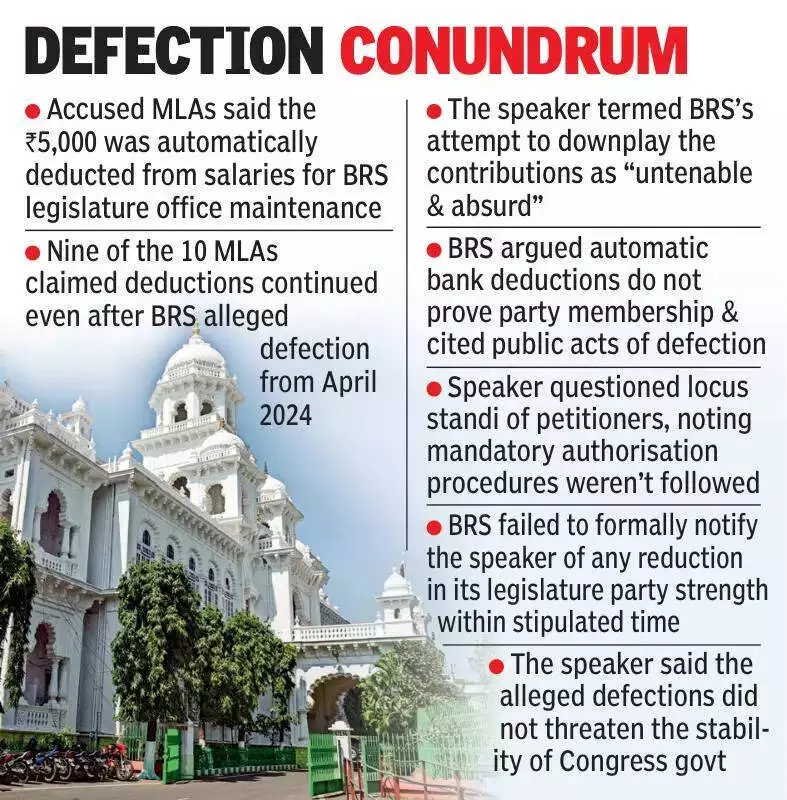
In a significant political development, the Speaker of the Telangana Legislative Assembly, Gaddam Prasad Kumar, has dismissed disqualification petitions filed by the Bharat Rashtra Samithi (BRS) against ten of its own Members of the Legislative Assembly (MLAs). The Speaker ruled that the evidence presented did not conclusively prove that the legislators had defected to the ruling Congress party.
Speaker's Rationale: Membership Fees Undercut Defection Claim
The core of the Speaker's decision hinged on the continued financial relationship between the MLAs and the BRS. He noted that the ten MLAs were still making monthly contributions towards the maintenance of the BRS legislature party office. This ongoing obligation, according to the ruling, indicated that the party itself still treated them as members, thereby undermining the BRS's own claim that they had voluntarily given up membership.
Prasad Kumar also pointed to a procedural lapse. He stated that the BRS had failed to follow the mandatory procedure under assembly rules, which requires the legislature party leader – in this case, former Chief Minister K Chandrasekhar Rao – to submit a form specifying authorized communicators within 30 days of the assembly's first sitting. This was not done.

Furthermore, the Speaker questioned why the BRS did not officially inform him about any change in its strength by removing the names of the alleged defectors within that 30-day window if the defection was so clear.
BRS Counters: Alleges Bias and Flawed Logic
The BRS swiftly rejected the Speaker's reasoning. Party general secretary and legal expert, Soma Bharat, argued that the payment of membership fees or office charges could not override what he called "clear evidence of defection." He contended that automatic bank deductions or even manual deposits into a party account could not be treated as definitive proof of continued political allegiance.
"There may be an automatic deduction from the defected MLAs' account to the party account. But nowadays, if you know the bank account of any unknown person, you can deposit the amounts," Bharat stated. He also alleged that the Speaker failed to act as an impartial tribunal and instead functioned as a "representative of the Congress."
The BRS had argued that the MLAs, who won the November 2023 assembly elections on a BRS ticket, had publicly joined the Congress. They cited instances of the MLAs meeting with Chief Minister A Revanth Reddy, appearing with senior Congress leaders, and wearing the Congress 'kanduva' (scarf), all of which were widely reported in the media.
MLAs' Defense and Evidentiary Hurdles
The MLAs in question countered the petitions, denying they had left the BRS. They stated that meetings with the Chief Minister were solely to seek development funds for their constituencies. Serilingampally MLA Arekapudi Gandhi argued that exchanging bouquets or wearing a kanduva was a courtesy and not indicative of a political shift. He also highlighted that he was appointed chairman of the Public Accounts Committee, a post traditionally given to the principal opposition.
The Speaker also flagged serious deficiencies in the evidence submitted by the BRS. As per the rules, petitions must be accompanied by authenticated media material with full publisher details. The Speaker concluded that the submitted clippings and electronic media extracts lacked these mandated particulars and thus could not be treated as valid primary evidence.
Additionally, the Speaker observed that even if the ten MLAs had defected, it would not impact the stability of the Congress government, which commands the support of 64 MLAs and was never dependent on these BRS members for its survival.
The ruling brings temporary relief to the ten MLAs but deepens the political acrimony between the BRS and the Congress in Telangana, setting the stage for further legal and political battles.






