

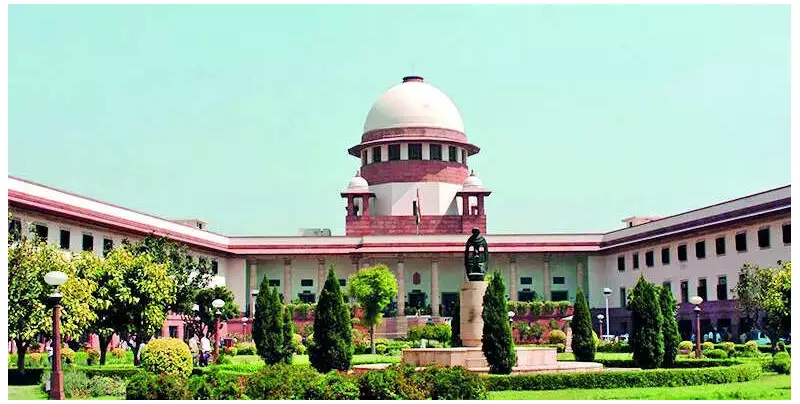
The Supreme Court is set to hear a significant case that could reshape the rules for sharing river water between Indian states. The newly formed state of Telangana has filed a petition challenging Andhra Pradesh's ambitious Polavaram-Banakacherla Link Project (PBLP), raising a fundamental legal question: can a state unilaterally decide to use flood waters from an inter-state river?
The Core of the Legal Dispute
At the heart of the controversy is the Godavari river. Telangana argues that the Andhra Pradesh government's project blatantly violates the binding award of the Godavari Water Disputes Tribunal (GWDT). The state contends that this move would deprive its residents of their rightful share of Godavari water. A bench led by Chief Justice of India Surya Kant is scheduled to hear the writ petition on Monday.
The Congress government led by Chief Minister A. Revanth Reddy has presented a critical argument. It states that the tribunal's award did not specifically address the distribution or use of surplus flood waters. Telangana alleges that Andhra Pradesh is constructing projects under the guise of utilizing this flood water, which would ultimately reduce Telangana's allocated share from the river basin.

A Precedent with National Ramifications
Telangana's petition warns of a potential chain reaction across the country if Andhra Pradesh's approach is allowed. The state highlights that Karnataka intends to use more water from the Krishna river in a similar manner, which would worsen water scarcity for Telangana. Furthermore, Maharashtra has indicated that if Andhra Pradesh is permitted to plan projects based on flood waters, it would also follow suit.
"This would completely destabilise the utilisation pattern in the co-basin states, violating the binding award of the GWDT," the Telangana government stated in its submission. The state pointed out a major regulatory gap: no mechanism exists in India to determine whether a project genuinely uses flood water or dips into the assured water share allocated to states by a tribunal.
Allegations of Procedural Violations
The legal challenge also focuses on procedural lapses. Telangana has accused the Andhra Pradesh government of jumping the gun by initiating expansion work for the PBLP and the Polavaram-Nallamalasagar Link Project (PNLP) even before submitting a pre-feasibility report to the Central Water Commission (CWC).
According to the petition, the CWC granted consent to Andhra Pradesh to prepare a detailed project report (DPR) for the PBLP without the mandatory in-principle consent for the project feasibility report (PFR). Despite the CWC specifically advising Andhra Pradesh to wait for PFR approval, the state has allegedly floated tenders for the work. Telangana has requested the Supreme Court to stay the tendering process and the ongoing expansion of the Polavaram Right Bank Canal.
The original Polavaram project, sanctioned by the GWDT, was designed to divert 80 thousand million cubic feet (TMC) of water to the Krishna river. Telangana's petition claims that Andhra Pradesh is now expanding the project's infrastructure without approvals to carry an additional 200 TMC of water, with plans to eventually increase this to 300 TMC, under the pretext of transporting Godavari's flood waters.






