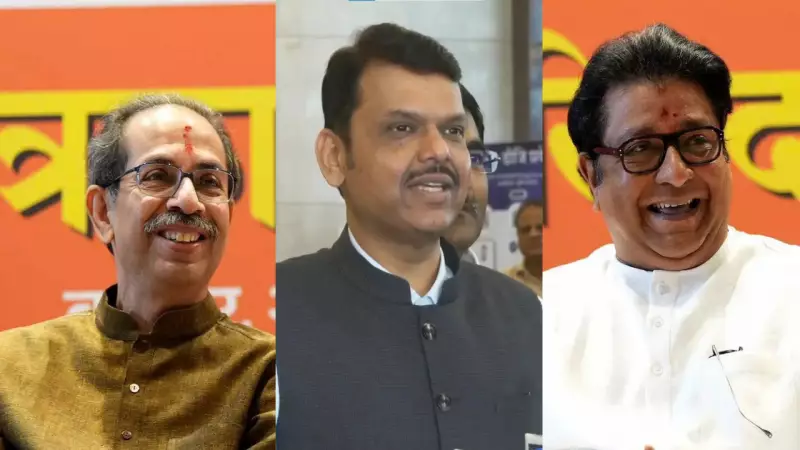
The dramatic political reunion of estranged cousins Uddhav Thackeray and Raj Thackeray, just ahead of the crucial Brihanmumbai Municipal Corporation (BMC) elections, has set off a fierce war of words across Maharashtra's political landscape. The ruling Mahayuti coalition has mocked the tie-up as a desperate and overhyped move, while Shiv Sena (UBT) loyalists have celebrated it as a turning point for Marathi unity.
A 'Putin-Zelensky' Moment or a Historic Turn?
Leading the charge against the alliance, Maharashtra's Deputy Chief Minister Devendra Fadnavis sarcastically compared it to an improbable peace summit between global adversaries. He argued that the relevance of the Shiv Sena (UBT) and Maharashtra Navnirman Sena (MNS) coming together was being grossly exaggerated.
"They are trying to create hype as if something as historic as peace talks between Russia and Ukraine are taking place," Fadnavis told reporters. He dismissed the notion that the reunion held significant political weight, likening it to Russian President Vladimir Putin and Ukrainian President Volodymyr Zelenskyy suddenly deciding to negotiate.

On the other side, the Thackeray cousins presented a united front, emphasizing the alliance's core mission. Uddhav Thackeray called for Marathi solidarity, accusing the Bharatiya Janata Party (BJP) of attempting to divide the Marathi vote bank during the recent assembly elections. "If division happens again, we will be finished. Therefore, the Marathi people should not break," he warned.
In a post on X, Raj Thackeray framed the pact as a battle for survival, stating it aimed to "bury the forces" trying to erase the Marathi identity in Mumbai. He made a significant promise, asserting, "The mayor of Mumbai will be a Marathi and will be ours."
Accusations Fly: From 'Mahajhoothi' to 'Opportunism'
The political rhetoric intensified as leaders from both sides traded sharp accusations. Shiv Sena (UBT) MP Priyanka Chaturvedi launched a scathing attack on the ruling Mahayuti, branding it "Mahajhoothi" (grand lie). She accused the coalition of looting the civic treasury and failing to hold BMC elections for over three and a half years. "For us, politics is a means of public service. For them, politics means only to grab power," she alleged, hailing the Thackeray reunion as a "historic moment."
Responding in kind, CM Fadnavis accused both Uddhav and Raj of abandoning ideology for pure opportunism. "Their track record is one of corruption and self-interest. They indulge in the politics of opportunism," he said, adding that their parties had weakened due to "appeasement politics." He also brushed aside Uddhav's criticisms of PM Narendra Modi and Home Minister Amit Shah, calling him a "disappointed and frustrated person."
Shiv Sena leader Shaina NC expressed confidence in the Mahayuti's victory, claiming the opposition Maha Vikas Aghadi (MVA) would be wiped out. She questioned the Thackeray-led front's contribution to Marathi welfare compared to the schemes implemented by Chief Minister Eknath Shinde.
The Road to the BMC Polls
The alliance comes at a critical juncture, with the State Election Commission announcing polls for 29 municipal corporations, including BMC, Pune, and Pimpri-Chinchwad, on January 15. The results will be declared on January 16.
While Shiv Sena (UBT) MP Sanjay Raut called for Congress to join the opposition unity to defeat the BJP, he remained evasive on the specifics of seat-sharing with MNS, calling it a matter among "brothers." Meanwhile, Maharashtra Social Justice Minister Sanjay Shirsat termed the alliance a product of "helplessness" (majboori), suggesting it was formed because Congress and Sharad Pawar's NCP were unwilling to align with Uddhav Thackeray.
As Mumbai prepares for a high-stakes civic battle, the reunion of the Thackeray cousins has undoubtedly reshaped the political narrative, setting the stage for a fiercely contested election that will test the influence of regional identity and the durability of new political partnerships.