

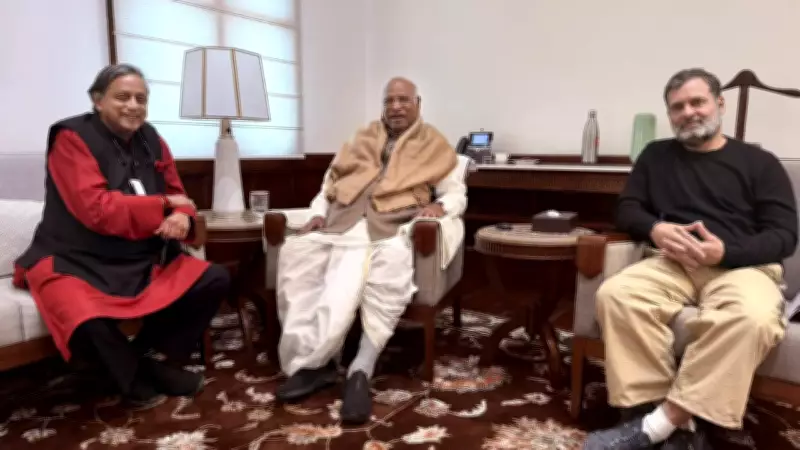
Congress Gains Crucial Momentum in Kerala with Tharoor Reconciliation
The recent reconciliation between senior Congress leader Shashi Tharoor and the party's high command has injected much-needed momentum into the Congress-led United Democratic Front (UDF) ahead of the crucial Kerala assembly elections scheduled for April-May. Tharoor's meeting with Congress president Mallikarjun Kharge and former president Rahul Gandhi in New Delhi has effectively ended weeks of speculation about strained relations within the party, positioning the three-time MP as a central campaign figure for the opposition alliance.
Strategic Unity at Critical Juncture
This political thaw arrives at a particularly strategic moment when the ruling Left Democratic Front (LDF) faces significant incumbency fatigue after securing an unprecedented consecutive term in 2021, while the Bharatiya Janata Party (BJP) continues testing the limits of its expansion in the southern state. The reconciliation provides the UDF with renewed coherence and organizational strength, addressing what many within the Congress had described as an "awkward episode" that threatened to undermine the party's electoral prospects.
The resolution comes after Tharoor reportedly expressed dissatisfaction with his treatment during a recent Kochi event and concerns about attempts by certain party leaders to marginalize his influence in Kerala politics. For a party frequently plagued by factionalism in its state units, the visible discord in Kerala had created damaging optics that the leadership has now addressed decisively.

Electoral Significance and Historical Context
The unity boost carries substantial electoral weight in a state where voters historically alternated between the UDF and LDF every five years until 2021, when the LDF under Chief Minister Pinarayi Vijayan broke this pattern by securing a second consecutive term. During those elections, the LDF improved its tally from 91 seats in 2016 to 99 seats, while the UDF dropped from 47 to 41 seats, highlighting the opposition's need for stronger cohesion.
Tharoor's reconciliation particularly addresses concerns raised by key UDF allies, including the Indian Union Muslim League (IUML), whose chief Sadiq Ali Thangal had publicly urged the Congress to resolve internal differences last year, warning that visible discord would only benefit political rivals. By bringing Tharoor back into confidence, the Congress has effectively neutralized this vulnerability within its coalition.
Tharoor's Electoral Appeal and Strategic Value
Tharoor's political magnetism, particularly evident in his fourth consecutive victory in the Thiruvananthapuram Lok Sabha constituency during the 2024 general elections, provides the UDF with significant strategic advantages. Despite facing Union Minister Rajeev Chandrasekhar as his BJP opponent, Tharoor retained his seat by over 16,000 votes, contributing to the UDF's sweeping victory in 18 of Kerala's 20 parliamentary constituencies.
The Congress leader demonstrates particular appeal among educated, salaried, and first-time voters – demographic segments that have shown increasing volatility in recent state and local elections. These voters have not consistently aligned with traditional Congress organizational structures and have at times been receptive to either the BJP's urban outreach or the LDF's governance narrative. Tharoor's sustained electoral success in Thiruvananthapuram suggests an ability to arrest this political drift even when broader party trends remain mixed.
At a strategic level, Tharoor's presence enables the UDF to expand beyond its traditional social bases without alienating core supporters. Urban centers including Thiruvananthapuram, Kochi, and Kozhikode – where voter turnout fluctuates and electoral margins often remain narrow – are likely to play disproportionately significant roles in determining the 2026 assembly election outcomes. Tharoor's credibility in these spaces provides the Congress with enhanced contestability, particularly as the BJP signals growing intent through incremental municipal gains and a recent mayoral victory in Thiruvananthapuram.

Countering Opposition Narratives
The reconciliation effectively blunts rival political narratives simultaneously. For the BJP, which has repeatedly highlighted Congress infighting to project itself as a disciplined alternative – frequently invoking Tharoor's name in this context – the visible unity weakens the "internal chaos" line of attack. This development arrives precisely as the BJP seeks to capitalize on its symbolic breakthrough in the Thiruvananthapuram municipal corporation, despite continued challenges in achieving assembly-level success.
Similarly, both the LDF and BJP-led National Democratic Alliance (NDA) have consistently portrayed the Congress as dynastic and directionless. The image of Tharoor standing alongside Rahul Gandhi and other senior leaders substantially undercuts these claims, at least in the immediate pre-election period. Tharoor's active campaign presence, with the Congress leadership reportedly tasking him with touring all 140 assembly constituencies, adds considerable star power to a contest that often hinges on narrative dominance.
Risk Mitigation and Future Prospects
Perhaps the most immediate benefit of the reconciliation involves risk mitigation. Speculation that Tharoor might drift toward the LDF or explore non-Congress political platforms has been firmly quashed through his visible integration into the party's election machinery. This sends a powerful message of consistency and commitment to both party cadres and the electorate.
The memory of 2021 continues to loom large for Congress strategists, who recall how favorable anti-incumbency indicators failed to translate into electoral victory for the UDF. The Tharoor patch-up is widely perceived as a corrective measure aimed at ensuring that organizational weaknesses do not once again squander political opportunities. By restoring unity and deploying Tharoor as a campaign spearhead, the Congress gains enhanced oratorical advantage, media presence, and ability to frame local issues within broader national and global contexts – all crucial elements for reaching undecided voters.
While electoral outcomes will ultimately depend on execution, alliance management, and local dynamics, the Congress-Tharoor reconciliation provides the opposition UDF with a credible pathway to challenge years of Left rule. With this renewed "Hum Saath Saath Hai" image, the UDF has secured an early and strategically vital victory before entering the intense campaign period, positioning itself more competitively against both the incumbent LDF and the expanding BJP in Kerala's complex political landscape.





