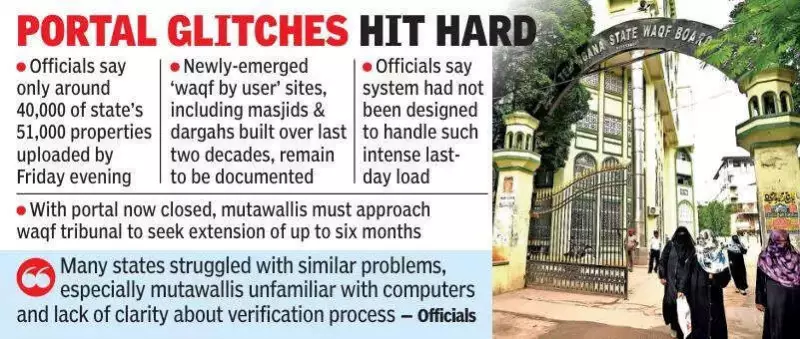
A frantic last-day effort to register thousands of waqf properties on the central government's Umeed portal concluded on Friday with a significant shortfall, leaving administrators across Telangana scrambling for extensions. Despite intense pressure in the final weeks, only about 40,000 of the state's estimated 51,000 waqf assets were successfully uploaded before the deadline passed.
Technical Glitches and Last-Minute Chaos
The final day witnessed a massive surge in activity as mutawallis, the caretakers of these charitable Islamic trusts, attempted to upload documents simultaneously. This unprecedented load led to multiple technical issues on the portal, which officials admitted was not designed to handle such intense traffic. The system slowdown left hundreds of users unable to complete their submissions, further contributing to the registration gap.
Compounding the problem is the large number of newly emerged 'waqf by user' sites, including masjids and dargahs built over the past two decades, which remain undocumented. Telangana Waqf Board CEO Mohammed Asadullah provided a detailed breakdown, stating the 51,000 properties include 33,929 identified in the 1955 survey, 13,400 from the post-2001 survey, and 3,600 pre-1955 properties, alongside several thousand newer sites.

Path Forward: Tribunal Extensions and Continued Confusion
With the portal now closed, mutawallis who failed to register must approach the waqf tribunal to seek an extension of up to six months. This triggers a fresh round of paperwork, as each case requires individual examination by the tribunal before additional time is granted. While the Supreme Court refused a blanket deadline extension, the Centre has stated that no punitive action will be taken for the next three months against those who missed the cut-off. However, securing a tribunal-approved extension remains mandatory.
Confusion persists among many mutawallis, some of whom expected a central extension following appeals from Telangana and other states. Officials note that Telangana's low completion rate is not an isolated case, with many states facing similar hurdles. Key challenges include a large number of mutawallis unfamiliar with digital processes, outdated property documentation, and lack of clarity in the verification procedure. Some also hesitated due to initial calls for a boycott by certain Muslim organizations, before the deadline was firmly upheld.
Understanding the Umeed Portal's Three-Level System
The registration process on the Umeed portal, mandated by the Ministry of Minority Affairs, operates on a three-tier verification system. First, the maker—either the mutawalli or an authorized representative—uploads the necessary documents. Next, a checker at the district level verifies the submission and recommends approval. Finally, the approver, typically the Waqf Board CEO or an authorized officer, grants the final confirmation, completing the registration.
This large-scale documentation effort is crucial for creating a transparent and centralized record of India's vast waqf properties, which are dedicated for religious, charitable, or philanthropic purposes under Islamic law. The current situation in Telangana highlights the practical difficulties in implementing such a nationwide digital drive, especially among communities with varying levels of digital literacy and access.