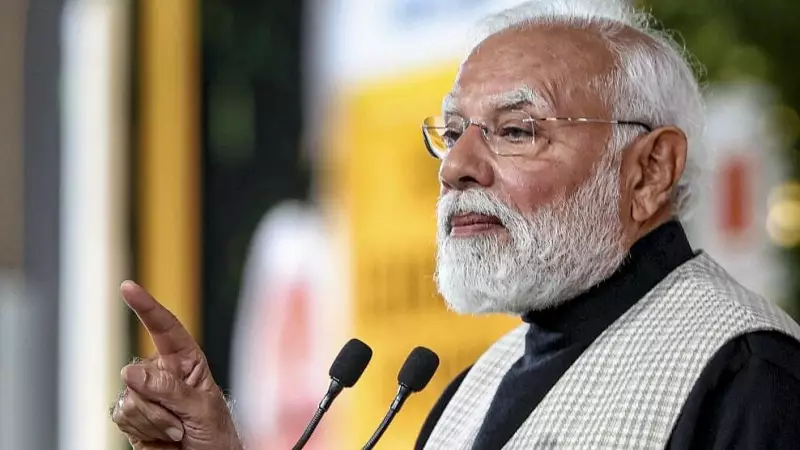
Ahead of Prime Minister Narendra Modi's scheduled visit to West Bengal, the state's ruling Trinamool Congress (TMC) launched a fierce political offensive, directly blaming the Prime Minister for the alleged suffering of the state. The party's sharp attack sets the stage for a tense political showdown during the PM's tour.
TMC's Scathing Accusations Against the Prime Minister
The Trinamool Congress, led by Chief Minister Mamata Banerjee, did not mince words in its criticism. The party explicitly stated that West Bengal is suffering because of Prime Minister Narendra Modi. This direct accusation forms the core of their pre-emptive strike against the BJP ahead of the Prime Minister's arrival in the state.
The TMC's attack is not an isolated comment but a coordinated political strategy. Senior party leaders and spokespersons have been vocal, aiming to frame the narrative around the visit. They are attempting to shift the focus from the Prime Minister's developmental agenda to one of accountability and alleged neglect. The party's messaging is designed to resonate with its core voter base and counter the BJP's campaign efforts in the state.
Context of the Visit and Political Tensions
Prime Minister Narendra Modi's visit to West Bengal is part of his ongoing tours across various states. However, given West Bengal's history of intense political rivalry between the TMC and the BJP, every such visit is charged with significance. The state has been a critical battleground in national politics, with the BJP making significant inroads in recent years, though the TMC remains the dominant force.
The timing and content of the TMC's attack are calculated. By accusing the PM of being responsible for the state's woes, the TMC aims to put the BJP on the defensive. The allegations likely encompass a range of issues, including central funds allocation, implementation of schemes, and overall economic distress. This is a classic political tactic to blunt the impact of the Prime Minister's rallies and public addresses, which often highlight central government projects and achievements.
Implications for State and National Politics
This public confrontation has significant implications. Firstly, it underscores the deeply polarized political environment in West Bengal. The exchange of sharp barbs is now a standard feature of the relationship between the state government and the central leadership of the BJP. It indicates that any possibility of cooperative federalism is currently absent in this particular state-center dynamic.
Secondly, the TMC's strategy reveals its preparedness for the ongoing and future electoral battles. By taking the fight directly to the Prime Minister, the party signals its confidence and attempts to project itself as the sole defender of Bengal's interests against a hostile central government. This narrative is powerful in regional politics and has been used effectively by several regional parties across India.
For the BJP, the TMC's attack presents both a challenge and an opportunity. The challenge is to navigate the hostile environment and ensure its message reaches the people without being drowned out by the counter-narrative. The opportunity lies in leveraging the TMC's aggression to portray it as an obstructionist force that disrespects the Prime Minister's office and hinders development for political gains.
The public discourse in the coming days will be dominated by this clash. As the Prime Minister's visit proceeds, his speeches are likely to contain rebuttals or indirect responses to the TMC's charges. The political temperature in West Bengal is set to rise further, with both sides digging in for a prolonged conflict. This episode is a clear reminder that in Indian federal politics, high-profile visits are rarely just about governance; they are pivotal moments of political theater and confrontation.