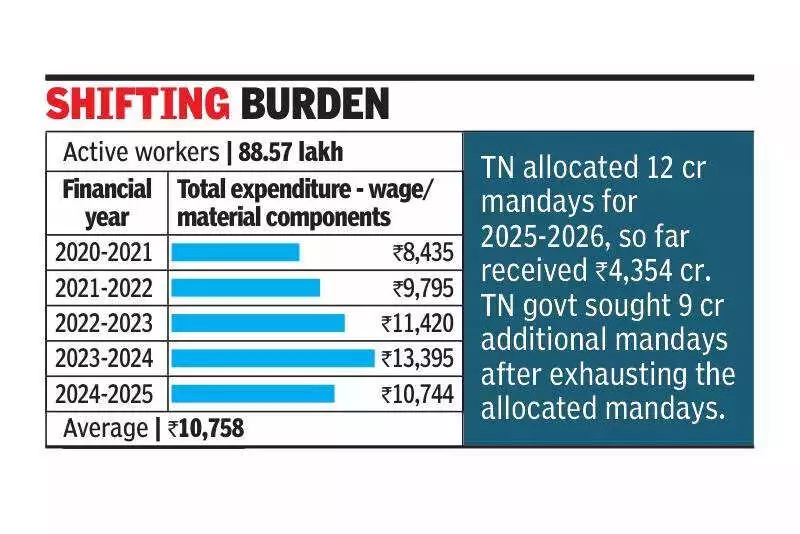
Senior officials in Tamil Nadu have raised a significant financial alarm over a proposed new central scheme set to replace the flagship rural jobs guarantee program. The state government may be forced to spend an extra Rs 4,300 crore every year to sustain the same level of employment if the Union government's new plan is implemented.
What is the Proposed VB-G RAM-G Scheme?
The Union government is preparing to introduce the Viksit Bharat - Guarantee For Rozgar and Ajeevika Mission - Gramin (VB - G RAM - G) Bill in Parliament. This legislation aims to replace the long-standing Mahatma Gandhi National Rural Employment Guarantee Scheme (MGNREGS). The most contentious change lies in the revised funding pattern between the Centre and the states.
Under the current MGNREGS framework, the Union government fully funds the wages for unskilled labourers, a 100% central contribution. The proposed bill would slash this central share to just 60%, obligating state governments to cover the remaining 40% of the wage bill.

Furthermore, the state's financial burden for materials used in the employment projects would also increase. The state's share of material costs would jump from the current 25% to 40%. Officials argue this dual hike places an unsustainable strain on state finances.
Financial Impact on Tamil Nadu Explained
The potential fiscal shock for Tamil Nadu is based on recent employment data. According to government figures from 2020-21 to 2024-25, the Union government released an average of Rs 10,758 crore annually to the state for MGNREGS. This funding supported employment for approximately 88.57 lakh active rural workers.
An official directly involved in the matter stated, "If the same level of employment is to be sustained under the new funding pattern, the state will have to spend at least Rs 4,300 crore every year from its own coffers." The official added that other states proactive in implementing the rural jobs scheme would find themselves in a similar difficult position.
Potential Consequences and Political Backlash
State authorities fear the revised funding structure will fundamentally dilute the objective of a guaranteed employment scheme. A senior officer involved in monitoring MGNREGS warned, "If the proposed changes are implemented, then this will lead to the state government cutting down the number of work days or workers to lower its expenditure."
This concern persists despite the proposed bill enhancing the guaranteed number of workdays from 100 to 125 per household. Officials point out that the national average of days jobs were actually provided stands at just 52, making the increased guarantee seem less impactful without full central funding.
The move has drawn sharp criticism from state planners. J. Jeyaranjan, Vice-Chairman of the Tamil Nadu State Planning Commission, described the policy shift as "anti-federal and anti-people." He accused the Centre of applying a problematic template used in other centrally sponsored schemes.
"The state is forced to use its own resources or go for loans to run welfare schemes as the Union government has failed to release its assured share after launch. The same approach is now being applied to MGNREGS, affecting the people's right to demand work," Jeyaranjan said.
The proposed legislative change sets the stage for a fresh debate on fiscal federalism and the sustainability of social welfare programs, with Tamil Nadu's calculations highlighting a nationwide concern for states committed to rural employment.